

Calcite is a mineral belonging to the class of carbonates, in the chemical composition of which impurities of iron, manganese, strontium and other minerals are noted. The rock—forming mineral is limestone, chalk, marl, carbonatite.
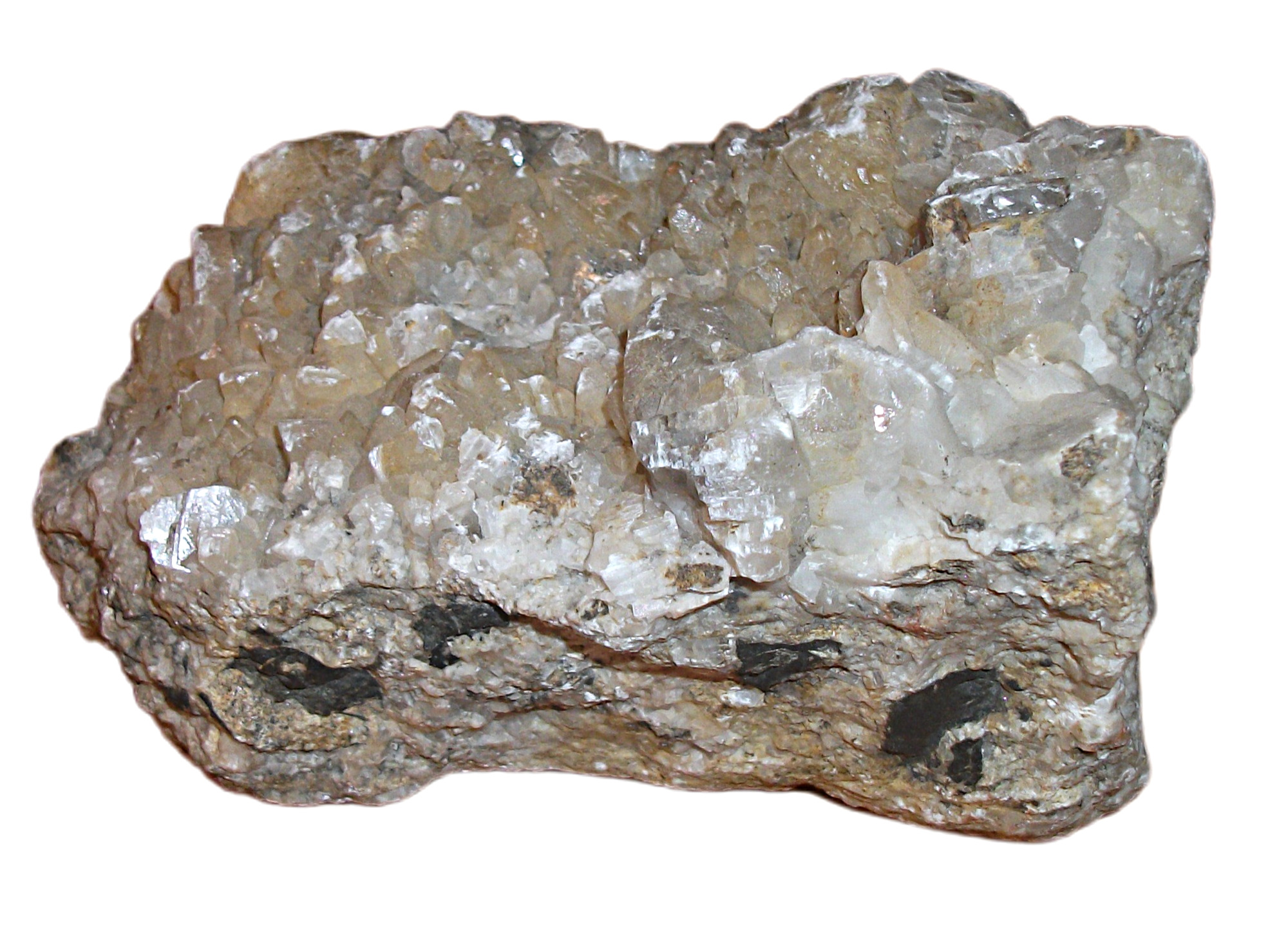
This exhibit of the collection has the shape of a beveled brick. The lower part is smooth, light gray in color with dark small inclusions. In the side parts there are larger impurities of iron, black in color. The upper part is with stepped fractures, with a glass sheen, with stepped and shell chips. The chemical formula is CaCO3.
Calcite is the third most common mineral in the Earth’s crust after quartz and feldspar.
Crystals: (trigonal syngony) are very common. Their facets are often dominated by sharp rhombohedra, as well as scalenohedra and prisms. Crystals are rich in combinations of various simple shapes. Doubles are not uncommon. Large crystals are formed in cracks and druze cavities.
Dense limestones are used as a building material, are the starting material for the production of synthetic rubber, plastics and other products, are used as a flux in ferrous metallurgy to produce lime (liming of soils), as sculptural marble and the like.
Loose earthy limestones are used as writing chalk, for the manufacture of tooth powder, paint, filler for paints and more. Water-transparent, very valuable birefringent Icelandic spar is used in the manufacture of optical polarization devices.
Marble onyx is an inexpensive but beautiful ornamental stone.
This exhibit of the collection has the shape of a beveled brick. The lower part is smooth, light gray in color with dark small inclusions. In the side parts there are larger impurities of iron, black in color. The upper part is with stepped fractures, with a glass sheen, with stepped and shell chips. The chemical formula is CaCO3.
Calcite is the third most common mineral in the Earth’s crust after quartz and feldspar.
Crystals: (trigonal syngony) are very common. Their facets are often dominated by sharp rhombohedra, as well as scalenohedra and prisms. Crystals are rich in combinations of various simple shapes. Doubles are not uncommon. Large crystals are formed in cracks and druze cavities.
Dense limestones are used as a building material, are the starting material for the production of synthetic rubber, plastics and other products, are used as a flux in ferrous metallurgy to produce lime (liming of soils), as sculptural marble and the like.
Loose earthy limestones are used as writing chalk, for the manufacture of tooth powder, paint, filler for paints and more. Water-transparent, very valuable birefringent Icelandic spar is used in the manufacture of optical polarization devices.
Marble onyx is an inexpensive but beautiful ornamental stone.