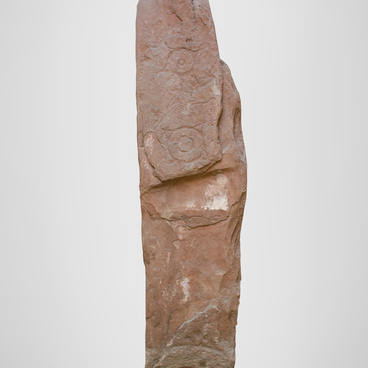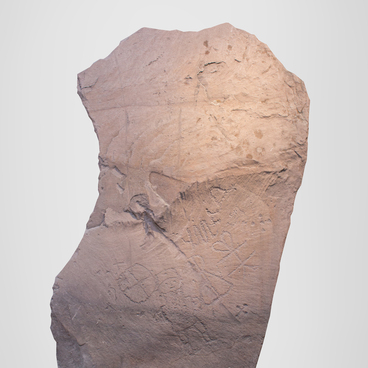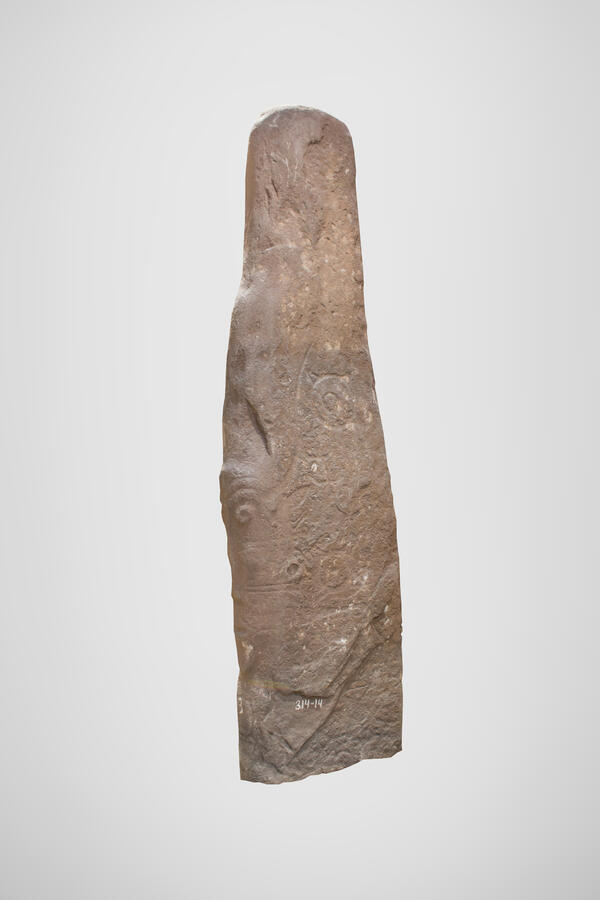
The museum contains a single stone statue, which was found near the village of Ust-Es in the Askiz district of Khakassia. The stone lay in the steppe two kilometers northwest of the village. Historical sources say that the statue was on a sacrificial site. Probably, the locals came here at a certain time and brought gifts to the stone in the form of food. Khakasses “fed” the statue and asked for the family’s well-being.
The image on the stone is in relief and has the appearance of a sculpture. Also, on it there are drawings that are made using the technique of pecking.
The central part of the sculpture, on its narrow edge, bears an anthropomorphic (human-like) image — a mask. The oval of the face is highlighted in relief, showing eyes on it in the form of circles with dots in the center — pupils. Double horizontal lines are drawn from the elongated nose, the brow arches and cheekbones are emphasized, the mouth is shown with a groove, the chin is indicated below by two bent double lines. The corners of the mouth can be seen.
The highly realistic depiction of a human face also has surreal elements: bull horns and animal ears. They can be viewed from the broad side. Researchers suggest that this is how the ancient master painted some kind of deity on the stone.
In the upper part of the central face, winding serpentine lines are visible, which convey the image of a mythological creature — a fantastic beast. In the lower part of the statue, on the obverse, there is a circle with four small protrusions-triangles. Such signs are called solar signs. On the right side of the statue, at least three similar symbols are engraved. A cow is also depicted here — a sacred animal. At a later time, a tamga was engraved in the center. This is a sign that denotes belonging to a certain Khakass clan.
Researchers have known about this statue near the village of Ust-Es since the end of the 19th century, it has been described more than once in scientific literature. In the 1960s, the stone was removed by the museum employee Albert Lipsky, a famous Khakass archaeologist, Honored Worker of Culture of the RSFSR.
The image on the stone is in relief and has the appearance of a sculpture. Also, on it there are drawings that are made using the technique of pecking.
The central part of the sculpture, on its narrow edge, bears an anthropomorphic (human-like) image — a mask. The oval of the face is highlighted in relief, showing eyes on it in the form of circles with dots in the center — pupils. Double horizontal lines are drawn from the elongated nose, the brow arches and cheekbones are emphasized, the mouth is shown with a groove, the chin is indicated below by two bent double lines. The corners of the mouth can be seen.
The highly realistic depiction of a human face also has surreal elements: bull horns and animal ears. They can be viewed from the broad side. Researchers suggest that this is how the ancient master painted some kind of deity on the stone.
In the upper part of the central face, winding serpentine lines are visible, which convey the image of a mythological creature — a fantastic beast. In the lower part of the statue, on the obverse, there is a circle with four small protrusions-triangles. Such signs are called solar signs. On the right side of the statue, at least three similar symbols are engraved. A cow is also depicted here — a sacred animal. At a later time, a tamga was engraved in the center. This is a sign that denotes belonging to a certain Khakass clan.
Researchers have known about this statue near the village of Ust-Es since the end of the 19th century, it has been described more than once in scientific literature. In the 1960s, the stone was removed by the museum employee Albert Lipsky, a famous Khakass archaeologist, Honored Worker of Culture of the RSFSR.