


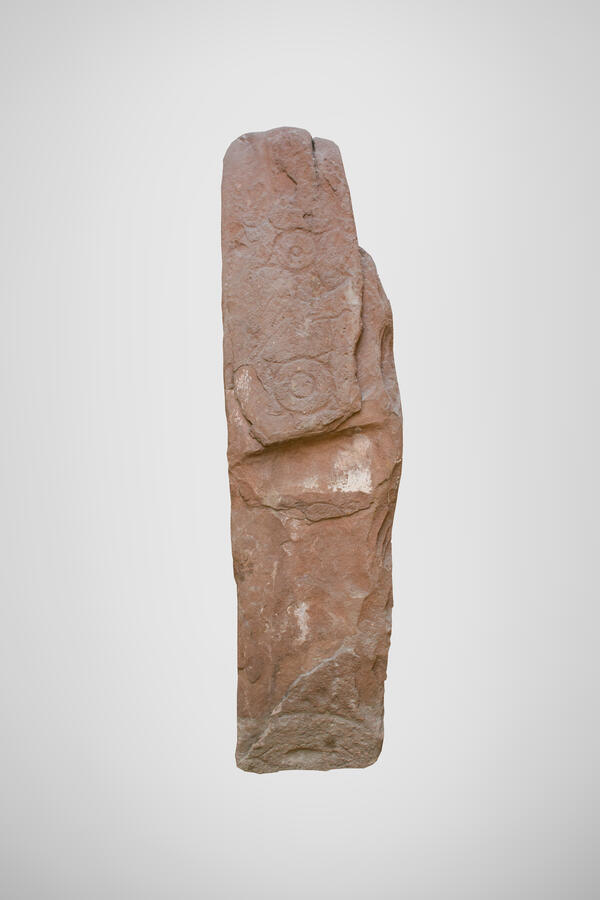
The statue was found in the Chitykhys chaatas — a burial ground — which was located on the left bank of the Askiz River not far from the former Palganov ulus of the Askiz region. An ulus was a clan-tribal community with a defined territory.
The stone was discovered in 1958 by the Khakass expedition led by archaeologist Leonid Kyzlasov. The find was removed by the museum employee Albert Lipsky.
The statue belongs to the Okunev culture and dates from the end of the 3rd millennium — the beginning of the 2nd millennium BC. Later, in the early Middle Ages (6th–13th centuries); it was used to build a stone mound. Such mounds formed large burial grounds; they received the name “chaatas” in the Khakass culture, which is translated as “a stone of war”. The local medieval burial ground began to be called Chity Khys — the name for the mountain range lying nearby. Its name is translated from Khakass as “seven virgins”.
The face of the statue was turned to the west. The surface of the stone is partially lost. In the center, ancient artists painted an anthropomorphic (human-like) image, from which the contour of the face and mouth have been preserved. The drawing was made using the technique of pecking: the master created the recesses with a special tool. Long animal ears are visible in the upper part of the face. A winding line runs upwards from the outline of the face, and under each winding line is a circle.
An anthropomorphic image is also engraved at the very top of the statue — a rounded outline, two eyes, a mouth, a nose. In the lower part of the stone, under the contour of the mask, a sign from a double circle is visible. Four equally spaced small triangles are drawn along its outer perimeter — this is a solar sign, denoting a heavenly body. Another small solar symbol is engraved in its center — such images are rarely found on stones.
Five solar signs are also engraved on the back of the narrow edge. Here they look like a circle with four small triangles on the sides. And in the center is another small circle with a dot in the center. Solar signs are also visible on a wide plane.
The stone was discovered in 1958 by the Khakass expedition led by archaeologist Leonid Kyzlasov. The find was removed by the museum employee Albert Lipsky.
The statue belongs to the Okunev culture and dates from the end of the 3rd millennium — the beginning of the 2nd millennium BC. Later, in the early Middle Ages (6th–13th centuries); it was used to build a stone mound. Such mounds formed large burial grounds; they received the name “chaatas” in the Khakass culture, which is translated as “a stone of war”. The local medieval burial ground began to be called Chity Khys — the name for the mountain range lying nearby. Its name is translated from Khakass as “seven virgins”.
The face of the statue was turned to the west. The surface of the stone is partially lost. In the center, ancient artists painted an anthropomorphic (human-like) image, from which the contour of the face and mouth have been preserved. The drawing was made using the technique of pecking: the master created the recesses with a special tool. Long animal ears are visible in the upper part of the face. A winding line runs upwards from the outline of the face, and under each winding line is a circle.
An anthropomorphic image is also engraved at the very top of the statue — a rounded outline, two eyes, a mouth, a nose. In the lower part of the stone, under the contour of the mask, a sign from a double circle is visible. Four equally spaced small triangles are drawn along its outer perimeter — this is a solar sign, denoting a heavenly body. Another small solar symbol is engraved in its center — such images are rarely found on stones.
Five solar signs are also engraved on the back of the narrow edge. Here they look like a circle with four small triangles on the sides. And in the center is another small circle with a dot in the center. Solar signs are also visible on a wide plane.


