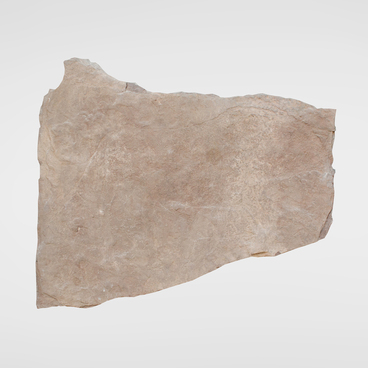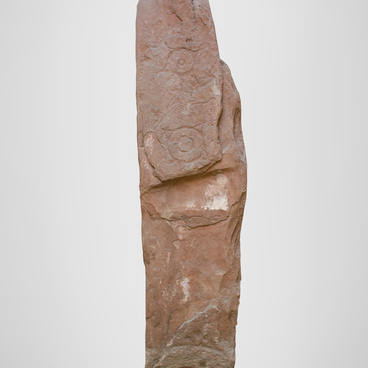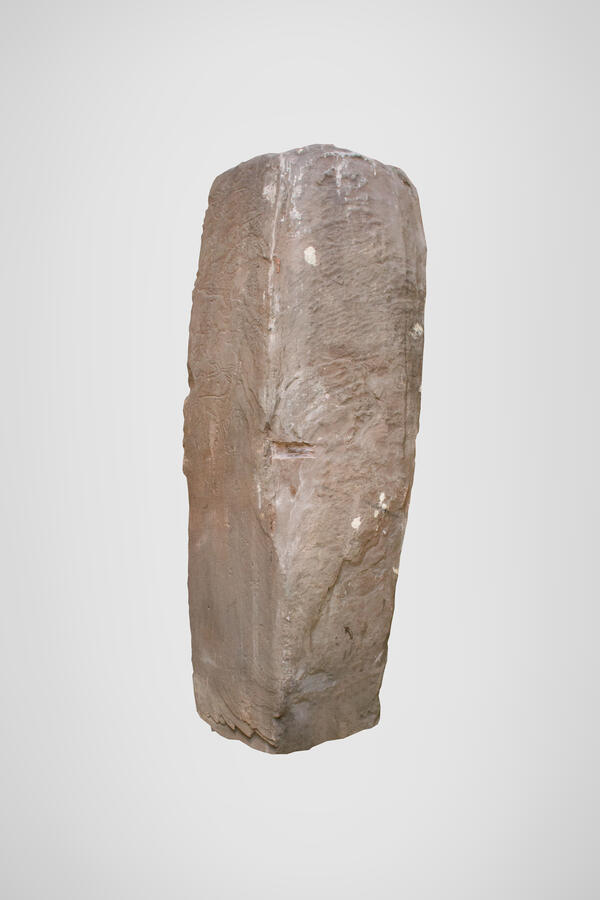
A stone with images of marals (red deer) was in the construction of a mound of the Tagar culture (8th-3rd centuries BC) near the mouth of the Uta river, in the Beysky district. It was moved (to the museum grounds) in the 1960s by an employee of the museum Albert Lipsky, a famous Khakass archaeologist, an honored worker of culture of the RSFSR. The image on the stone was created at the same time as the mound.
In the structures of the kurgans in the Khakass-Minusinsk depression, sandstone slabs were placed vertically, usually at the corners of the burials. They were often engraved with petroglyphs.
The stela from the museum collection is an elongated rectangular sandstone slab. On two smooth opposite surfaces, the ancient master depicted deer (marals) using the technique of picking. One of them has a thrown back head with branched horns, ears, and a bent back. Numerous spirals are engraved on the body. Another deer is seen a little lower and to the right. He also has a well-visible muzzle, spreading horns and spiral marks on the torso.
Below it, a figure of an animal, with its front and rear body twisted and turned in different directions is carved in solid embossing. This is how in ancient art — and especially often in Siberia in the Scythian time — a rapid movement was depicted.
Further down in a row are the figures of three deer in motion, their antlers drawn in unbranched lines. Below is a red deer with a high neck and branching horns, one can see its eye and its ear; a bird with a long beak is drawn in the center of its body. The shape of another bird on the right resembles that of a bustard. On the right side of the sculpture, there is a more sketchy depiction of deer.
The drawings on the stone belong to the Scythian-Siberian animal style. It was widespread in the Eurasian steppes in the 8th–3rd centuries BC. Characteristic of the style are animal subjects in dynamic poses and movement. The ancient masters depicted the deer very often: it was considered a totem animal. Such drawings were endowed with magical properties. Some researchers believe that in Siberia there was a cult of the deer as a solar deity — a source of light and life on earth.
In the structures of the kurgans in the Khakass-Minusinsk depression, sandstone slabs were placed vertically, usually at the corners of the burials. They were often engraved with petroglyphs.
The stela from the museum collection is an elongated rectangular sandstone slab. On two smooth opposite surfaces, the ancient master depicted deer (marals) using the technique of picking. One of them has a thrown back head with branched horns, ears, and a bent back. Numerous spirals are engraved on the body. Another deer is seen a little lower and to the right. He also has a well-visible muzzle, spreading horns and spiral marks on the torso.
Below it, a figure of an animal, with its front and rear body twisted and turned in different directions is carved in solid embossing. This is how in ancient art — and especially often in Siberia in the Scythian time — a rapid movement was depicted.
Further down in a row are the figures of three deer in motion, their antlers drawn in unbranched lines. Below is a red deer with a high neck and branching horns, one can see its eye and its ear; a bird with a long beak is drawn in the center of its body. The shape of another bird on the right resembles that of a bustard. On the right side of the sculpture, there is a more sketchy depiction of deer.
The drawings on the stone belong to the Scythian-Siberian animal style. It was widespread in the Eurasian steppes in the 8th–3rd centuries BC. Characteristic of the style are animal subjects in dynamic poses and movement. The ancient masters depicted the deer very often: it was considered a totem animal. Such drawings were endowed with magical properties. Some researchers believe that in Siberia there was a cult of the deer as a solar deity — a source of light and life on earth.