Hunting knives are the oldest type of cold weapons. They existed since the Paleolithic when they were just lithic (mostly flint) flake tools that did not undergo any kind of special processing. The blade and the handle in such a knife were made of a single piece of stone, but over time, the handle began to be made of bone or wood. Stone knives were replaced by those made of bronze, copper, and later iron, which were superior in strength and, unlike their stone counterparts, could be resharpened if they became dull.
Etymologically, the word “nozh”, which is Russian for “knife”, goes back to the Proto-Slavic “nož ь” meaning “to pierce, to cut”, which indicates the main, but not the only purpose of this tool. Structurally, the knife consists of a handle and a blade with a pointed tip called a point, a sharpened side, or edge, and a dull opposite side — spine (optional, as there are double-edged knives).
Depending on the purpose of the knife, the blade can be smooth or serrated; to reduce the weight of the object, it may feature small grooves called fullers. To secure the blade inside the handle, its hidden part — the tang — is inserted into a special hole or fixed between the scales of the handle.
The main part of the handle — the grip — is connected to the choil of the blade; sometimes knives feature a protective cross-guard. The bottom part of the handle often has a special hole for the lanyard, which was used to secure the knife on the hunter’s wrist.
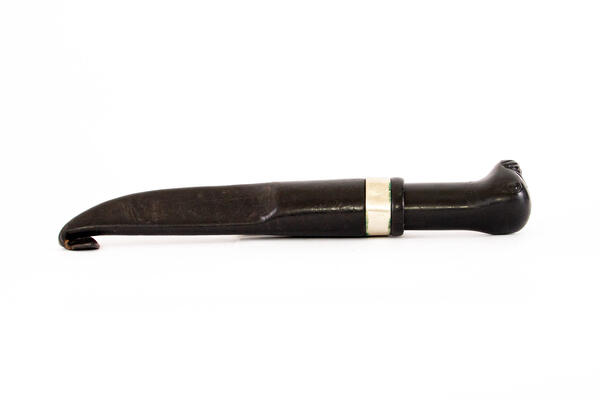
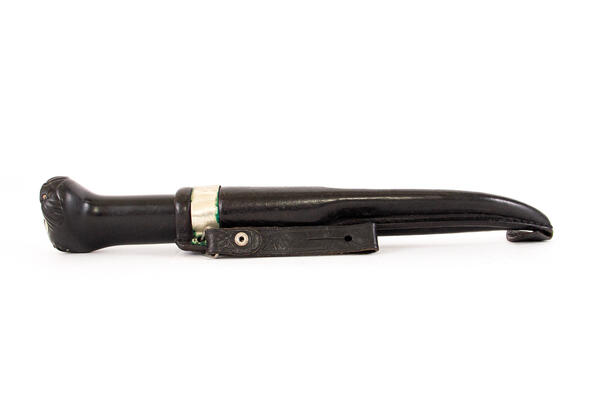
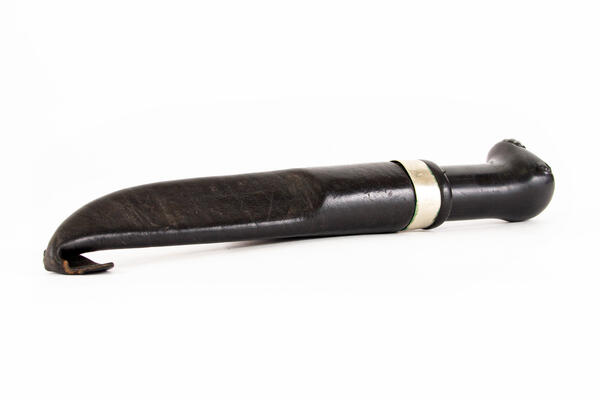
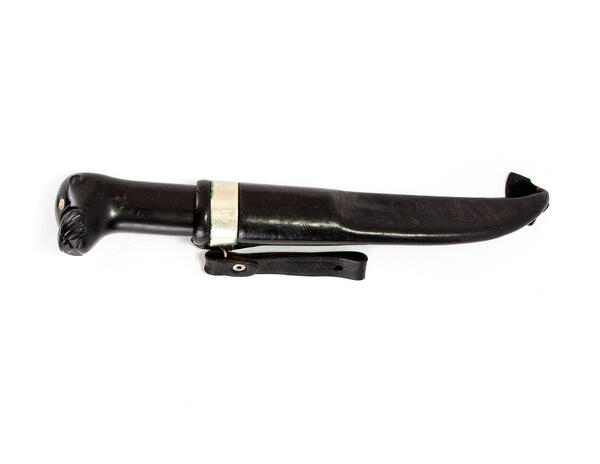
Hunting knives belong to a special category, which includes weapons for hunting proper (various daggers with high penetrating capabilities), those with curved blades for skinning prey (skinners) and all-purpose or camp knives with which one can not only cut meat, but also cut and split branches as well as perform a multitude of other tasks. The same group includes seax knives, also known as “goat legs”. They have straight blades, have low piercing capabilities, but provide good control over the direction of the cut. The one on display belongs to the second category.
The sheath ensures that the knife is stored and carried
safely without risk of damage to both the person and the knife itself, while at
the same time providing easy access. Traditionally, sheaths are made of
leather. Wood, metal, fabric and other less durable materials are used less
frequently. They may be solid on the inside and feature a clasp and a loop or a
belt hook.