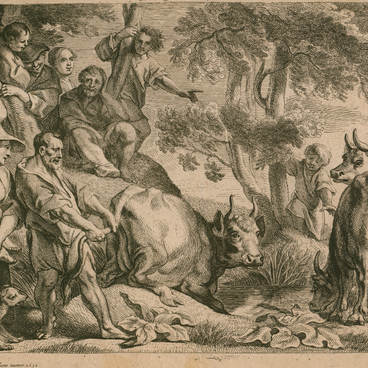
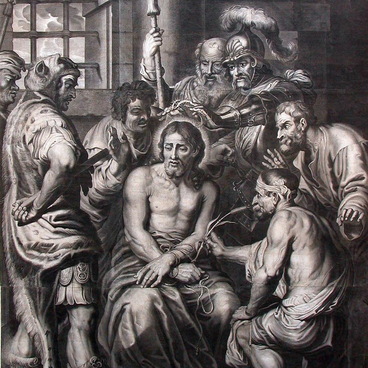
The engraving from the collection of the Irbit State Museum of Fine Arts is titled “The Temptation of St. Anthony”. This late 15th-century work by an unknown master captures the medieval interpretation of St. Anthony the Great’s spiritual struggle. Its bold, unrefined carving and stark, laconic composition are emblematic of early printed devotional imagery, where expressive power and spiritual message outweighed technical finesse.
Such engravings circulated widely among monastic communities and the devout laity, serving as visual sermons on the necessity of spiritual vigilance. Their very simplicity amplified their emotional force: jagged lines evoke torment; stark contrasts of black and white embody the eternal battle between good and evil.
The life of Anthony the Great (c. 251–356) — one of Christianity’s most venerated saints and the founding father of Christian monasticism — was described by St. Athanasius of Alexandria. His hagiography became a spiritual guide for many generations of monks and laypeople. Anthony was born in Egypt to a prosperous family. After his parents’ death, he was moved by Christ’s words — “If you want to be perfect, go, sell your possessions and give to the poor, and you will have treasure in heaven; then come, follow me” (Matthew 19:21) — and gave away everything that he owned, retreating into the desert to live in solitude and prayer.
His decades of hermitage became a legendary theater of spiritual warfare. According to the hagiography, demons assailed him in countless guises: as snarling beasts, grotesque fiends, and seductive women — all seeking to break his resolve. Yet Anthony prevailed through prayer, fasting, and unwavering faith. These dramatic encounters became a favorite subject in Christian art, from medieval miniatures and engravings to famous paintings by Hieronymus Bosch and Salvador Dalí.
One of the most celebrated episodes recounts how Anthony secluded himself for twenty years in an abandoned Roman fortress, overcoming fear and despair. Only occasionally some locals would pass him bread through a narrow hole in the wall. When friends finally dared to enter, they expected to find a broken, tormented man — but instead encountered a figure radiant with peace and divine grace. Though Anthony left no written works, his oral teachings became the bedrock of Christian monastic traditions.