In 1889, the results of Alexander Stoletov’s research on the photoelectric effect were published in a paper entitled “Actinoelectric Research” in the 21st volume of the “Journal of the Russian Society of Physics and Chemistry”.
The prerequisites for the discovery of the photoelectric effect can be traced back to the 17th century, when Isaac Newton proposed the theory of light, which was most highly valued for over a century and a half. In 1887, Heinrich Hertz, a German physicist, conducted a series of experiments that led to the discovery of the phenomenon of external photoelectric effect. His findings sparked widespread interest among scientists. By the start of 1888, Stoletov was joined by many notable physicists who were all exploring this phenomenon: Wiedemann, Ebert and Hallwachs from Germany, Righi from Italy, and Blondlot from France. However, Stoletov’s actinoelectric research became most popular.
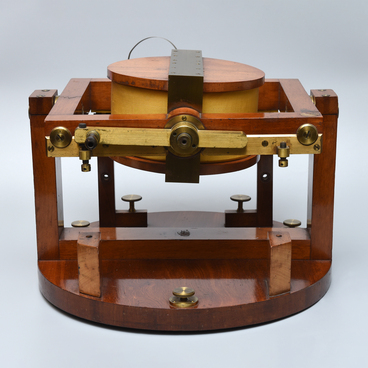
In February 1888, he began a series of experiments that lasted approximately four months. During this period of intense work, he achieved remarkable results that garnered him global recognition. In his research, Stoletov describes the development of a mesh capacitor, which he considered to be the “primary and indispensable component” of his experiments. This device consisted of two metal discs — a solid zinc plate and a fine mesh mounted vertically opposite each other.
To conduct the experiment, Stoletov sequentially connected a device consisting of a galvanometer and battery to a circuit. He then illuminated the plates using the light from an electric lamp, allowing light to freely pass through the mesh and illuminate the surface of the solid zinc disc. Stoletov observed that when the zinc plate in the capacitor was connected to the negative terminal of the voltage source (that is, when it acted as a cathode), the galvanometer, connected to the circuit, indicated a current. However, when the grid was the cathode, no current was observed. This indicated that the illuminated zinc plate emitted negatively charged particles that caused a current to flow between it and the grid, a phenomenon known as a photocurrent. Subsequent experiments confirmed that the photocurrent was actually a stream of electrons produced by electromagnetic radiation in the photoelectric effect.
In early June 1889, Stoletov completed work on his article. However, before submitting it for publication, he revisited and edited it, incorporating comments on works that had been published in the summer of that year. Some of these materials were presented by Stoletov as a report at the Second International Congress of Electricians held in Paris in the same year. The same year, “Actinoelectric Research, ” written by Stoletov, was published as a separate publication.