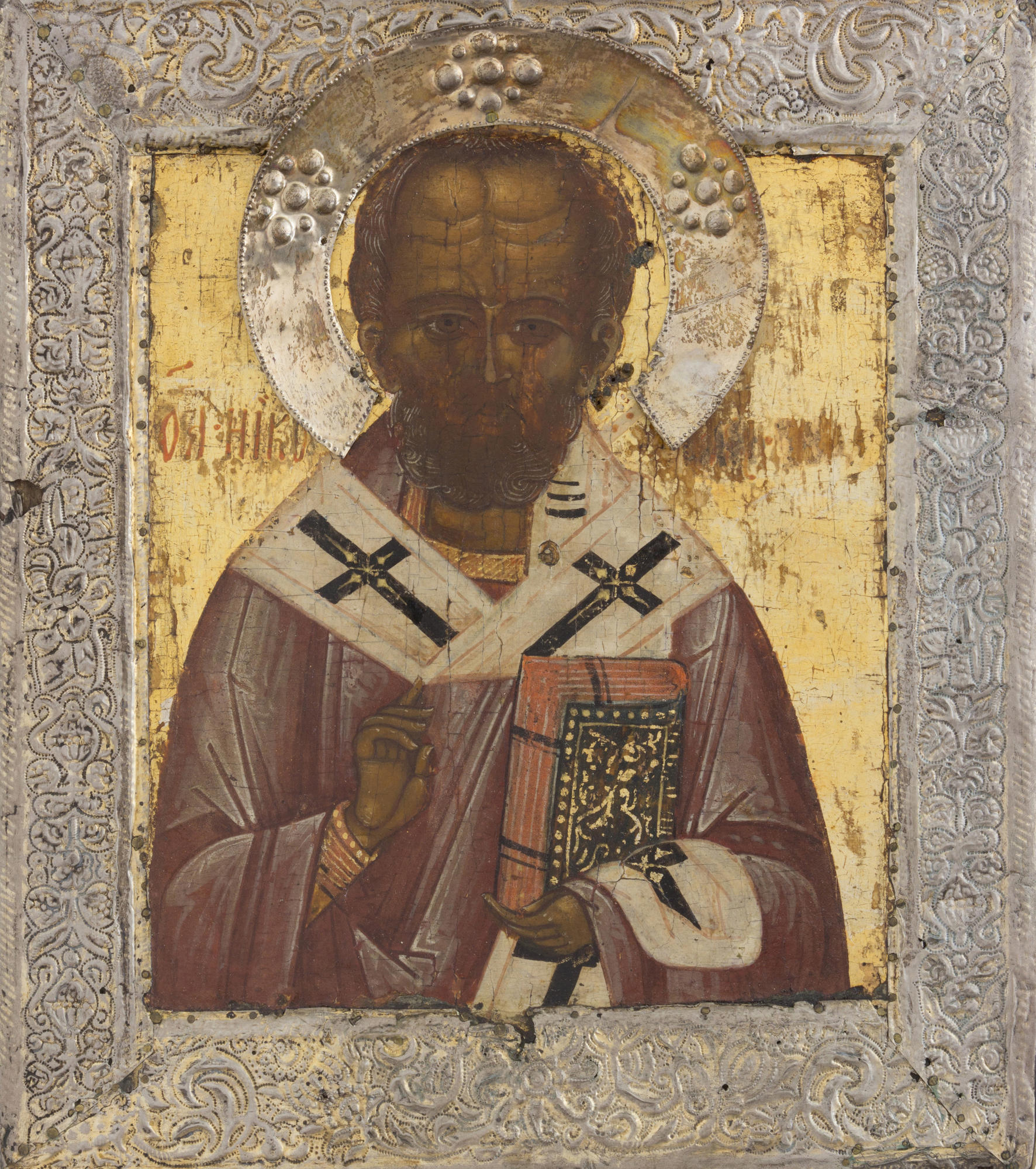


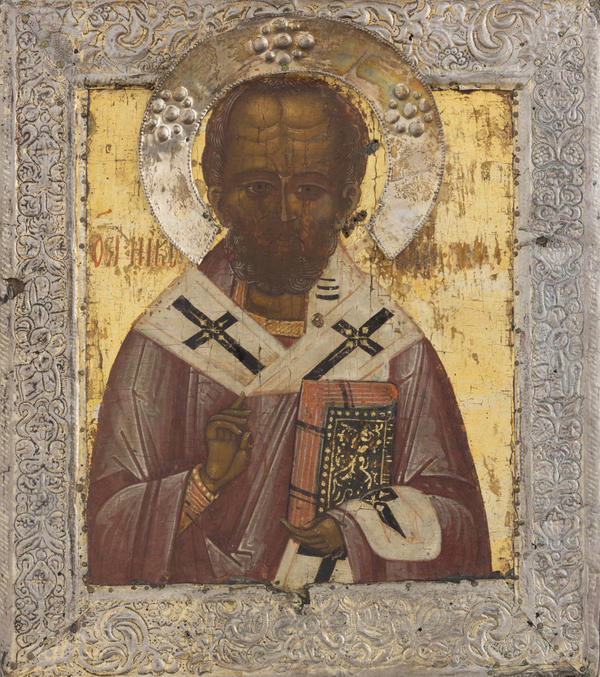
The icon of Nikola the Wonderworker got to the museum from the Church of St. Philip, Metropolitan Solovetsky Transfiguration of the Saviour Monastery in 1923. The figure of the saint is waist-length, on his shoulders, there is a reddish-brown phelonion. The right hand is raised in a gesture of blessing, in the left, covered with an omophorion, he holds the closed gospel. The background of the icon is gilded, the margins are covered with the 18th-century wrought silver: thin silver plates with embossed ornaments which are nailed to the surface of the icon with small carnations to form a frame.
St. Nicholas, Bishop of the city of Myra (4th century), in Russian Orthodoxy is referred to as Nikola the Wonderworker and is one of the most revered saints in the Russian North. Pomors, whose life was built around the marine industries, considered him their patron and dubbed Nickola the Marine. The French traveller Pierre Martin de Lamartinier, who visited the North in 1653 as part of the expedition of the Northern Trading Company, called the Pomors ‘nicholasists’ because in every house he saw the icon of St. Nicholas the Wonderworker. In Pomorye there were many churches dedicated to the saint, which is reflected in the famous local proverb: ‘From Kholmogor to Kola there are 33 Nikolas’.
On May 9 (22), on the day of St. Nicholas the Vernant, the Pomors opened navigation, timing the first venturing into the sea to coincide with this day. Until the 19th century, the tradition of calling ships by the name of St. Nicholas remained.
Among all the saints of the Christian world, the iconography of St. Nicholas is the most developed. The oldest and most common type of the saint’s icons is his chest images, in which he blesses with his right, slightly raised hand, and holds the closed Gospel in his left hand.
St. Nicholas, Bishop of the city of Myra (4th century), in Russian Orthodoxy is referred to as Nikola the Wonderworker and is one of the most revered saints in the Russian North. Pomors, whose life was built around the marine industries, considered him their patron and dubbed Nickola the Marine. The French traveller Pierre Martin de Lamartinier, who visited the North in 1653 as part of the expedition of the Northern Trading Company, called the Pomors ‘nicholasists’ because in every house he saw the icon of St. Nicholas the Wonderworker. In Pomorye there were many churches dedicated to the saint, which is reflected in the famous local proverb: ‘From Kholmogor to Kola there are 33 Nikolas’.
On May 9 (22), on the day of St. Nicholas the Vernant, the Pomors opened navigation, timing the first venturing into the sea to coincide with this day. Until the 19th century, the tradition of calling ships by the name of St. Nicholas remained.
Among all the saints of the Christian world, the iconography of St. Nicholas is the most developed. The oldest and most common type of the saint’s icons is his chest images, in which he blesses with his right, slightly raised hand, and holds the closed Gospel in his left hand.