The art of copper-cast icons came to Russia from Byzantium. Most often, such religious objects were small and one-sided. Copper icons with a special loop were suspended from the neck by a cord and worn over a shirt on the chest, so they were called pectoral icons.
The spread of Christianity led to the spread of Byzantine products, but around the 12th century, artisans began to make local cast icons in the territory of Old Rus. These items most often featured half-length and occasionally full-length images of one or two Christian saints. The pendants with the image of the saint were decorated with an ornament, and the masters mainly used geometric and floral ornaments.
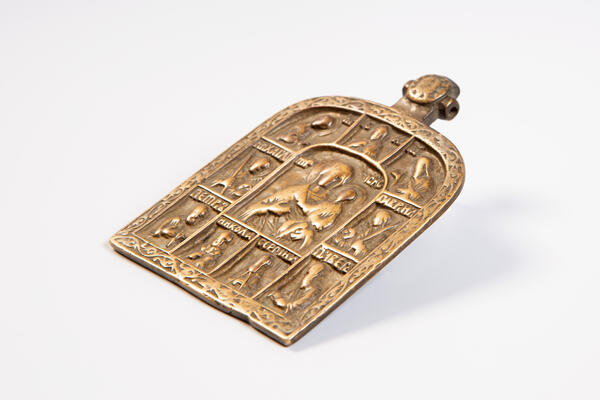
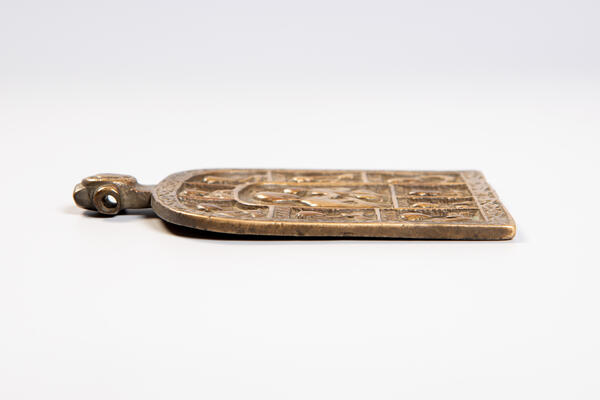
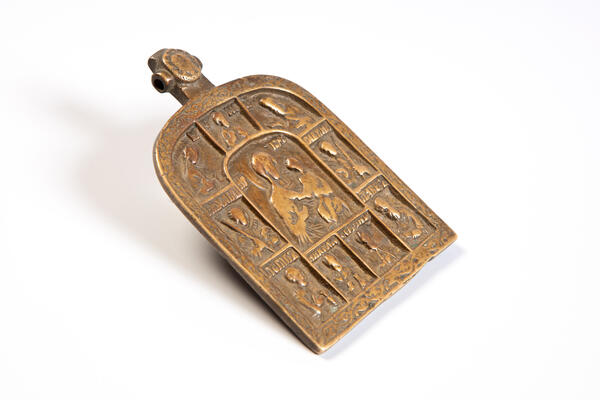
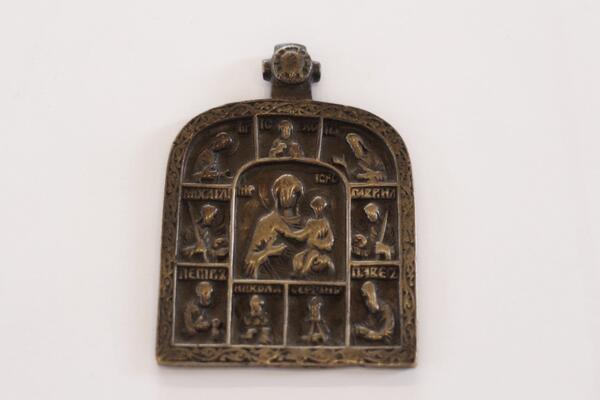
The copper-cast icon from the museum’s collection features Our Lady of Smolensk (Hodegetria) in the center of the exhibit. The side images feature the Savior, the Mother of God, John the Baptist, the archangels Michael and Gabriel. The saints Peter, Nicholas, Sergius, and Paul are depicted in the bottom row. Along the edge of the icon is a floral pattern that resembles bindweeds. The loop has a complex design in the shape of a cross. In the middle is a symbol that resembles the sun. Such a composition conveys the belief that the saints can be intercessors before God.
The Hodegetria (meaning “She Who Shows the Way”) type of icon is one of the most common images of the Mother of God. Legend has it that Luke the Evangelist painted the very first image of this kind. The Virgin is depicted in the center of the icon with Baby Jesus on her arm. She points to Her Son with the other hand, thus revealing the Divine Child to the world.
The Holy Child gives his blessing with one hand while holding a scroll in his other hand. Although his figure is small, the future Savior can be identified by the clear severe outline. His high forehead, stately gesture and regal posture create this impression.
The Smolensk iconographic type became widespread after the first quarter of the 16th century, when the Smolensk lands were annexed to the Muscovite state. Such icons were called “Our Lady of Smolensk”, and people started to use this name to refer to similar earlier images.
The spread of Christianity led to the spread of Byzantine products, but around the 12th century, artisans began to make local cast icons in the territory of Old Rus. These items most often featured half-length and occasionally full-length images of one or two Christian saints. The pendants with the image of the saint were decorated with an ornament, and the masters mainly used geometric and floral ornaments.
The copper-cast icon from the museum’s collection features Our Lady of Smolensk (Hodegetria) in the center of the exhibit. The side images feature the Savior, the Mother of God, John the Baptist, the archangels Michael and Gabriel. The saints Peter, Nicholas, Sergius, and Paul are depicted in the bottom row. Along the edge of the icon is a floral pattern that resembles bindweeds. The loop has a complex design in the shape of a cross. In the middle is a symbol that resembles the sun. Such a composition conveys the belief that the saints can be intercessors before God.
The Hodegetria (meaning “She Who Shows the Way”) type of icon is one of the most common images of the Mother of God. Legend has it that Luke the Evangelist painted the very first image of this kind. The Virgin is depicted in the center of the icon with Baby Jesus on her arm. She points to Her Son with the other hand, thus revealing the Divine Child to the world.
The Holy Child gives his blessing with one hand while holding a scroll in his other hand. Although his figure is small, the future Savior can be identified by the clear severe outline. His high forehead, stately gesture and regal posture create this impression.
The Smolensk iconographic type became widespread after the first quarter of the 16th century, when the Smolensk lands were annexed to the Muscovite state. Such icons were called “Our Lady of Smolensk”, and people started to use this name to refer to similar earlier images.