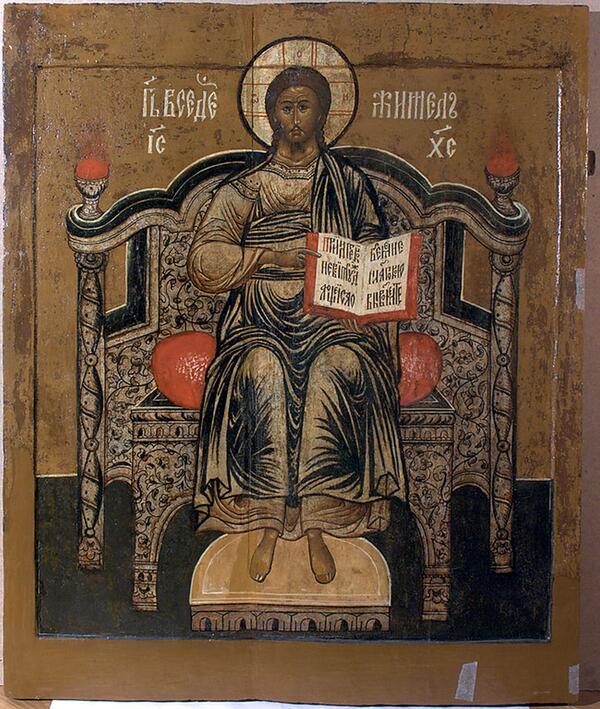
The central icon of the Deesis — the main tier of the iconostasis, is the image of the Lord Almighty. It was found in an abandoned church near Murom by an expedition of the Tretyakov Gallery in 1965. Jesus Christ, the Son of God, who descended to earth as a man, voluntarily accepted a painful death on the cross in order to free the human race from sin, resurrected and returned to heaven. When Christ appears a second time, the world as we know it will end. And after the Last Judgment, the righteous will have a pleasant eternity in paradise, while sinners will experience torture in hell.
The traditional arrangement of icons in the main tier of the altar wall in the Christian church is based precisely on this prophecy. Jesus Christ, who is coming to judge the living and the dead, is flanked by heavenly hosts and saints praying for people: the Most Holy Theotokos, John the Baptist, the Archangels Michael and Gabriel. Often, the tier also includes the images of the apostles Peter and Paul and some locally revered saints.
Jesus wears traditional clothes — a shirt-like chiton and a cloak-like himation. He is depicted in front view, in full length, sitting on a throne. This image of Christ was called “The Savior Enthroned.” It appeared in Byzantium in the 9th century and came to Russia in the 12th century.
This type of icons depicts Jesus at the time when He began preaching: He is about 30 years old. The characteristic trends of that time — long hair, a small mustache and beard — complement his appearance.
The pointing gesture of his right hand is directed to the open Gospel, which Jesus holds in His left hand. The Holy Book is opened on the words “Come to me, all you who labor and are heavy laden…” (Matt. 11:28–30). With these words He seems to show people the way to salvation.
The halo of Christ with a cross inside, the so-called “cross halo”, reminds of His sacrifice made for people.
In the crosshairs is the Greek inscription “WON”, which means “Existing”. The halo is flanked by words in the Old Slavonic language: “The Lord Almighty” and letters “IC XC”, symbolizing the name “Jesus Christ”.
In the Byzantine tradition, Christ was portrayed as a formidable and inaccessible great ruler. In Russia, He was depicted as the Savior, who was compassionate and understanding, and had a wise and sad look.
The traditional arrangement of icons in the main tier of the altar wall in the Christian church is based precisely on this prophecy. Jesus Christ, who is coming to judge the living and the dead, is flanked by heavenly hosts and saints praying for people: the Most Holy Theotokos, John the Baptist, the Archangels Michael and Gabriel. Often, the tier also includes the images of the apostles Peter and Paul and some locally revered saints.
Jesus wears traditional clothes — a shirt-like chiton and a cloak-like himation. He is depicted in front view, in full length, sitting on a throne. This image of Christ was called “The Savior Enthroned.” It appeared in Byzantium in the 9th century and came to Russia in the 12th century.
This type of icons depicts Jesus at the time when He began preaching: He is about 30 years old. The characteristic trends of that time — long hair, a small mustache and beard — complement his appearance.
The pointing gesture of his right hand is directed to the open Gospel, which Jesus holds in His left hand. The Holy Book is opened on the words “Come to me, all you who labor and are heavy laden…” (Matt. 11:28–30). With these words He seems to show people the way to salvation.
The halo of Christ with a cross inside, the so-called “cross halo”, reminds of His sacrifice made for people.
In the crosshairs is the Greek inscription “WON”, which means “Existing”. The halo is flanked by words in the Old Slavonic language: “The Lord Almighty” and letters “IC XC”, symbolizing the name “Jesus Christ”.
In the Byzantine tradition, Christ was portrayed as a formidable and inaccessible great ruler. In Russia, He was depicted as the Savior, who was compassionate and understanding, and had a wise and sad look.