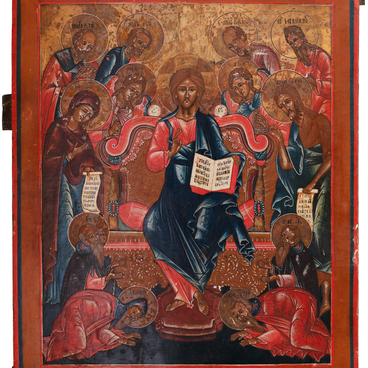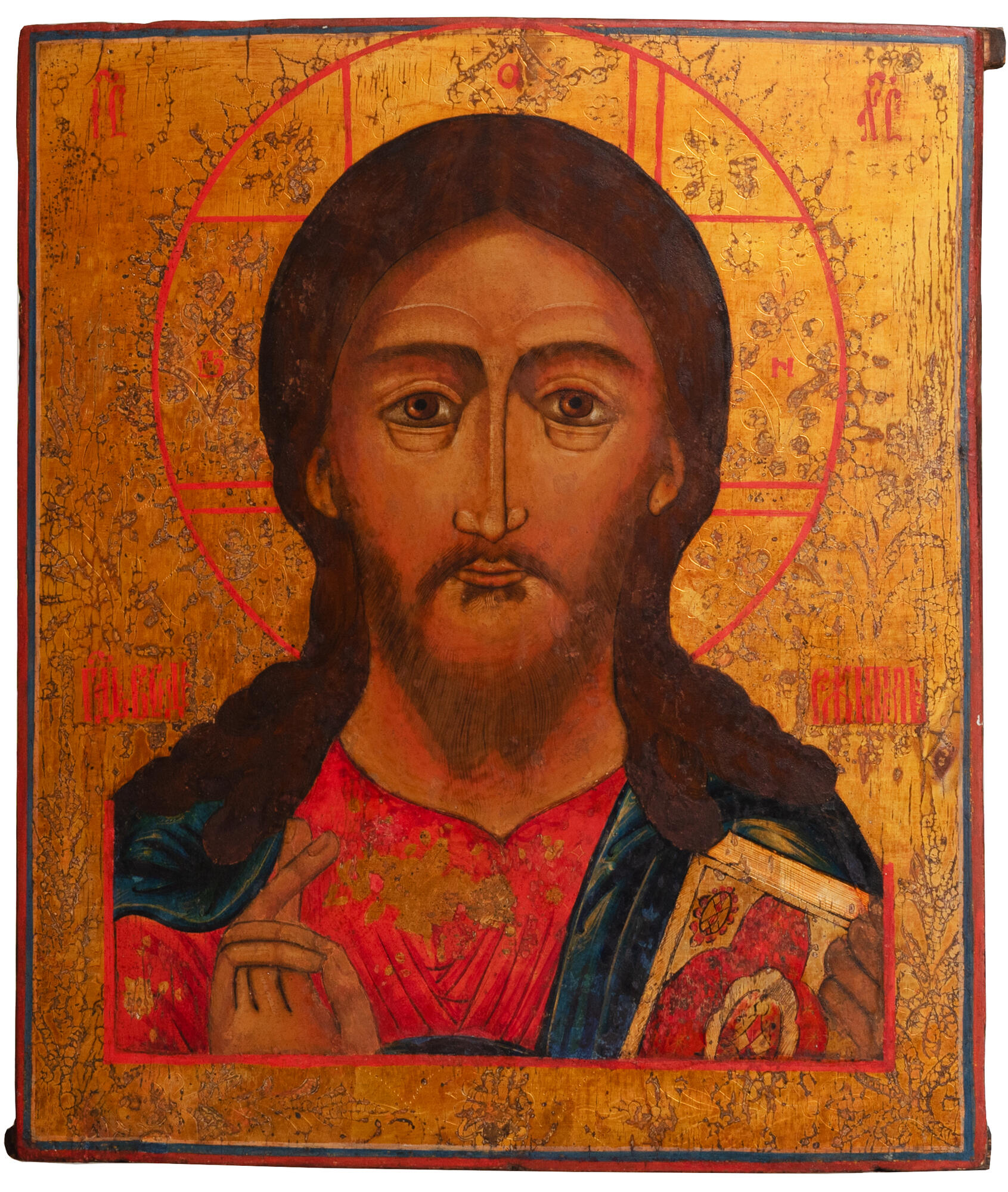


Originally, the Deesis was painted on a single panel. Later, however, three separate panels began to be used, as is the case with this icon. In the center, there is a chest-length image of Christ Pantocrator, or the Lord Almighty, dressed in a bright red chiton and a dark blue himation. With His right hand, he makes a blessing gesture, and with His left hand, He supports a closed Book of the Gospels decorated with gold and gemstones.
This icon of “Christ Pantocrator” was created by representatives of the so-called Don school of icon painting, which has received little attention from scholars. Its icons were popular among the Cossacks of the Lower Don region. This particular icon belonged to the Gladkov family, who lived in the Pogozhev village of the Tsimlyansky District, Rostov Oblast. Yakov Gladkov served at the court of His Imperial Majesty in the late 19th century.
In Greek, the word “Deesis” means “prayer” and “supplication”. An icon of this type may include images of apostles, holy fathers, and martyrs (a multi-figure Deesis). The main meaning of the composition is the prayer and intercession on behalf of humanity before the Heavenly King and Judge.
Deesis compositions can be divided into two categories — chest-length and full-length. The displayed icon belongs to the former category. The latter includes icons in which the Virgin Mary and John the Baptist are depicted full-length, standing before Christ in prayer. These images could also be part of a composition depicting the Last Judgment. They correspond with the oldest surviving liturgical texts in which the Virgin Mary and John the Baptist are mentioned as intercessors on behalf of the believers.
The first mention of the word “Deesis” can be found
in the Hypatian Codex on a page dated 1288. The Deesis is most often referred
to as icons of Jesus Christ flanked by the Virgin Mary and John the Baptist. In
Byzantium, these icons were known as trimorphs. The first documented mention of
such an icon dates back to 629. The earliest known icons were painted in the 7th century.