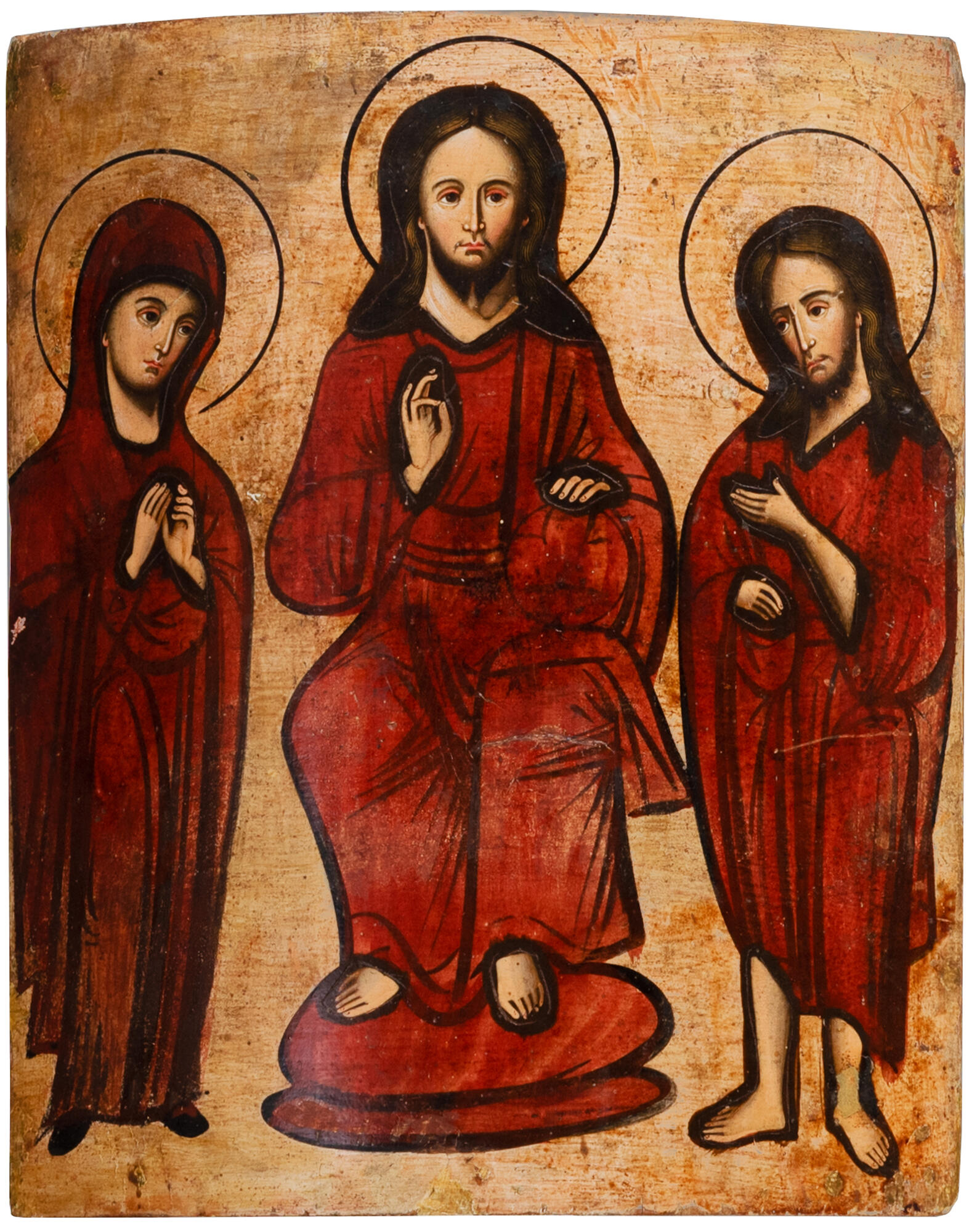


The displayed icon features the Deesis composition with three full-length figures. In the center, there is Christ Pantocrator seated on a throne. In His left hand, He holds an orb, and with His right hand, He makes a blessing gesture. His feet rest on an oval, two-stepped red base, with the right foot pointing slightly outward. Christ is flanked by the Virgin Mary on His right and John the Baptist on His left. All three figures are dressed in red robes with contrasting folds.
The figures are squatty, their feet are placed slightly apart. According to art experts, this creates a sense of balance and stability. The icon painter used a limited palette of colors, mainly consisting of light yellow and bright red. It is noteworthy that Christ, the Virgin Mary, and John the Baptist are all depicted within a single plane.
This Deesis was created by icon painters of the Old Believer school which preserved the ancient Russian iconographic traditions. The Old Believers strongly opposed innovation, defending the traditions of the Ancient Russian and Byzantine iconography. They collected “pre-schism” icons and believed that new icons “were not filled with grace.”
A division in the Russian Orthodox Church began in the mid-17th century, during the reign of Patriarch Nikon. He began to implement reforms, introducing changes in respect of liturgical and ritual practices, theological treatises, and iconography. Those who refused to accept Nikon’s reforms were referred to as “raskolniki” (schismatics). Those who supported them became known as the Old Believers. These, in turn, were divided into two groups: the Popovtsy (“with priests”) and the Bezpopovtsy (“priestless”). The latter were a more radical group who renounced priests.