The image of Christ in this icon is based on the ancient type of Christ Pantocrator, or Christ the Almighty. It is very popular in Orthodox iconography. In the centerpiece, Christ is depicted frontally, half-length. He makes a blessing gesture with His right hand and holds the Book of the Gospels in His left hand. He is dressed in a bright red chiton with a monochrome border and a dark blue himation with dark folds.
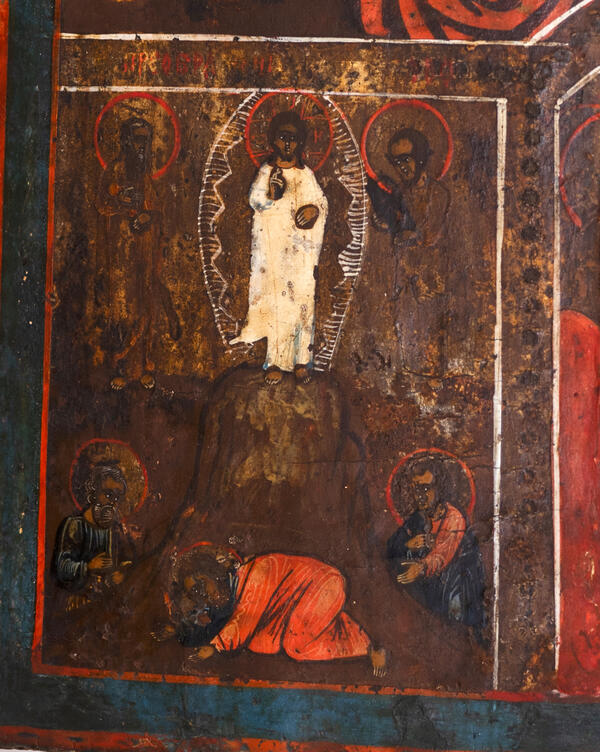
Christ is flanked by full-length images of saints, each holding the Book of the Gospels. At the top and bottom of the icon, there are border scenes with feasts. The upper part features “The Holy Trinity” and “The Nativity of Christ, ” while the lower part displays “The Transfiguration of Jesus, ” “The Resurrection of Jesus, ” and “The Ascension of Jesus”. The background is decorated with a floral pattern.
The icon represents Russian church art of the late 18th and early 19th centuries. Christ’s face is depicted in a traditional iconographic manner. The facial features are small and regular. Jesus is depicted with a straight nose, close-set eyes, a small mouth, his lips tightly closed, and a rounded chin. His wavy hair frames His face and falls in strands to His shoulders. The artist skillfully used a halo with a cross and a red outline to enhance the image. Such images of the Savior were common both in Russia and in the countries of the Byzantine region.
The designation “Pantocrator” or “the Almighty” in
relation to Jesus Christ can be found in Byzantine, Balkan, and Ancient Russian
art. According to some researchers, this iconography was formed under the
influence of the late antique imperial portrait. The inscription “Pantocrator”
has been used since the 6th century. There are various images of Christ
Pantocrator, including full-length variations and the ones where He is enthroned.
The Book of the Gospels can be open or closed. There are also variations in the
position of the hand making a blessing gesture — it can be held at the chest or
to the side. The gesture can be directed outward or inward. Additionally, there
are different combinations of fingers used to make the sign of the cross. Half-length
icons of the Lord Almighty are typically placed in the center of the Deesis row.
The Deesis is the oldest and most important part of Russian iconography. It symbolizes
prayer on behalf of humanity before Christ’s Second Coming and the Last
Judgment.