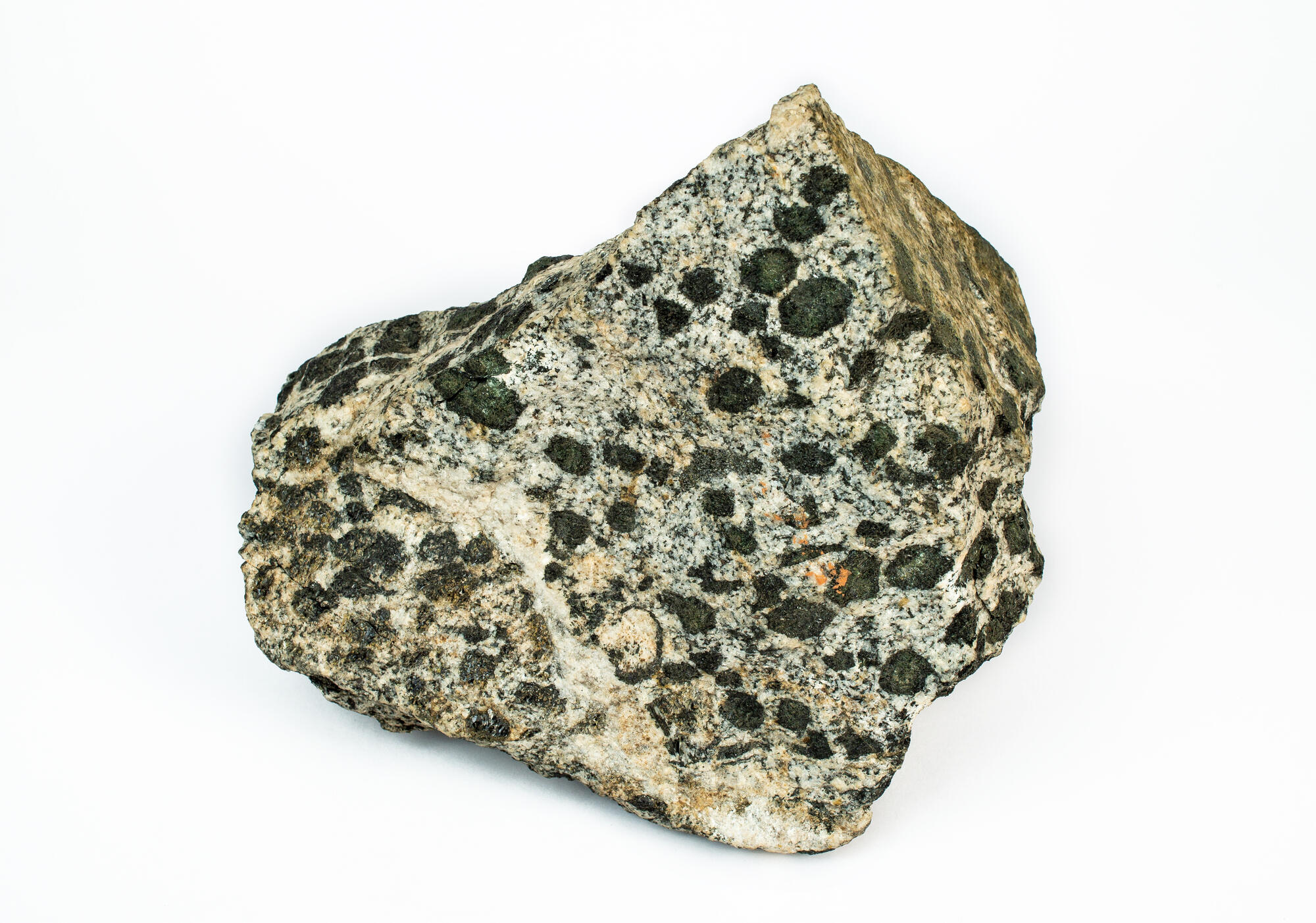


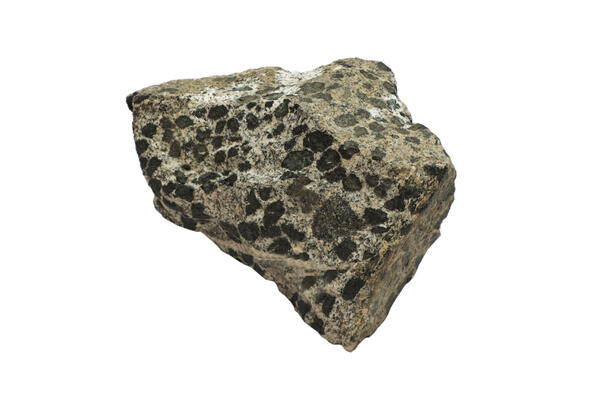
The Verkhnyaya Pyshma Historical Museum houses an extensive collection of minerals that were mined in the local area. Among them is a small piece of granite from the Iset deposit.
Granite is the most abundant rock type. It forms from cooled and solidified magma. Usually, granite is a light gray stone interspersed with quartz and mica.
Mining granite is quite difficult: the rock is extracted in whole slabs, and only then, it is split into pieces or cut into blocks. A lot of granite chips are formed during processing — they are used for paving and flooring.
The Iset mine is located on the Verkh-Iset granite massif in the village of Iset, in the suburb of Verkhnyaya Pyshma. Mineral deposits formed about 240–280 million years ago and now occupy a vast area near the Ural Mountains. In the west, the Verkh-Iset granite massif borders with the Sokoliniy Kamen rock, in the northeast, the border runs along the Shitovskaya Tolstik mountain, in the north — along the Seven Brothers rocks, and in the south the area ends within the boundaries of Yekaterinburg.
The length of the massif from north to south is approximately 80 kilometers, and from west to east — 30 kilometers. The total area is over 1800 square kilometers. One third of the Verkh-Iset granite massif is occupied by granodiorite — this rock differs from granite in composition and color. Minerals are mined at a depth of four to nine kilometers.
There are several natural lakes within the area: Iset, Tavatui, Shitovskoe, and Ayatskoe. The Iset River also flows here, and there are quarries formed after the production of crushed stone — breaking granite or some other rock to the desired size. The crushed stone was used to build roads in the area.
The rocks of the Verkh-Iset granite massif are popular archaeological sites, and scientists often work in that area. In 1895, ancient cave paintings were discovered; they were made in the 3rd millennium BC. There were geometric patterns, images of hoofed animals, birds, and four or five human figures. The site was named Severskaya Pisanitsa — after the name of the nearest village.
Granite is the most abundant rock type. It forms from cooled and solidified magma. Usually, granite is a light gray stone interspersed with quartz and mica.
Mining granite is quite difficult: the rock is extracted in whole slabs, and only then, it is split into pieces or cut into blocks. A lot of granite chips are formed during processing — they are used for paving and flooring.
The Iset mine is located on the Verkh-Iset granite massif in the village of Iset, in the suburb of Verkhnyaya Pyshma. Mineral deposits formed about 240–280 million years ago and now occupy a vast area near the Ural Mountains. In the west, the Verkh-Iset granite massif borders with the Sokoliniy Kamen rock, in the northeast, the border runs along the Shitovskaya Tolstik mountain, in the north — along the Seven Brothers rocks, and in the south the area ends within the boundaries of Yekaterinburg.
The length of the massif from north to south is approximately 80 kilometers, and from west to east — 30 kilometers. The total area is over 1800 square kilometers. One third of the Verkh-Iset granite massif is occupied by granodiorite — this rock differs from granite in composition and color. Minerals are mined at a depth of four to nine kilometers.
There are several natural lakes within the area: Iset, Tavatui, Shitovskoe, and Ayatskoe. The Iset River also flows here, and there are quarries formed after the production of crushed stone — breaking granite or some other rock to the desired size. The crushed stone was used to build roads in the area.
The rocks of the Verkh-Iset granite massif are popular archaeological sites, and scientists often work in that area. In 1895, ancient cave paintings were discovered; they were made in the 3rd millennium BC. There were geometric patterns, images of hoofed animals, birds, and four or five human figures. The site was named Severskaya Pisanitsa — after the name of the nearest village.