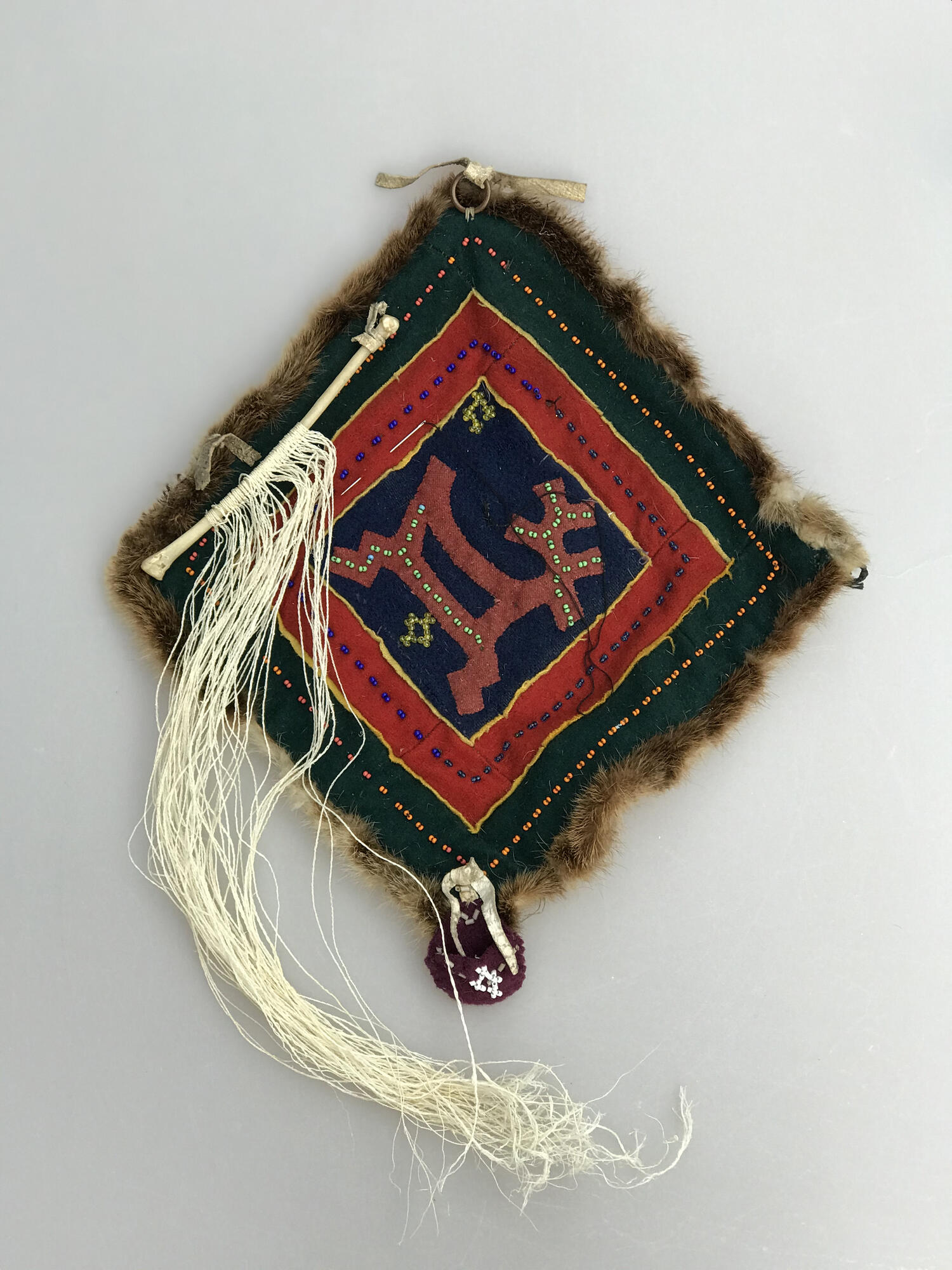


The traditional needle case is called “namt” in the Khanty language. It is made manually from squirrel fur, fabric, beads, leather, metal and bone. To sew a namt, four squares from strips of cloth need to be cut out and joined together. The central square is called the eye or heart of the needle case. It is decorated with beads or applique fabric, so no needles are inserted into it during work.
Many northern peoples consider the needle case to be a sacral item, since the needle symbolizes the womanhood. Therefore, the needle cases are treated very carefully. They are stored in the women’s half of the house, either hanging next to the bag for needlework, or inside the bag in a rolled-up form.
The needle case from the exhibition is made of thick cloth and decorated with ornaments. The ornament, which is made in the form of a deer and decorated with beads, is sewn on the blue square in the center of the item. The outer edge of the needle case is trimmed with squirrel fur. There is a small pouch for a thimble and a plate made of duck bone with tendon threads attached.
Such threads are used to create household utensils, clothes, footwear, strings for musical instruments. They are made from the spinal tendon of a deer. Girls are taught the techniques of processing this material from childhood. As a rule, the winter months are devoted to the preparation of tendons, so that by the summer the necessary stock of threads is ready and the craftswomen can start sewing clothes for the new season.
When cutting the carcass, tendons are extracted from the leg and back muscles of the deer. Firstly, they are hung by their thick parts on a rope to dry. Only well-dried tendons can be stored for a long time. If they are too dry, they have to be “broken” with a hammer before further processing. Then the tendons are divided into thin fibers and twisted into threads.
Threads for sewing clothes are made only from spinal tendons. They are carefully pulled apart with fingers into thin fibers and twisted with each other. The tendons of the deer’s hind legs are thicker and much stronger than the back ones, so they serve as a material for making ropes. The process is as follows: thick threads are twisted together to make ropes, and then they are folded with spinal tendons into two strips and twisted again. Thus, you can weave a rope of any thickness.
Many northern peoples consider the needle case to be a sacral item, since the needle symbolizes the womanhood. Therefore, the needle cases are treated very carefully. They are stored in the women’s half of the house, either hanging next to the bag for needlework, or inside the bag in a rolled-up form.
The needle case from the exhibition is made of thick cloth and decorated with ornaments. The ornament, which is made in the form of a deer and decorated with beads, is sewn on the blue square in the center of the item. The outer edge of the needle case is trimmed with squirrel fur. There is a small pouch for a thimble and a plate made of duck bone with tendon threads attached.
Such threads are used to create household utensils, clothes, footwear, strings for musical instruments. They are made from the spinal tendon of a deer. Girls are taught the techniques of processing this material from childhood. As a rule, the winter months are devoted to the preparation of tendons, so that by the summer the necessary stock of threads is ready and the craftswomen can start sewing clothes for the new season.
When cutting the carcass, tendons are extracted from the leg and back muscles of the deer. Firstly, they are hung by their thick parts on a rope to dry. Only well-dried tendons can be stored for a long time. If they are too dry, they have to be “broken” with a hammer before further processing. Then the tendons are divided into thin fibers and twisted into threads.
Threads for sewing clothes are made only from spinal tendons. They are carefully pulled apart with fingers into thin fibers and twisted with each other. The tendons of the deer’s hind legs are thicker and much stronger than the back ones, so they serve as a material for making ropes. The process is as follows: thick threads are twisted together to make ropes, and then they are folded with spinal tendons into two strips and twisted again. Thus, you can weave a rope of any thickness.