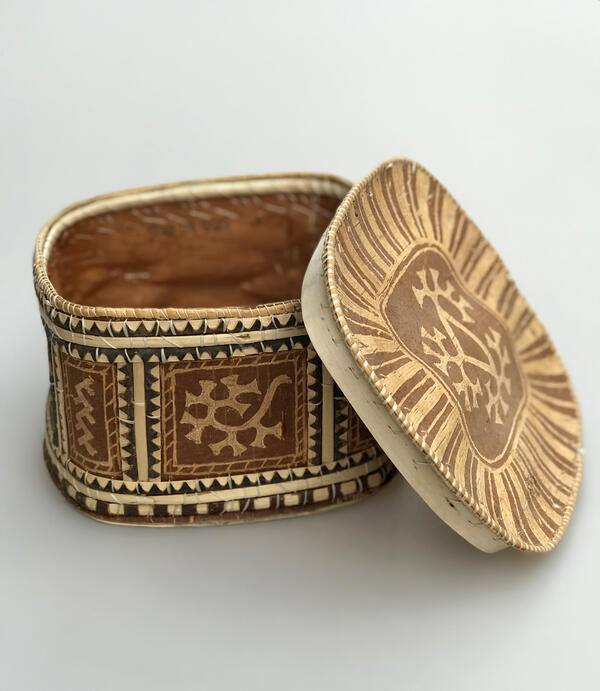
A birch bark ornamented box for storing small items is called ‘yingl’ in the language of the Khanty people. The yingl that is on display in the exhibition is made of two layers of birch bark. Inside is a rim made of a bird cherry twig that enables the box to hold its round shape.
Among the peoples of the North, small boxes for storing dry foods or handicraft items are the most common products made of birch bark. The boxes can be rectangular or round. They are fitted with special removable lids. The lid has a smaller diameter than the box itself and, thus, it looks as if it is put inside the box.
A yingl is made with the dark, inner layer of birch bark on the outside. If the box is made of two layers of birch bark, both the outer and inner sides are dark. White birch bark, collected in the summer, is painted with natural dyes, for example, decoctions of berries or roots.
The walls and the lid of the yingl are decorated with traditional ornaments. Geometrical ornaments are most often used in the applied arts of the indigenous peoples of the North. Each ornament has its own particular meaning.
There are quite a lot of details in traditional Khanty ornaments. They may resemble the Nenets ornament “deer horns”, may be curved and resemble wavy ribbons, and sometimes the pattern consists of closed elements with numerous branches at the ends.
Birch bark is decorated with ornaments in different ways: by scraping, by applying an overlay on a colored or sooty background, as well as by using stamps. In the scraping technique, the ornament is applied to the birch bark with a knife, removing the dark top layer of the birch bark to create a contrasting pattern. The ornament is usually placed on the entire surface of the container and lid. Stencils are not used for making drawings in this technique.
For the embossing technique, the flat side of a knife is used, and the ornament turns out to be netlike most of the time.
Stamps for decorating birch bark items are made of deer or elk horn, across which the pattern is cut out. The horn is immersed in paint and used to apply a drawing on the surface.
Among the peoples of the North, small boxes for storing dry foods or handicraft items are the most common products made of birch bark. The boxes can be rectangular or round. They are fitted with special removable lids. The lid has a smaller diameter than the box itself and, thus, it looks as if it is put inside the box.
A yingl is made with the dark, inner layer of birch bark on the outside. If the box is made of two layers of birch bark, both the outer and inner sides are dark. White birch bark, collected in the summer, is painted with natural dyes, for example, decoctions of berries or roots.
The walls and the lid of the yingl are decorated with traditional ornaments. Geometrical ornaments are most often used in the applied arts of the indigenous peoples of the North. Each ornament has its own particular meaning.
There are quite a lot of details in traditional Khanty ornaments. They may resemble the Nenets ornament “deer horns”, may be curved and resemble wavy ribbons, and sometimes the pattern consists of closed elements with numerous branches at the ends.
Birch bark is decorated with ornaments in different ways: by scraping, by applying an overlay on a colored or sooty background, as well as by using stamps. In the scraping technique, the ornament is applied to the birch bark with a knife, removing the dark top layer of the birch bark to create a contrasting pattern. The ornament is usually placed on the entire surface of the container and lid. Stencils are not used for making drawings in this technique.
For the embossing technique, the flat side of a knife is used, and the ornament turns out to be netlike most of the time.
Stamps for decorating birch bark items are made of deer or elk horn, across which the pattern is cut out. The horn is immersed in paint and used to apply a drawing on the surface.