

#1
Hushpu, Surpan
#3
#6
#4
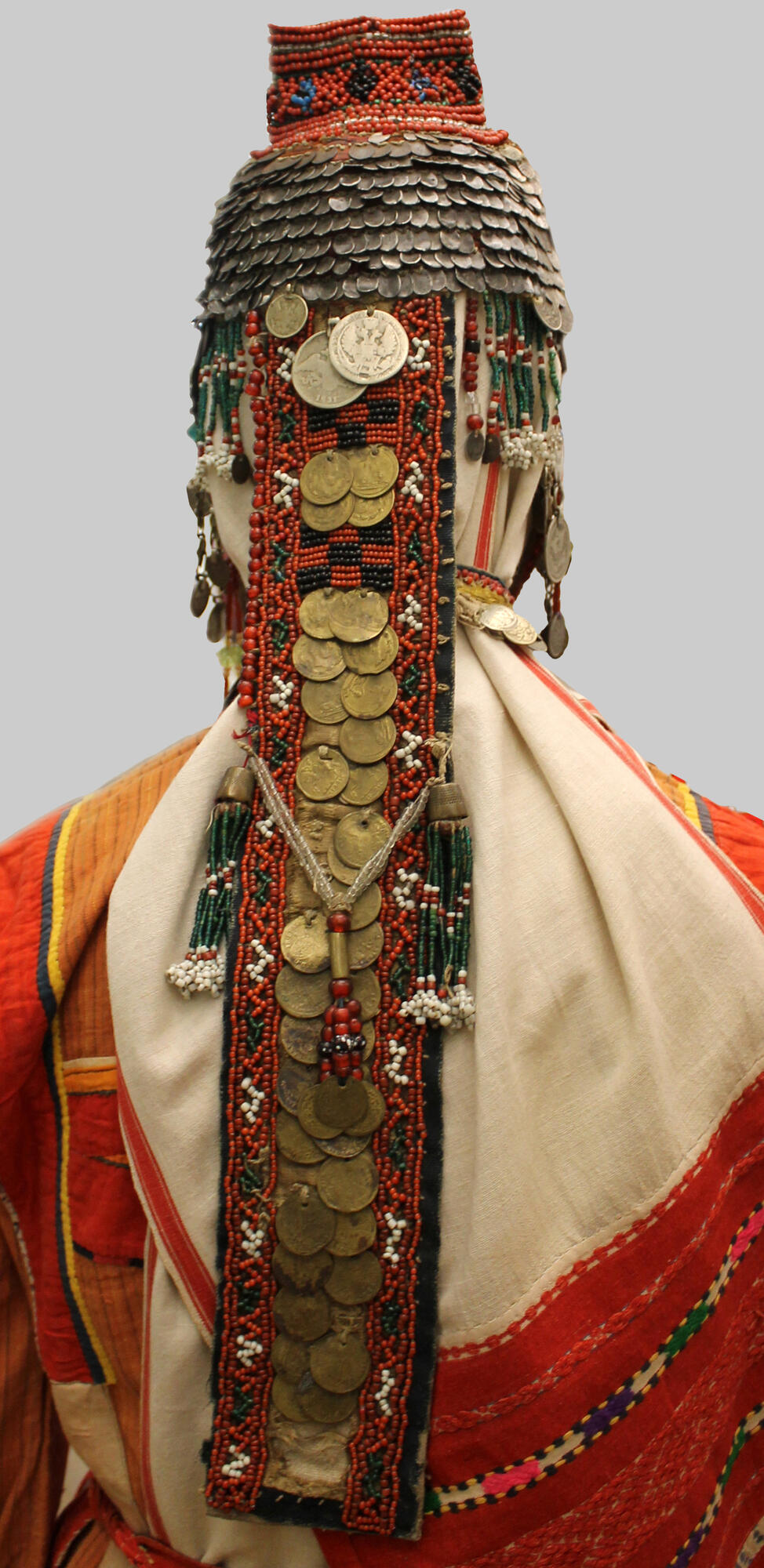
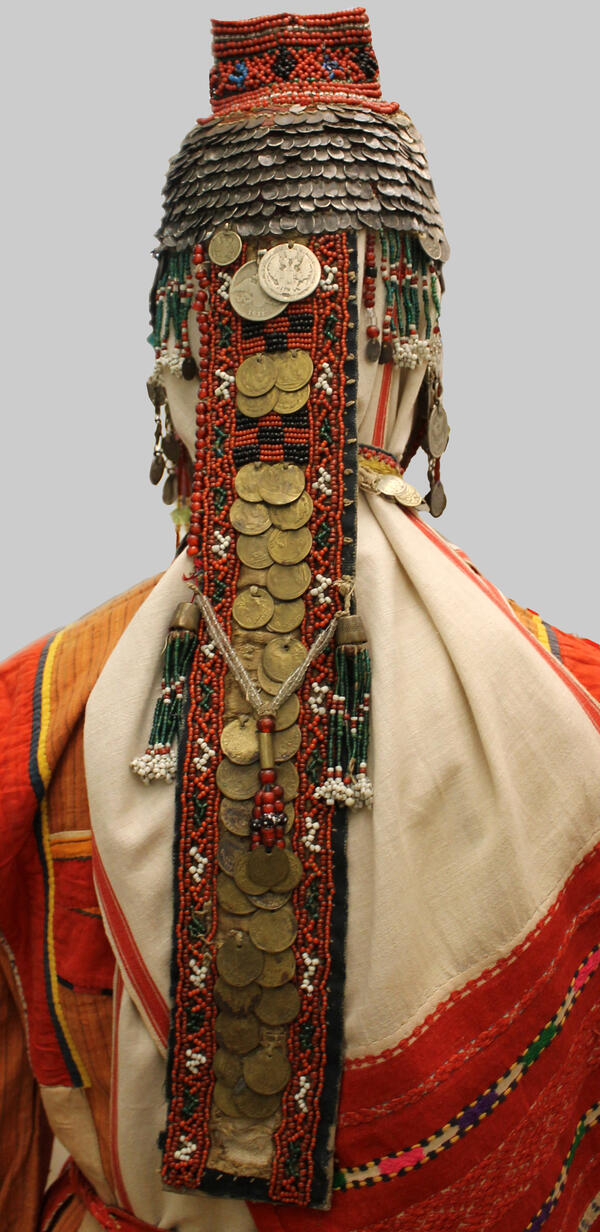
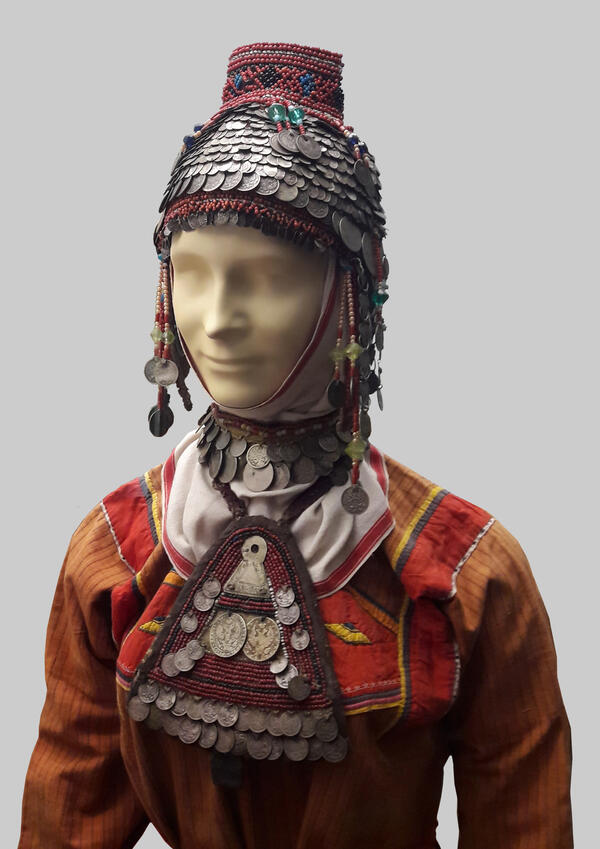
Hushpu–a Chuvash headdress for married women that has a solid, conical or cylindrical frame. The upper edge of the hushpu frame was covered with coral and beads; and below there were silver coins of various denominations, or copper medals and tin plaques were sewn in row, like fish scales. On the back, the headdress had a long tail, which was also decorated with beads, coins, braiding, and copper medals.
In ancient times, the hushpu was a headress that was a must for every married woman, and without it she could not go outside. This was reported by Peter Simon Pallas and all the authors in the 18th and 19th centuries that wrote about the Chuvash, calling it a ‘fushpu’, a ‘kashpal’, a ‘hoshpa’, or a ‘hushpu’. They give very contradictory information about this attire, sometimes describing it as a helmet, or a ‘cap’ without a crown, or saying it has the form of a truncated cone.
The hushpu for married women had different shapes, but almost all of them had an open top, as well as a back part in the form of a straight strip of canvas that descended down to waist level. A hushpu that had a helmet-like shape, with a small hole in its upper part, became widespread among the Pribelsk Chuvash. The frame was made from a dense material, and was covered by rows of beads and coins. The conceptual and decorative center of the headdress was a strip of ornamentation with geometric motifs running along the circumference of the person’s head, along the upper edge of the hushpu. The process of decorating elegant headdresses was done in keeping with the same rules. Coins with holes punched in them were sewn with coarse threads, allowing them to move about. Beads strung on the thread were fastened in dense, horizontal rows, creating a field of color like a background for the main ornamental frieze that run along the circumference of the person’s head.
On older versions, beaded embroidery was the main method used for decoration, and coins played a secondary role, but by the 19th century beaded decoration was of little importance, and was only placed around the edges, ceding to shiny rows of silver. Particular attention was given to how the face was ‘framed’ in a circular manner. Silver coins were hung on the headgear and straps, one above the other, while at the bottom there were large fifty-kopeck and ruble coins. This kind of well-thought-out composition also created a certain harmonious resonance for all the coins. Due to the variety of materials and production techniques, the headpiece appears alive and dynamic. The gentle ringing of silver, and the iridescent movements of light along the beaded rows, impart a special, unique expressiveness to this masterpiece of folk culture.
In ancient times, the hushpu was a headress that was a must for every married woman, and without it she could not go outside. This was reported by Peter Simon Pallas and all the authors in the 18th and 19th centuries that wrote about the Chuvash, calling it a ‘fushpu’, a ‘kashpal’, a ‘hoshpa’, or a ‘hushpu’. They give very contradictory information about this attire, sometimes describing it as a helmet, or a ‘cap’ without a crown, or saying it has the form of a truncated cone.
The hushpu for married women had different shapes, but almost all of them had an open top, as well as a back part in the form of a straight strip of canvas that descended down to waist level. A hushpu that had a helmet-like shape, with a small hole in its upper part, became widespread among the Pribelsk Chuvash. The frame was made from a dense material, and was covered by rows of beads and coins. The conceptual and decorative center of the headdress was a strip of ornamentation with geometric motifs running along the circumference of the person’s head, along the upper edge of the hushpu. The process of decorating elegant headdresses was done in keeping with the same rules. Coins with holes punched in them were sewn with coarse threads, allowing them to move about. Beads strung on the thread were fastened in dense, horizontal rows, creating a field of color like a background for the main ornamental frieze that run along the circumference of the person’s head.
On older versions, beaded embroidery was the main method used for decoration, and coins played a secondary role, but by the 19th century beaded decoration was of little importance, and was only placed around the edges, ceding to shiny rows of silver. Particular attention was given to how the face was ‘framed’ in a circular manner. Silver coins were hung on the headgear and straps, one above the other, while at the bottom there were large fifty-kopeck and ruble coins. This kind of well-thought-out composition also created a certain harmonious resonance for all the coins. Due to the variety of materials and production techniques, the headpiece appears alive and dynamic. The gentle ringing of silver, and the iridescent movements of light along the beaded rows, impart a special, unique expressiveness to this masterpiece of folk culture.
#5
Full name: Hushpu–a Chuvash headdress for married women
Date: end of 19th century
Technique: hand-sewn with coral, coins, and beads
Dimentions: 19.5 centimeters (height of the cap), 51.5×9 cm (lobe)
Collection: ‘Textiles’, National Museum of the Republic of Bashkortostan
Copyright: National Museum of the Republic of Bashkortostan
Date: end of 19th century
Technique: hand-sewn with coral, coins, and beads
Dimentions: 19.5 centimeters (height of the cap), 51.5×9 cm (lobe)
Collection: ‘Textiles’, National Museum of the Republic of Bashkortostan
Copyright: National Museum of the Republic of Bashkortostan
#7
Surpan–Chuvash women’s long towel-shaped headdress
#8
#9
Surpan is a Chuvash female long towel-like dress made of thin canvas or fabric with ends decorated by woven, embroidered ornaments, trimmed with braid and lace. Surpans were worn by married women, which completely covered the head and neck, with decorated endings lowered onto the back. It was believed that if a woman came out ‘bare-headed’ in the hallway, an evil spirit could grab her by the braids and drag her upstairs. To ‘light up your hair’, that is, to put it out or to go with your head open, is a great shame and sin. It was believed that the exposed hair of a woman brings misfortune and harm. According to custom, the surpan had to be tied early in the morning, even for pasture, otherwise women were considered naked.
Surpan of the lower Chuvashes was a strip of homespun thin linen canvas, of different lengths and decoration in different regions. The headdress could be up to 3 meters long and up to 35 centimeters wide.
The technique of patterned weaving was often used to decorate surpans. Patterns in the form of diamonds or oblique crosses were usually grouped into a clear symmetrical composition against a white or red background. Geometric patterns made by Chuvash girls on ordinary wooden looms amaze with their precision, complexity and harmonious interaction of shapes and colors.
Multicolor patterns were woven with woolen threads over a red background. Craftswomen used up to 14-15 colors and shades of patterned thread — red, yellow, lemon, bright green, grassy green.
If a colorful pattern was performed on a red background, then it was necessarily shaded with black and white.
The surpan was completed with white lace with points (in rare cases, the lace was black) or a fringe of colored threads.
In addition to khushpu, the grassroots Chuvash would wrap their head like a turban with a shorter headband surpan — a surpan tutri with ornamented ends.
Surpan of the lower Chuvashes was a strip of homespun thin linen canvas, of different lengths and decoration in different regions. The headdress could be up to 3 meters long and up to 35 centimeters wide.
In many villages, the canvas for the surpan was woven with a longitudinal red border. At both ends, stripes of red homespun were sewn, where an embroidery or a strip of bright purchased material was added to the ‘brany’ or elective pattern, along which there was also embroidery, made very often with a chain stitch (in the form of a ‘chain’). The ‘brany’ technique (from the Russian word ‘take’, ‘choose’) consists in the use of a second weft (a system of threads running across the fabric), most often colored; the pattern went along the entire width of the canvas and turned out to be convex, and from the inside it had a negative reflection.
The elective technique is a type of complex weave in which the patterned weft was not laid from edge to edge of the canvas, but in separate sections, often of different colors. The elements of the pattern in the fabrics of the elective technique were located more freely, leaving a large space of the linen background, which was never the case in ‘brany’ weaving.
The technique of patterned weaving was often used to decorate surpans. Patterns in the form of diamonds or oblique crosses were usually grouped into a clear symmetrical composition against a white or red background. Geometric patterns made by Chuvash girls on ordinary wooden looms amaze with their precision, complexity and harmonious interaction of shapes and colors.
Multicolor patterns were woven with woolen threads over a red background. Craftswomen used up to 14-15 colors and shades of patterned thread — red, yellow, lemon, bright green, grassy green.
If a colorful pattern was performed on a red background, then it was necessarily shaded with black and white.
The surpan was completed with white lace with points (in rare cases, the lace was black) or a fringe of colored threads.
In addition to khushpu, the grassroots Chuvash would wrap their head like a turban with a shorter headband surpan — a surpan tutri with ornamented ends.
#10
Full name: Surpan–Chuvash women’s long towel-shaped headdress
Date: early 20th century
Technique: “Brany” weaving, elective weaving, applique
Dimentions: 310×36 cm
Collection: “Textiles”, National Museum of the Republic of Bashkortostan
Copyright: Republic of Bashkortostan National Museum
Date: early 20th century
Technique: “Brany” weaving, elective weaving, applique
Dimentions: 310×36 cm
Collection: “Textiles”, National Museum of the Republic of Bashkortostan
Copyright: Republic of Bashkortostan National Museum
State catalog number: 20419016
read morehide
00:00
00:00
1x
Hushpu, Surpan
1
 Point your smartphone camera to open in the app
Open in app
Share