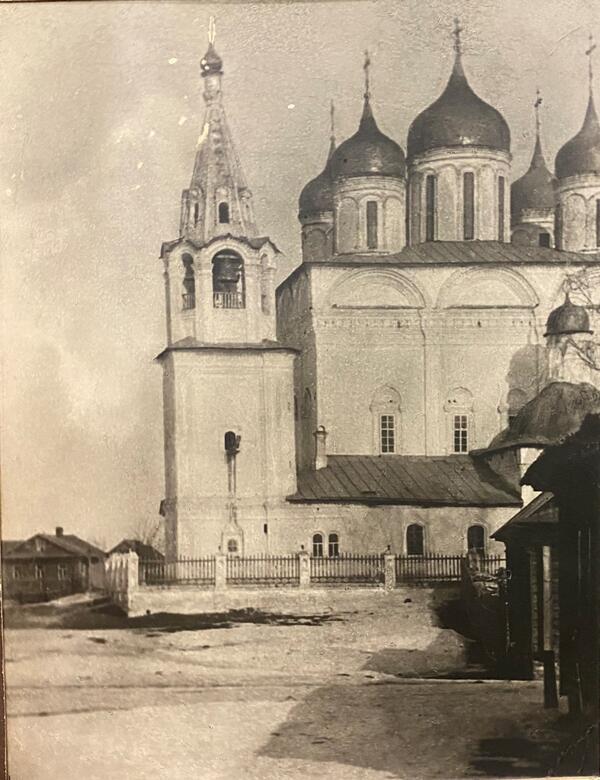
The Nativity Church of Balakhna was erected as a main church of the Nativity Convent.
The convent was founded in the 16th century and received from Tsar Ivan IV the Terrible two royal charters and a “Tarkhannaya charter” (a letter granting the convent a tax-free status and immunity from prosecutions). Subsequently, they were confirmed by Vasily Shuysky (1606) and the Romanov tsars: Michael I (1613), Alexis (1646), Fyodor III (1677), Ivan V and Peter the Great (1685).
Until the early 17th century, all convent’s buildings were wooden. In 1610, they were destroyed in a fire during an attack on Balakhna by a Polish-Lithuanian detachment.
A new wooden church with a tented roof in honor of the Nativity of Christ was built in 1618 as a chapel and was first mentioned in a land registry two years later. The priest Alexey Spisok is named as its builder.
Half a century later, in 1674–1676, a stone church of the same name, not yet consecrated, was noted in a scribe’s book. The church was patronized by Protopope Kondrat Ilyin.
The impressive structure included the Nativity Church, which was not heated, with the chapels of the Presentation of the Vladimir Icon of the Mother of God in the southern part and St. Antipas of Pergamum in the northern part, as well as a cloister (an open gallery) and a bell tower attached to the southwest corner.
In 1680, the icons for the lowest row of the central iconostasis were created, and at the same time the church was consecrated.
It was a cube-shaped building with four piers; its five domes were covered with green ceramic roof tiles. It was built of brick and covered with lime grout. This church is the only 17th–century monument of this kind in the Balakhninsky district.
The composition and décor of the side churches were similar: the corners of the quadrangles were decorated with pilaster strips; the domes were installed on round drums with blind arcades; the helmet-like domes were covered with iron sheets.
The belt between the first and second tiers of the bell tower corresponded to the height of the walls of the church, which emphasized the shared cornice. An internal staircase was used to enter the upper tiers.
The convent was abolished in 1764, and in 1937 the same fate befell the church, which until then remained a parish. The restoration of the church began in 1989, and services resumed.
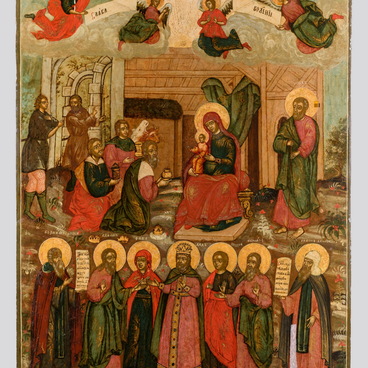
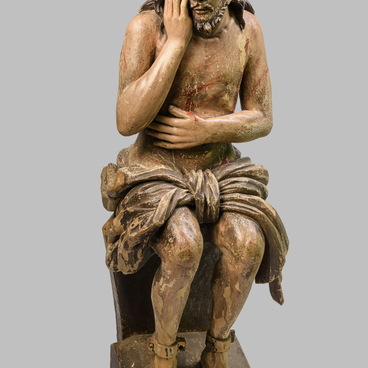
Collections of icons from the Nativity Church are kept in the Balakhna Museum Complex of History and Art, the Nizhny Novgorod Art Museum and the Central Andrei Rublev Museum of Ancient Russian Culture and Art.
The convent was founded in the 16th century and received from Tsar Ivan IV the Terrible two royal charters and a “Tarkhannaya charter” (a letter granting the convent a tax-free status and immunity from prosecutions). Subsequently, they were confirmed by Vasily Shuysky (1606) and the Romanov tsars: Michael I (1613), Alexis (1646), Fyodor III (1677), Ivan V and Peter the Great (1685).
Until the early 17th century, all convent’s buildings were wooden. In 1610, they were destroyed in a fire during an attack on Balakhna by a Polish-Lithuanian detachment.
A new wooden church with a tented roof in honor of the Nativity of Christ was built in 1618 as a chapel and was first mentioned in a land registry two years later. The priest Alexey Spisok is named as its builder.
Half a century later, in 1674–1676, a stone church of the same name, not yet consecrated, was noted in a scribe’s book. The church was patronized by Protopope Kondrat Ilyin.
The impressive structure included the Nativity Church, which was not heated, with the chapels of the Presentation of the Vladimir Icon of the Mother of God in the southern part and St. Antipas of Pergamum in the northern part, as well as a cloister (an open gallery) and a bell tower attached to the southwest corner.
In 1680, the icons for the lowest row of the central iconostasis were created, and at the same time the church was consecrated.
It was a cube-shaped building with four piers; its five domes were covered with green ceramic roof tiles. It was built of brick and covered with lime grout. This church is the only 17th–century monument of this kind in the Balakhninsky district.
The composition and décor of the side churches were similar: the corners of the quadrangles were decorated with pilaster strips; the domes were installed on round drums with blind arcades; the helmet-like domes were covered with iron sheets.
The belt between the first and second tiers of the bell tower corresponded to the height of the walls of the church, which emphasized the shared cornice. An internal staircase was used to enter the upper tiers.
The convent was abolished in 1764, and in 1937 the same fate befell the church, which until then remained a parish. The restoration of the church began in 1989, and services resumed.
Collections of icons from the Nativity Church are kept in the Balakhna Museum Complex of History and Art, the Nizhny Novgorod Art Museum and the Central Andrei Rublev Museum of Ancient Russian Culture and Art.