


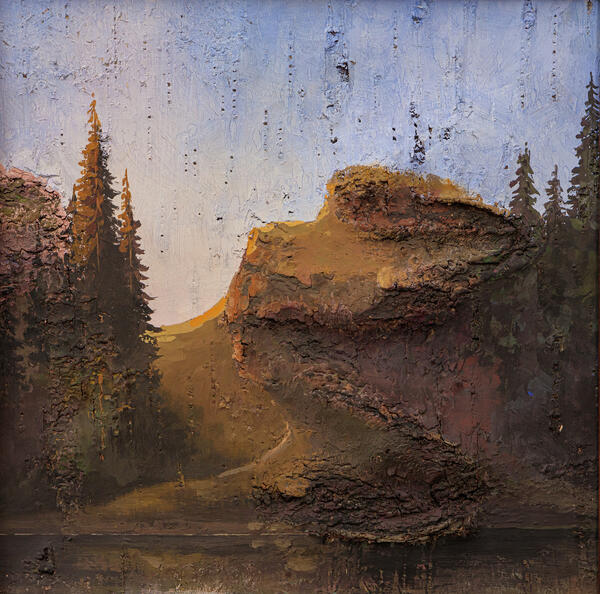
The artist Nikolay Eregin created the painting ‘Hills, Spruces’ on an unusual surface — birch bark. He turned the natural bumps on the birch bark into details of the image. That is how a long curved outgrowth became a hillside and gave the work its volume.
Painting on birch bark has been known in Russia since the 15th century. Most often, it was used to decorate various household utensils: bast baskets, caskets, boxes. The basic color scale consisted of red, yellow, green, blue shades, and the main elements of the pattern were foliage motifs. Sometimes painting was combined with carving or embossing. Paintings on birch bark appeared much later, in the 20th century.
To prepare birch bark for work, the upper white layer is removed from it. Thin yellowish layers underneath are left, only the rough lumps are removed. Then the birch bark sheets are pressed and left to dry for 2 to 3 weeks. If the birch bark becomes to dry and breakable, it is treated with water and dried anew. Such sheets of birch bark should be protected from moisture so that they do not go moldy and from direct sunlight, so they do not fade.
Before painting, birch bark is primed with a mixture of chalk and glue. It is applied with a small spatula, and smoothed especially carefully where there are cracks or bumps on the bark. The primer dries for 6 to 8 hours and then it is finished with a fine emery cloth, after which the paint can be applied. The best materials for such painting are tempera paints based on dry mineral pigments, ink or gouache. The final work is coated with oil varnish to protect the image.
The artist Nikolay Eregin, who created the painting ‘Hills, Spruces’ lives in the village of Uyemsky, Primorsky District, Arkhangelsk region — the same place where the Primorye Arts and Crafts Museum is located. The artist has mastered many folk crafts, except for creating artworks out of metal. But the main material in his work is birch bark. Eregin weaves various items from it and paints pictures on it, mostly landscapes of his native Arkhangelsk region. Now his works are in private collections in 27 countries.
Painting on birch bark has been known in Russia since the 15th century. Most often, it was used to decorate various household utensils: bast baskets, caskets, boxes. The basic color scale consisted of red, yellow, green, blue shades, and the main elements of the pattern were foliage motifs. Sometimes painting was combined with carving or embossing. Paintings on birch bark appeared much later, in the 20th century.
To prepare birch bark for work, the upper white layer is removed from it. Thin yellowish layers underneath are left, only the rough lumps are removed. Then the birch bark sheets are pressed and left to dry for 2 to 3 weeks. If the birch bark becomes to dry and breakable, it is treated with water and dried anew. Such sheets of birch bark should be protected from moisture so that they do not go moldy and from direct sunlight, so they do not fade.
Before painting, birch bark is primed with a mixture of chalk and glue. It is applied with a small spatula, and smoothed especially carefully where there are cracks or bumps on the bark. The primer dries for 6 to 8 hours and then it is finished with a fine emery cloth, after which the paint can be applied. The best materials for such painting are tempera paints based on dry mineral pigments, ink or gouache. The final work is coated with oil varnish to protect the image.
The artist Nikolay Eregin, who created the painting ‘Hills, Spruces’ lives in the village of Uyemsky, Primorsky District, Arkhangelsk region — the same place where the Primorye Arts and Crafts Museum is located. The artist has mastered many folk crafts, except for creating artworks out of metal. But the main material in his work is birch bark. Eregin weaves various items from it and paints pictures on it, mostly landscapes of his native Arkhangelsk region. Now his works are in private collections in 27 countries.



