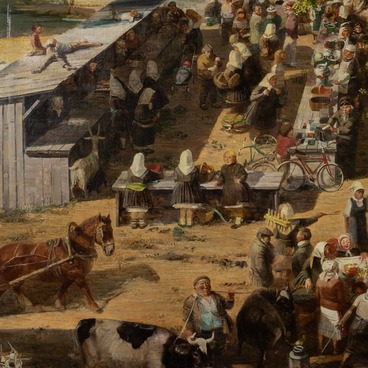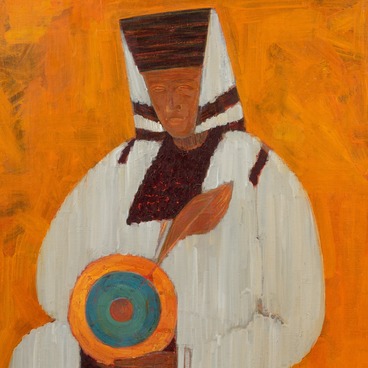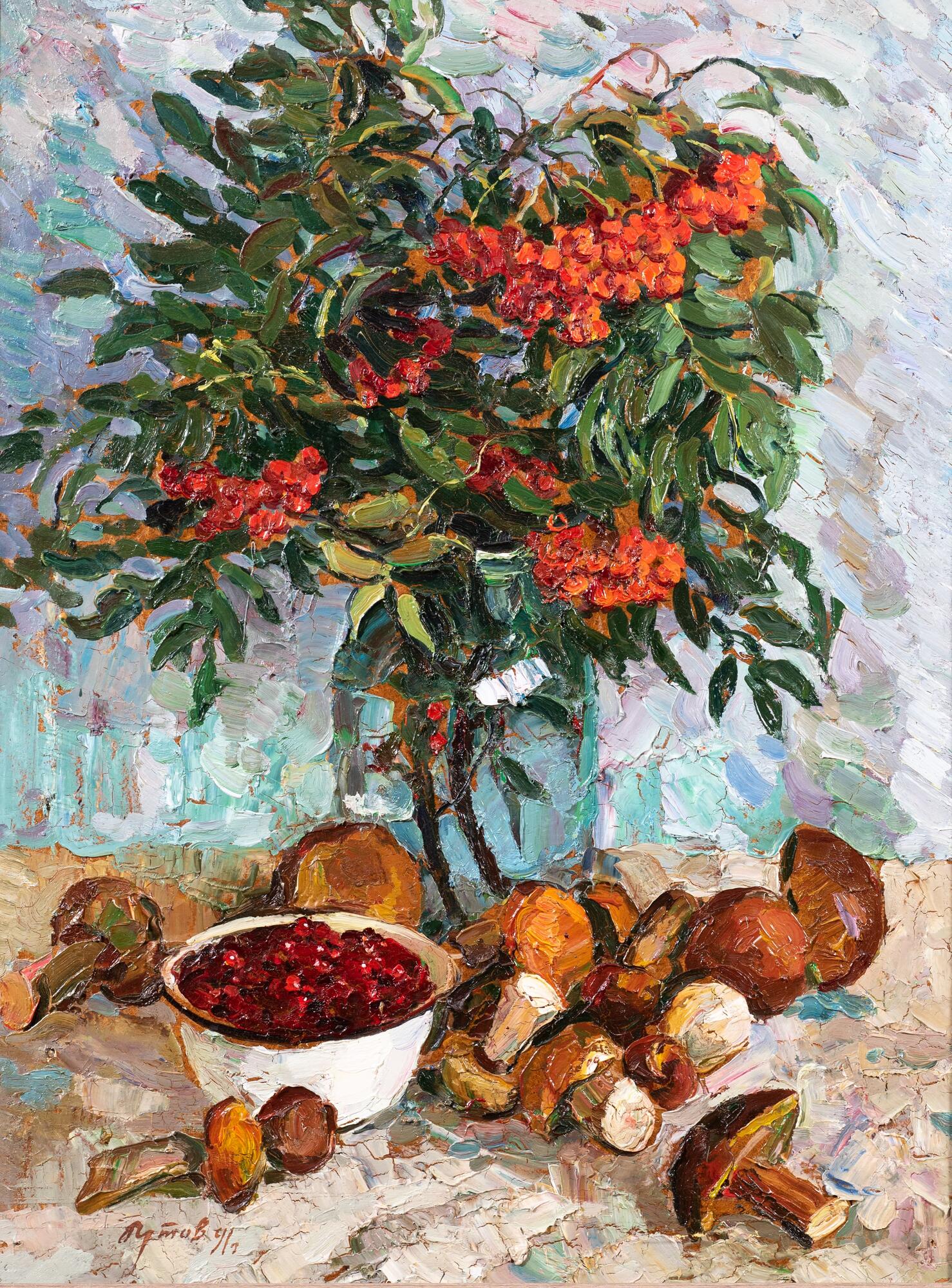


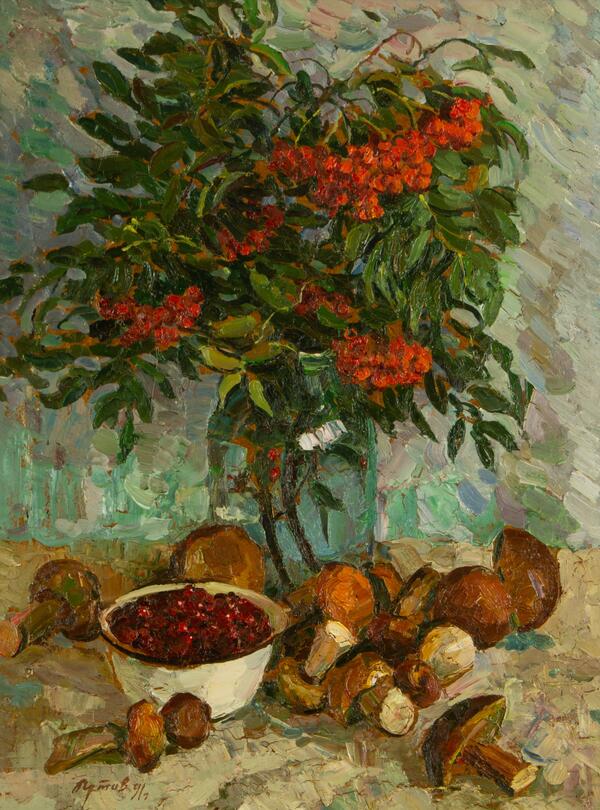
The presented canvas was painted by Alexey Butov. He was born in Oryol Oblast. In 1957, he graduated from the Yelets Art College, studied under V.A. Dudchenko, V.S. Sorokin, N.N. Marevsky, A.M. Korr. In 1958, he came to Yoshkar-Ola, where he quickly joined the creative life of Mari artists. At the beginning of his career, the artist was engaged in design and illustration of books printed by the Mari Publishing House.
Alexey Butov stood at the origins of the Artists’ Union of Mari ASSR, was the chairman of its youth committee and a member of the exhibition committee of the project “The Big Volga”. He received the prize of the Artists’ Union of the USSR and the Central Committee of the Komsomol (1962). He became a member of the Artists’ Union in 1964. He participated in regional, interrepublican, republican and All-Union exhibitions. Alexey Butov’s works are exhibited in the museums of Samara, Saransk, Yoshkar-Ola, and Kozmodemyansk, and kept in private collections in Russia and abroad. The work “The Mari Woman at the Well” is housed in the Prado Museum in Madrid. His solo exhibitions were held in 1976 and 1986 in Yoshkar-Ola.
Alexey Butov created oil paintings in various genres. He predominantly created themed paintings and portraits. In addition, he made a tangible contribution and introduced an original worldview to the landscape genre. Alexey Butov was called a born painter who worked equally successfully in any genre. He created his paintings using large brush strokes, after each stroke he carefully wiped the brush and prepared a new mix of colors. This allowed him to avoid greyness, to make a cleaner and more saturated image, to give the canvas a rich colorful harmony. Every stroke in the artist’s paintings is enlivened, the colors burn and shimmer with juicy contrasts, the necessary psychological atmosphere and air environment are conveyed through color. Coloristic richness stems from the artist’s great vision, from his spiritual wealth and generous soul. He loved all kinds of combinations of emerald greens: they brought sophistication and softness to the canvases, coalesced other colors and carried the entire color palette.
Alexey Ivanovich distinguished himself in creating expressive pencil portrait. Sharing his experience with young people, the artist advised “to observe life more, to paint life”. He was convinced that neither the brightest imagination, nor photography, to which artists now resort, can replace life impressions and work en plein air.
Alexey Butov stood at the origins of the Artists’ Union of Mari ASSR, was the chairman of its youth committee and a member of the exhibition committee of the project “The Big Volga”. He received the prize of the Artists’ Union of the USSR and the Central Committee of the Komsomol (1962). He became a member of the Artists’ Union in 1964. He participated in regional, interrepublican, republican and All-Union exhibitions. Alexey Butov’s works are exhibited in the museums of Samara, Saransk, Yoshkar-Ola, and Kozmodemyansk, and kept in private collections in Russia and abroad. The work “The Mari Woman at the Well” is housed in the Prado Museum in Madrid. His solo exhibitions were held in 1976 and 1986 in Yoshkar-Ola.
Alexey Butov created oil paintings in various genres. He predominantly created themed paintings and portraits. In addition, he made a tangible contribution and introduced an original worldview to the landscape genre. Alexey Butov was called a born painter who worked equally successfully in any genre. He created his paintings using large brush strokes, after each stroke he carefully wiped the brush and prepared a new mix of colors. This allowed him to avoid greyness, to make a cleaner and more saturated image, to give the canvas a rich colorful harmony. Every stroke in the artist’s paintings is enlivened, the colors burn and shimmer with juicy contrasts, the necessary psychological atmosphere and air environment are conveyed through color. Coloristic richness stems from the artist’s great vision, from his spiritual wealth and generous soul. He loved all kinds of combinations of emerald greens: they brought sophistication and softness to the canvases, coalesced other colors and carried the entire color palette.
Alexey Ivanovich distinguished himself in creating expressive pencil portrait. Sharing his experience with young people, the artist advised “to observe life more, to paint life”. He was convinced that neither the brightest imagination, nor photography, to which artists now resort, can replace life impressions and work en plein air.