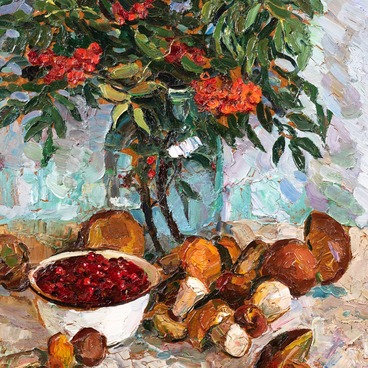
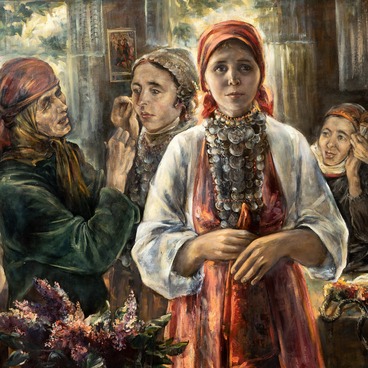
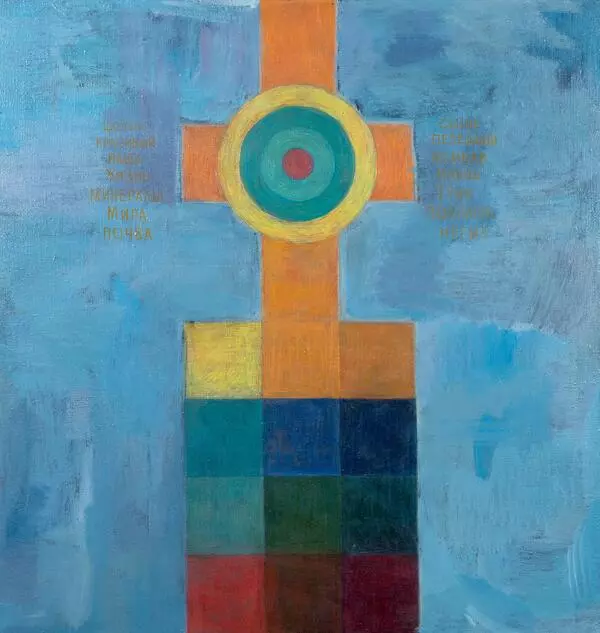
Valery Bogolyubov, an Honored Artist of the Mari El Republic and member of the Artists’ Union of Russia, was one of the brightest representatives of contemporary Mari painting. A unique and original personality, he graduated from the Institute of Painting, Sculpture and Architecture named after Ilya Repin and began his career as a realist artist. Since the 1990s, the artist was actively developing his own philosophical and artistic concept, striving to express his emotions, feelings and thoughts through symbols. Bogolyubov’s symbolism includes Finno-Ugric folklore, the fusion of graphic arts and painting, and his personal spiritual experience.
Valery Bogolyubov combined his work as an artist with teaching at the Mari Republican Art School. He worked in thematic printmaking, watercolor, easel painting, in the style of national symbolism close to ethnofuturism, and developed his own system of color symbolism. He expressed his poetic nature both through fine art and literature. The artist was a regular participant of republican, All-Russian and international Finno-Ugric exhibitions.
The main aspect in Valery Bogolyubov’s work is the search for the meaning of life. With his works, the painter speaks about the senselessness of the pursuit of imposed material goods, which are vain and turn to dust. The artist reminds the viewer of eternal values: loving one’s neighbor, help and compassion, love for one’s native land, selflessness, integrity, and purity of conscience.
“The Embroideress” is a generalized image of a woman in national Mari clothing. The artist gives this everyday episode a sacred meaning. The woman in traditional national clothes embroiders a celestial and terrestrial sphere (a set of squares turned into a circle), and the human connection with the Universe is upheld by a thin thread. The image of the embroideress is the feminine principle of the World, her pose vaguely resembles the pose of the Mother of God, who holds on her knees the sphere of life itself, instead of Christ Child. Here, the main techniques of the artist’s approach to the ethnic prototype are the generalization and simplification of the depicted forms of reality. Figures are barely sculpted and flattened, chiaroscuro practically disappears, and planes of color are generalized to the maximum.
Valery Bogolyubov combined his work as an artist with teaching at the Mari Republican Art School. He worked in thematic printmaking, watercolor, easel painting, in the style of national symbolism close to ethnofuturism, and developed his own system of color symbolism. He expressed his poetic nature both through fine art and literature. The artist was a regular participant of republican, All-Russian and international Finno-Ugric exhibitions.
The main aspect in Valery Bogolyubov’s work is the search for the meaning of life. With his works, the painter speaks about the senselessness of the pursuit of imposed material goods, which are vain and turn to dust. The artist reminds the viewer of eternal values: loving one’s neighbor, help and compassion, love for one’s native land, selflessness, integrity, and purity of conscience.
“The Embroideress” is a generalized image of a woman in national Mari clothing. The artist gives this everyday episode a sacred meaning. The woman in traditional national clothes embroiders a celestial and terrestrial sphere (a set of squares turned into a circle), and the human connection with the Universe is upheld by a thin thread. The image of the embroideress is the feminine principle of the World, her pose vaguely resembles the pose of the Mother of God, who holds on her knees the sphere of life itself, instead of Christ Child. Here, the main techniques of the artist’s approach to the ethnic prototype are the generalization and simplification of the depicted forms of reality. Figures are barely sculpted and flattened, chiaroscuro practically disappears, and planes of color are generalized to the maximum.