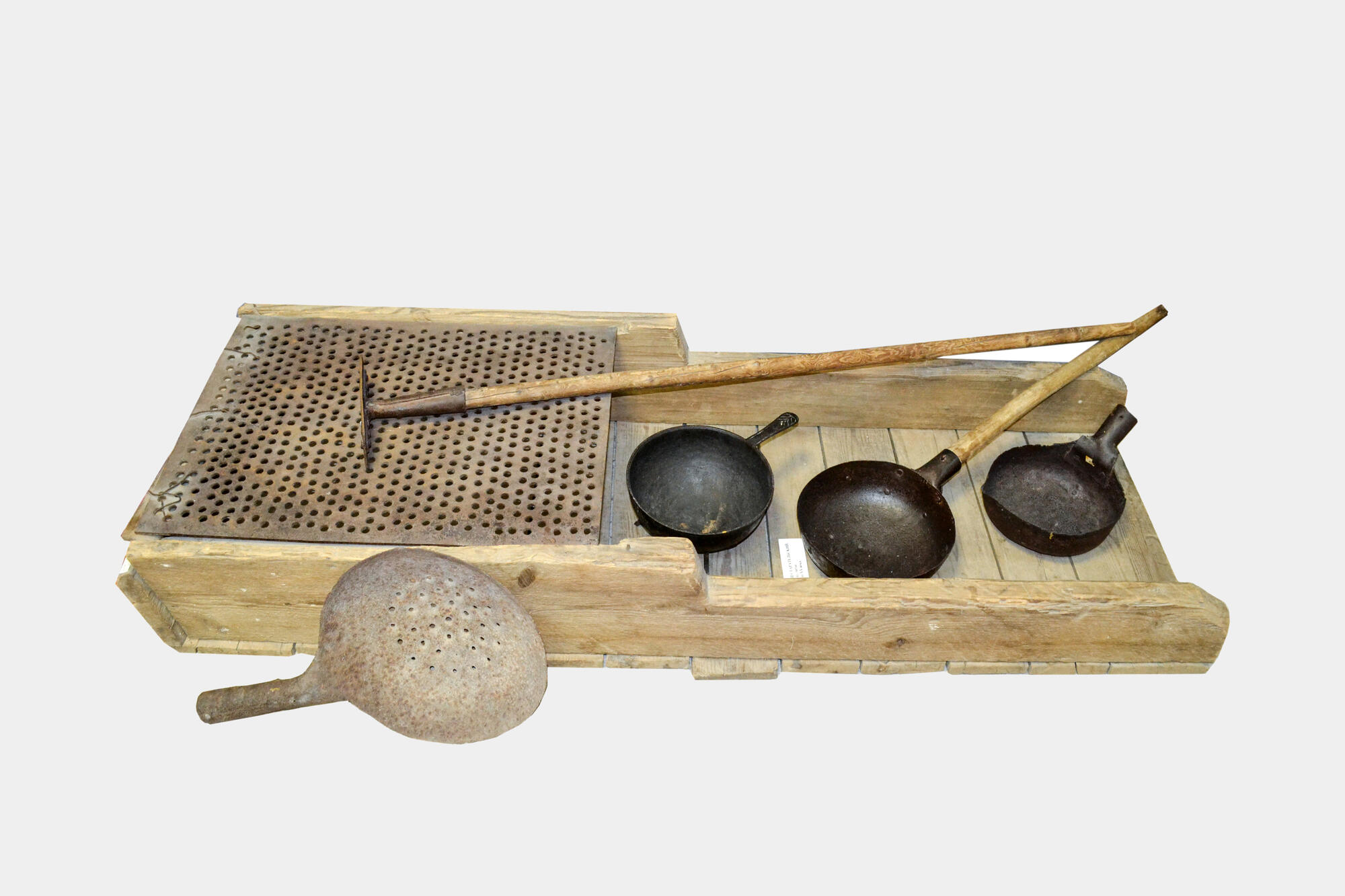


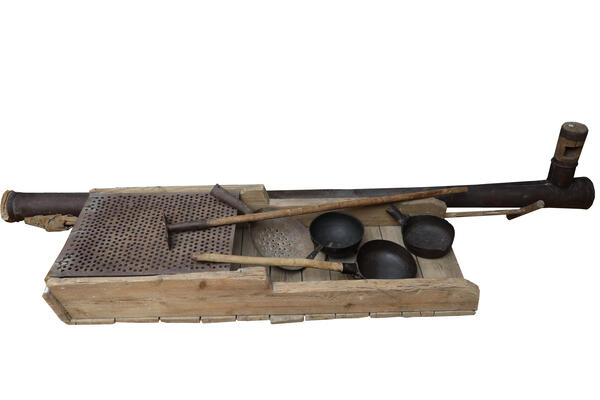
A rocker box (also known as a cradle) is a wooden tray with a metal sieve, which is used for separating sand and gravel from gold. The exhibit from the Verkhnyaya Pyshma Museum was used by gold miners at the beginning of the 20th century in the village of Mostovskoye.
Researchers identify two types of gold deposits: primary and secondary. Primary deposits of precious metal appeared under the influence of magma. Most often, they are found underground, where gold is deposited in large layers.
Secondary deposits are alluvial gold, which broke away from the layers, got into underground waters, and from there into the nearest rivers and streams. Such gold was found in the territory of the modern urban district of Verkhnyaya Pyshma in 1822. It was found in the sand on the banks of the Mostovka and Aduy rivers.
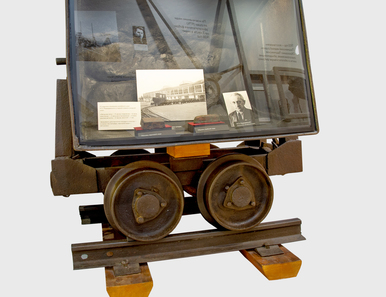
The locals soon realized that gold could be found in the valleys of virtually every nearby river, stream, and even dry valleys. Then, in the late 1820s — early 1830s, a gold rush began in the area. Near the rivers Mostovka, Mostovaya, Aduy, Pyshma and Iset, dozens of gold mines arose — enterprises where river sand was washed manually in order to find the precious metal.
The rocker box was used in the following way: several kilograms of river sand were put on a metal grate and rubbed with a special paddle under a constant pouring of water. If there was clay, it was kneaded. The resulting black mass was then beaten off with a coarse dense brush to extract gold. Using the cradle was considered an efficient method: workers found up to 96–98% of the gold deposited in the sand.
However, people were unable to find any primary gold deposits in the area for quite a long time. They were discovered and developed only dozens of years later: in 1879, the Ural Blagodatnaya Company began mining the precious metal in the north of the modern urban district of Verkhnyaya Pyshma, near the village of Verkhoturka.
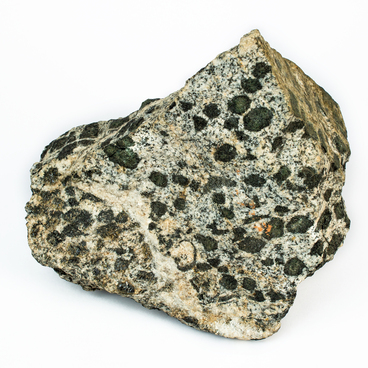
The miners looked for gold in the Mostovka and Mostovaya rivers, where they discovered a new type of rock. The white-yellow mineral was named ‘mostovit’ in Russian after the rivers where it had been found. Later, chemical analysis proved that it also contained gold particles.
Researchers identify two types of gold deposits: primary and secondary. Primary deposits of precious metal appeared under the influence of magma. Most often, they are found underground, where gold is deposited in large layers.
Secondary deposits are alluvial gold, which broke away from the layers, got into underground waters, and from there into the nearest rivers and streams. Such gold was found in the territory of the modern urban district of Verkhnyaya Pyshma in 1822. It was found in the sand on the banks of the Mostovka and Aduy rivers.
The locals soon realized that gold could be found in the valleys of virtually every nearby river, stream, and even dry valleys. Then, in the late 1820s — early 1830s, a gold rush began in the area. Near the rivers Mostovka, Mostovaya, Aduy, Pyshma and Iset, dozens of gold mines arose — enterprises where river sand was washed manually in order to find the precious metal.
The rocker box was used in the following way: several kilograms of river sand were put on a metal grate and rubbed with a special paddle under a constant pouring of water. If there was clay, it was kneaded. The resulting black mass was then beaten off with a coarse dense brush to extract gold. Using the cradle was considered an efficient method: workers found up to 96–98% of the gold deposited in the sand.
However, people were unable to find any primary gold deposits in the area for quite a long time. They were discovered and developed only dozens of years later: in 1879, the Ural Blagodatnaya Company began mining the precious metal in the north of the modern urban district of Verkhnyaya Pyshma, near the village of Verkhoturka.
The miners looked for gold in the Mostovka and Mostovaya rivers, where they discovered a new type of rock. The white-yellow mineral was named ‘mostovit’ in Russian after the rivers where it had been found. Later, chemical analysis proved that it also contained gold particles.