Paektu Mountain, Oxman
Creation period
1989
Place of сreation
DPRK (North Korea)
Dimensions
53х42 cm, 70х39 cm
Collection
Exhibition
0
Open in app#5
Paektu Mountain, Oxman
#6
#1
Paektu Mountain
#2
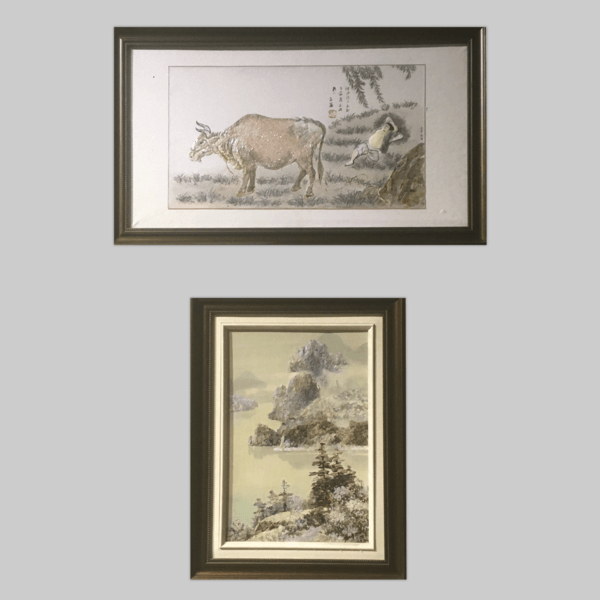
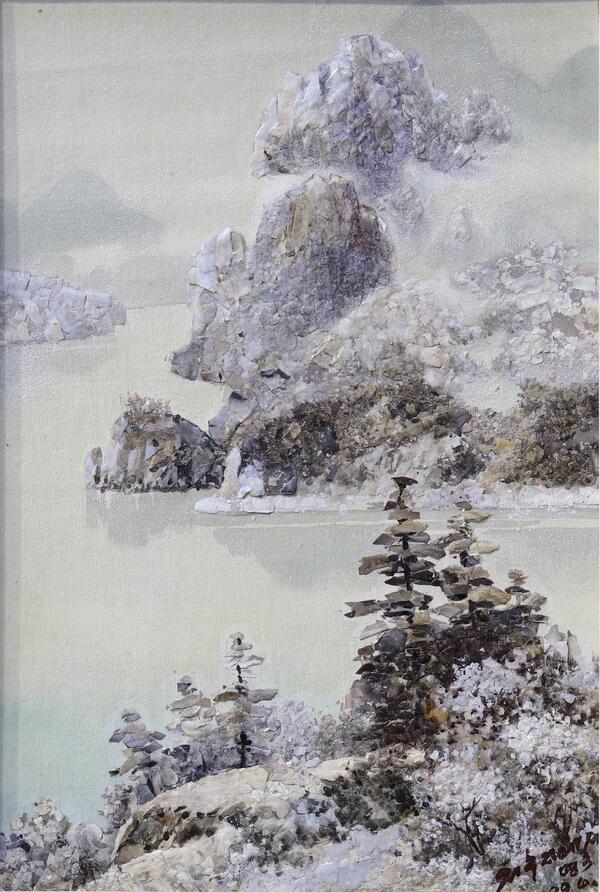
A landscape is depicted on a gray background using applique technique. In the foreground is a small snow-covered hill with shrubs and trees. Behind it is a winding mountain river, to the right and left of which there are rocks, hills with dark reflections in still water. A gray sky is in the background. The panel is framed with a dark brown wooden frame.
Mother-of-pearl paintings are a type of applied art which roots go far back in time. When making such paintings, the inlay method was used. It attracted attention not only due to the brilliance of the image, but also draw the eye with its style.
Such paintings were created by the masters of Asian countries located next to the ocean or rivers. A large amount of mother-of-pearl contributed to the development of folk craft, craftsmen honed their skills for years and came up with new ways of depicting. A rich color range, a special technique of cutting mother-of-pearl, incredible scrupulousness in the selection of shells and jewelry work — all this made it possible to create real works of art of rare beauty. By combining yellow, pink, red, blue and lilac mother-of-pearl, the artists created works that had no equal.
Mother-of-pearl is the inner layer of the shells. This is a German name that comes from two words: perl — pearl and mutter — mother. A substance of extraordinary beauty accumulates inside the shells of certain types of mollusks. Mother-of-pearl is classified as a semi-precious stone, but jewelers value it quite highly. Since ancient times, it has been used to decorate furniture and interior items, caskets and fans have been inlaid with it.
The Korean inlay technique used for mother-of-pearl decoration is divided into two types: jureumjil (filling) and kkeuneumjil (cutting). Usually, the first type is used when creating plots where floral patterns and birds appear. At the beginning of the 20th century, a band saw appeared, which made it possible to make decor even smaller in thickness.
The second method is much older and appeared during the Goryeo dynasty. When working, craftsmen use sharp metal tools. With their help, thin strips of ‘sangsa’ are cut. When a sufficient amount has been obtained from the blanks, the master begins to lay them out on the surface of the canvas, thereby forming a figure or image. Koreans compare this process to silk embroidery, since the master needs to be as concentrated as possible.
The ‘Paektu Mountain’ panel was purchased by the Amur Regional Museum of Local Lore in 1989 from Park Zon Sen, a representative of the trading company ‘Vneshtorg Rynrada’.
#7
Oxman
#3
Oxman
#4
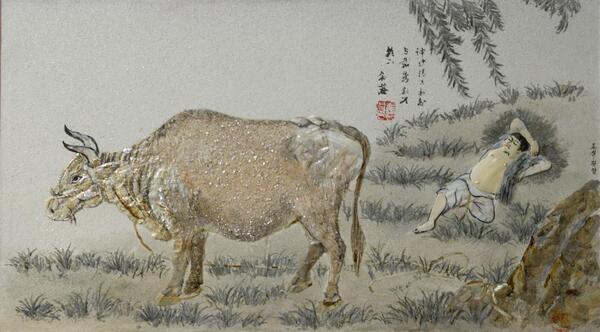
The painting is an application on a plot, copying the work of the Korean painter of the 18th century Kim Du Ryan, who did a lot to convey the village life in a realistic manner. His painting ‘Oxman’, depicting the real life of a peasant, is characterized by simplicity and clarity, concise and clear way of depicting. This artist belonged to the style of Korean ‘realistic landscape’, which was experiencing the heyday of everyday life genre.
The applique depicts an ox grazing in a clearing and a shepherd stretched out on the grass, sleeping with his leg tucked in and his hand over his head. He is dressed in light knee-length short pants and a vest unbuttoned at his chest. The day is, apparently, summer and hot, the sun got the shepherd drowsy. The ox stands motionless, its side shimmers with dots glowing in the sun. At the top, closer to the center, are the hieroglyphs and the artist’s red seal. The picture is inserted into a white passe-partout in a frame, on the reverse side it is sealed with paper.
The applique is made using the “najon chilgi” technique. This is the traditional Korean art of mother-of-pearl and varnish decoration. Mother-of-pearl it is the inner layer of shells of various mollusks, its color resembles gentle iridescent tints of different shades. Pearls are formed only in those shells whose mollusks can secrete mother-of-pearl.
This material has miraculously passed through the centuries from antiquity to the present day. In the early Christian catacombs, archaeologists discovered many mother-of-pearl amulets that warded off the spell of evil forces from a person, attracting patron spirits to him. Processing of mother-of-pearl came to Europe after the Crusades. Artisans began to make bowls and cups framed with gold and silver, jewelry, buttons, cufflinks, and purses from it.
First, the master carefully prepared the material for inlay, then cut the mother-of-pearl into plates and, using special tools, gave them different shapes. In the next step, he applied them to flat material or specially prepared recesses and covered them with a thick layer of varnish. In ancient times in the East the shell was immersed in tea to enhance the iridescence.
Currently, Korean museums exhibit luxurious inlaid objects from different eras. Products made of papier-mâché and wood, decorated with mother-of-pearl figurines, are sold in shops and small trades. Everyone can choose a piece of furniture, a jewelry box, chopsticks and other souvenirs.
The work was purchased at the exhibition “Decorative and Applied Arts of the DPRK”, held in the Amur Regional Museum of Local Lore in April 1990.
#8
Ministry of Culture of the Russian Federation
read morehide
00:00
00:00
1x
Paektu Mountain, Oxman
Creation period
1989
Place of сreation
DPRK (North Korea)
Dimensions
53х42 cm, 70х39 cm
Collection
Exhibition
0
 Point your smartphone camera to open in the app
Open in app
Share