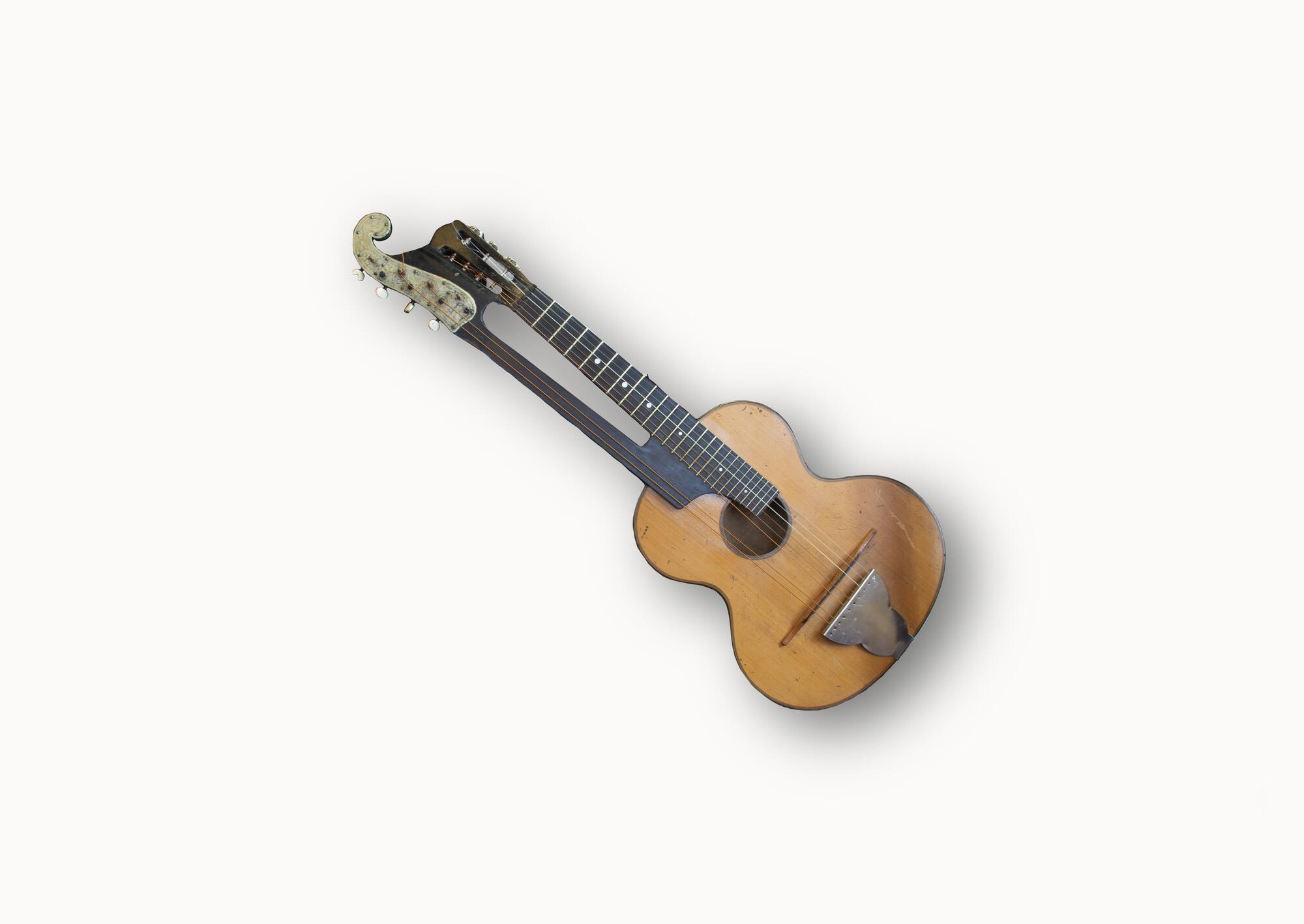


The contraguitar from the museum’s collection was manufactured by Gebrüder Schuster under the trademark Cid. It belonged to Alexey Maksimovich Afromeev, a well-known Tyumen publisher and public figure. Alexey had a great interest in music: he learned to play the guitar from the famous musician Sergey Sirtsov. Since the late 1890s, he published the only music magazines in the Russian Empire: “Correspondence Lessons in Playing the Seven-String Guitar” (1898–1917), the monthly magazine “The Guitarist” (1906–1910, together with Lyudmila Vysotskaya), the magazine “Chord: The Bulletin of the Guitar and Other Folk Instruments” (1911–1918) and others.
The Gebrüder Schuster company was founded in Germany, in the town of Markneukirchen, in 1854 by the hereditary instrument dealer Heinrich Voldemar Schuster. Later the brothers Martin and Albert Schuster became the owners. Hence the name — the “Shuster Brothers”. In addition to the production of stringed and plucked instruments, they sold all other kinds of musical instruments.
Double-neck acoustic guitars, or contraguitars, are unusual in their design, but they are widely known among musicologists. Contraguitars or, as they are also called, Schrammel guitars, are a special design of an acoustic guitar with additional bass strings. The contraguitar is heard mainly in Viennese music (Schrammelmusik, named after the brothers Johann and Josef Schrammel) as well as Alpine folk music. In addition to the usual guitar neck and fretboard, the countraguitar usually has a second neck, which has from 3 to 11 loose bass strings (horn or double bass strings). A typical contraguitar would have 7 or 9 additional strings, that is, 13 or 15 strings in total. When playing the bass guitar strings, the musician does not fret the notes, but rather plucks strings individually. Thus, the neck with the bass strings is fretless. The bass strings resonate as passively as the sympathetic strings, thus providing a fuller sound.
There are two subtypes of contraguitars: the first is German, characterized by an even number of strings, the second is Austrian, which typically has an odd number of strings. This guitar belongs to the Austrian type.
The Gebrüder Schuster company was founded in Germany, in the town of Markneukirchen, in 1854 by the hereditary instrument dealer Heinrich Voldemar Schuster. Later the brothers Martin and Albert Schuster became the owners. Hence the name — the “Shuster Brothers”. In addition to the production of stringed and plucked instruments, they sold all other kinds of musical instruments.
Double-neck acoustic guitars, or contraguitars, are unusual in their design, but they are widely known among musicologists. Contraguitars or, as they are also called, Schrammel guitars, are a special design of an acoustic guitar with additional bass strings. The contraguitar is heard mainly in Viennese music (Schrammelmusik, named after the brothers Johann and Josef Schrammel) as well as Alpine folk music. In addition to the usual guitar neck and fretboard, the countraguitar usually has a second neck, which has from 3 to 11 loose bass strings (horn or double bass strings). A typical contraguitar would have 7 or 9 additional strings, that is, 13 or 15 strings in total. When playing the bass guitar strings, the musician does not fret the notes, but rather plucks strings individually. Thus, the neck with the bass strings is fretless. The bass strings resonate as passively as the sympathetic strings, thus providing a fuller sound.
There are two subtypes of contraguitars: the first is German, characterized by an even number of strings, the second is Austrian, which typically has an odd number of strings. This guitar belongs to the Austrian type.