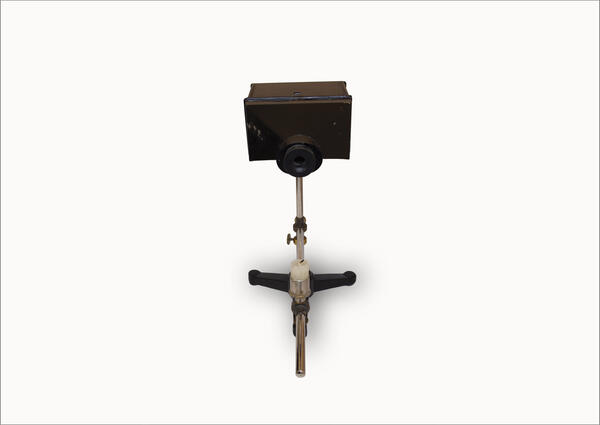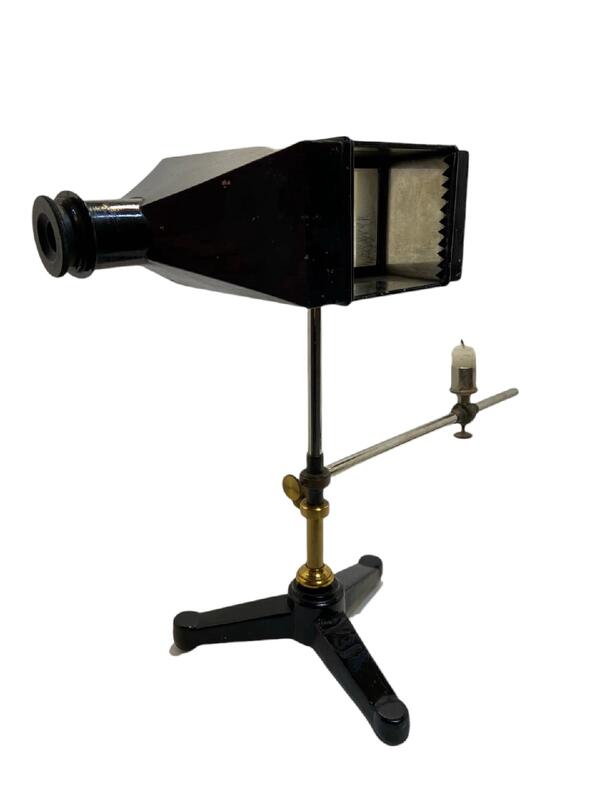
This classroom photometer is an assembled structure with a metal tripod base painted black. In the center is a vertical metal rod assembled from three parts. Another rod with a device for a candle is attached at a right angle to the middle of the vertical rod; in the upper part of the main rod, the black device itself is installed, with recesses for lenses and a tube for an eyepiece.
This photometer was stored in the building of the former male gymnasium in Irbit (a city in the area that is now known as the Sverdlovsk region). A photometer is an optical device designed to measure photometric quantities: illumination, luminous intensity, luminous flux, brightness, and transmittance. Generally speaking, it is intended for measuring visible light. The observer’s eye is used as a receiver. If any physical receiver is used, the photometers are called physical. Today, the term “photometer” refers to a range of instruments. Luxmeters measure illumination, luminance meters — brightness, integrating photometers are used to measure luminous flux and light energy. The instruments used to measure color are called colorimeters.
The human eye evaluates absolute photometric quantities extremely poorly, but it is good at recognizing the boundary of fields with different illumination. These qualities are used in the operation of most visual observation photometers. Using the optical system of the instrument, the light from the source whose characteristics are to be measured and the light from the reference source form two adjacent fields. The light of one of the sources is weakened in one way or another until the eye ceases to distinguish the boundary of the fields. At this point, the illuminances produced by both sources are considered to be the same.
The reference light source on this photometer is a candle, its glow is considered to be a reference. The strength of the glow from one candle was taken as a unit of luminous intensity. Such a unit is called a candela — it is the luminous intensity, in a given direction, of a source that emits monochromatic radiation of frequency 540×1012 hertz and that has a radiant intensity in that direction of 1/683 watt per steradian. The light source on the photometer is movable and is used to achieve equal illumination of surfaces and determine the illumination level.
This photometer was stored in the building of the former male gymnasium in Irbit (a city in the area that is now known as the Sverdlovsk region). A photometer is an optical device designed to measure photometric quantities: illumination, luminous intensity, luminous flux, brightness, and transmittance. Generally speaking, it is intended for measuring visible light. The observer’s eye is used as a receiver. If any physical receiver is used, the photometers are called physical. Today, the term “photometer” refers to a range of instruments. Luxmeters measure illumination, luminance meters — brightness, integrating photometers are used to measure luminous flux and light energy. The instruments used to measure color are called colorimeters.
The human eye evaluates absolute photometric quantities extremely poorly, but it is good at recognizing the boundary of fields with different illumination. These qualities are used in the operation of most visual observation photometers. Using the optical system of the instrument, the light from the source whose characteristics are to be measured and the light from the reference source form two adjacent fields. The light of one of the sources is weakened in one way or another until the eye ceases to distinguish the boundary of the fields. At this point, the illuminances produced by both sources are considered to be the same.
The reference light source on this photometer is a candle, its glow is considered to be a reference. The strength of the glow from one candle was taken as a unit of luminous intensity. Such a unit is called a candela — it is the luminous intensity, in a given direction, of a source that emits monochromatic radiation of frequency 540×1012 hertz and that has a radiant intensity in that direction of 1/683 watt per steradian. The light source on the photometer is movable and is used to achieve equal illumination of surfaces and determine the illumination level.