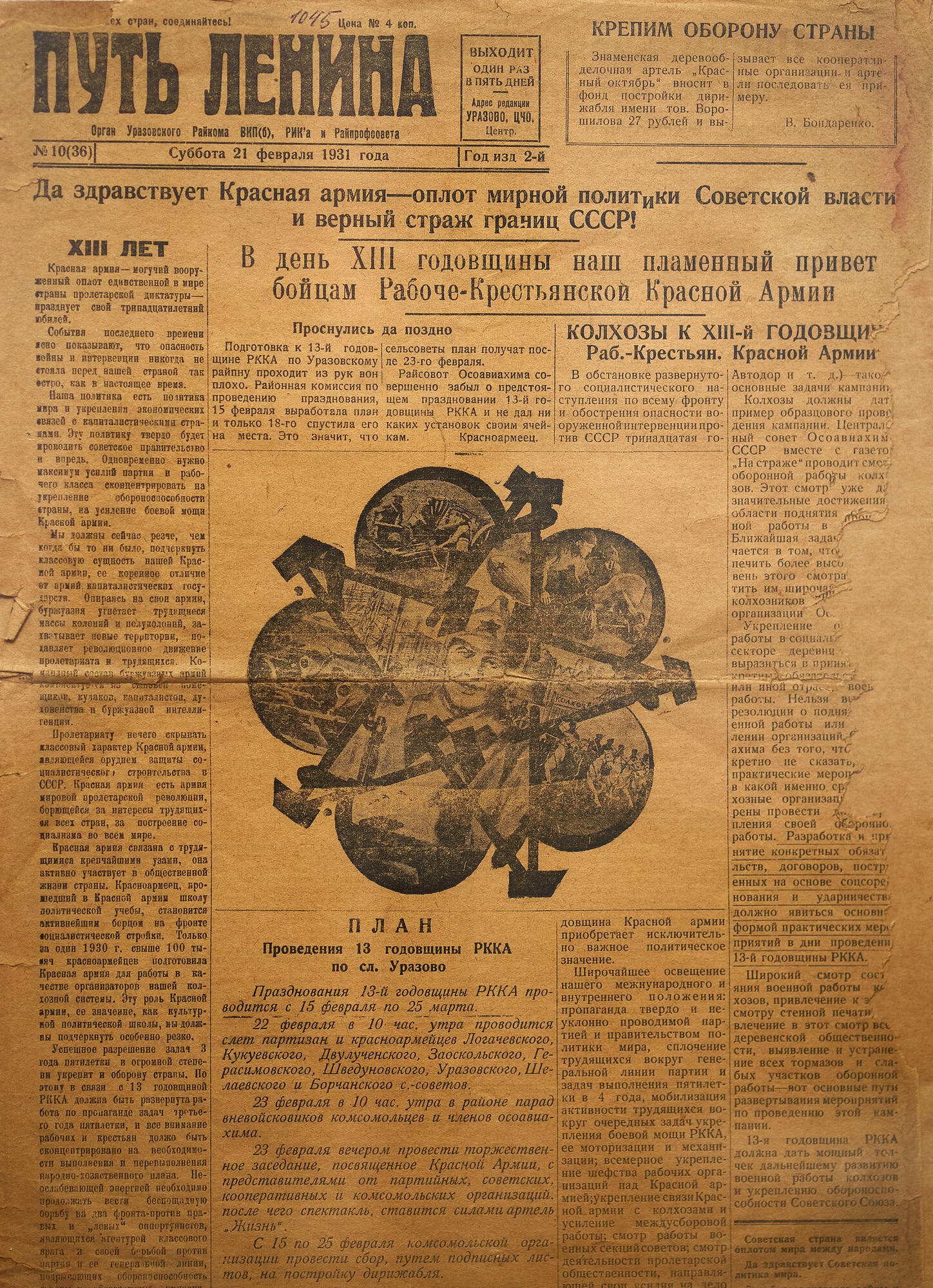


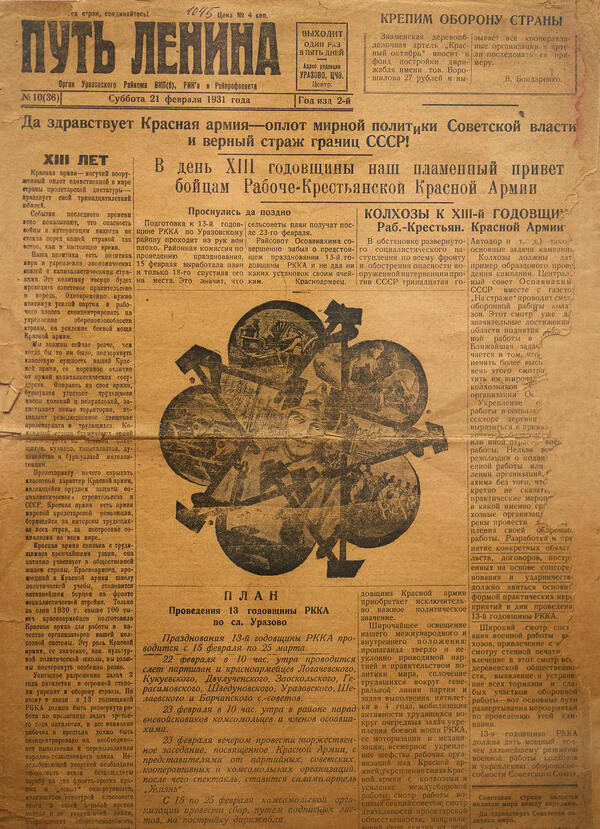
In the collection of the Urazovo Local History Museum you can find a copy of the newspaper “Lenin”s Way” dated February 21, 1931.
The newspaper “Lenin”s Way” served as the Press Organ of the Urazovo District Committee of the All-Union Communist Party of Bolsheviks, the District Executive Committee and the District Professional Council. Its circulation was printed in the Urazovo district printing house. By a Resolution of the Presidium in 1928 of the All-Russian Central Executive Committee of June 30, 1928, the list of districts, a part of the Central Black Earth Region, were approved. At the same time, the Urazovo district with the center in the Urazovo settlement, a part of the Ostrogozhsky district, was established. By this time, the population in the settlement reached almost 13 thousand people. There was one second-level school and seven first-level schools in the settlement, as well as one hospital with 25 beds and a health district point.
The industry of the Urazovo district was mainly the processing one. Trade developed quite well, eight consumer societies and three credit partnerships, as well as 18 fairs worked here. The overwhelming majority of the population of the settlement itself was engaged in handicrafts: leather, shoe and sheepskin-fur coat. The communication routes of the region passed through unpaved roads, since due to the unfortunate configuration of the region, the railway served only the Urazovo settlement itself.
In 1929, in the villages of the Urazovo district, mass propaganda to organize collective farms was started. As of November 20, 1930, there was one commune, 53 agricultural cartels and one land cultivation union — 55 associations in total. In 1930, an agricultural technical college was opened in the settlement, which trained personnel for the newly created collective farms. Most of the collective farm property consisted of dispossessed families. The homes of the dispossessed families were used as red corner clubs, reading rooms and hostels for poor people.
In the 1930s, the construction of the second tracks of the Kupyansk — Valuyki section, which passed through the Urazovo station, began here. By the Decree of the Presidium of the Supreme Soviet of the RSFSR dated February 1, 1963, on the consolidation of rural areas and towns of the Belgorod region, the Urazovo district was abolished and it became part of the Valuyki district.
The newspaper “Lenin”s Way” served as the Press Organ of the Urazovo District Committee of the All-Union Communist Party of Bolsheviks, the District Executive Committee and the District Professional Council. Its circulation was printed in the Urazovo district printing house. By a Resolution of the Presidium in 1928 of the All-Russian Central Executive Committee of June 30, 1928, the list of districts, a part of the Central Black Earth Region, were approved. At the same time, the Urazovo district with the center in the Urazovo settlement, a part of the Ostrogozhsky district, was established. By this time, the population in the settlement reached almost 13 thousand people. There was one second-level school and seven first-level schools in the settlement, as well as one hospital with 25 beds and a health district point.
The industry of the Urazovo district was mainly the processing one. Trade developed quite well, eight consumer societies and three credit partnerships, as well as 18 fairs worked here. The overwhelming majority of the population of the settlement itself was engaged in handicrafts: leather, shoe and sheepskin-fur coat. The communication routes of the region passed through unpaved roads, since due to the unfortunate configuration of the region, the railway served only the Urazovo settlement itself.
In 1929, in the villages of the Urazovo district, mass propaganda to organize collective farms was started. As of November 20, 1930, there was one commune, 53 agricultural cartels and one land cultivation union — 55 associations in total. In 1930, an agricultural technical college was opened in the settlement, which trained personnel for the newly created collective farms. Most of the collective farm property consisted of dispossessed families. The homes of the dispossessed families were used as red corner clubs, reading rooms and hostels for poor people.
In the 1930s, the construction of the second tracks of the Kupyansk — Valuyki section, which passed through the Urazovo station, began here. By the Decree of the Presidium of the Supreme Soviet of the RSFSR dated February 1, 1963, on the consolidation of rural areas and towns of the Belgorod region, the Urazovo district was abolished and it became part of the Valuyki district.