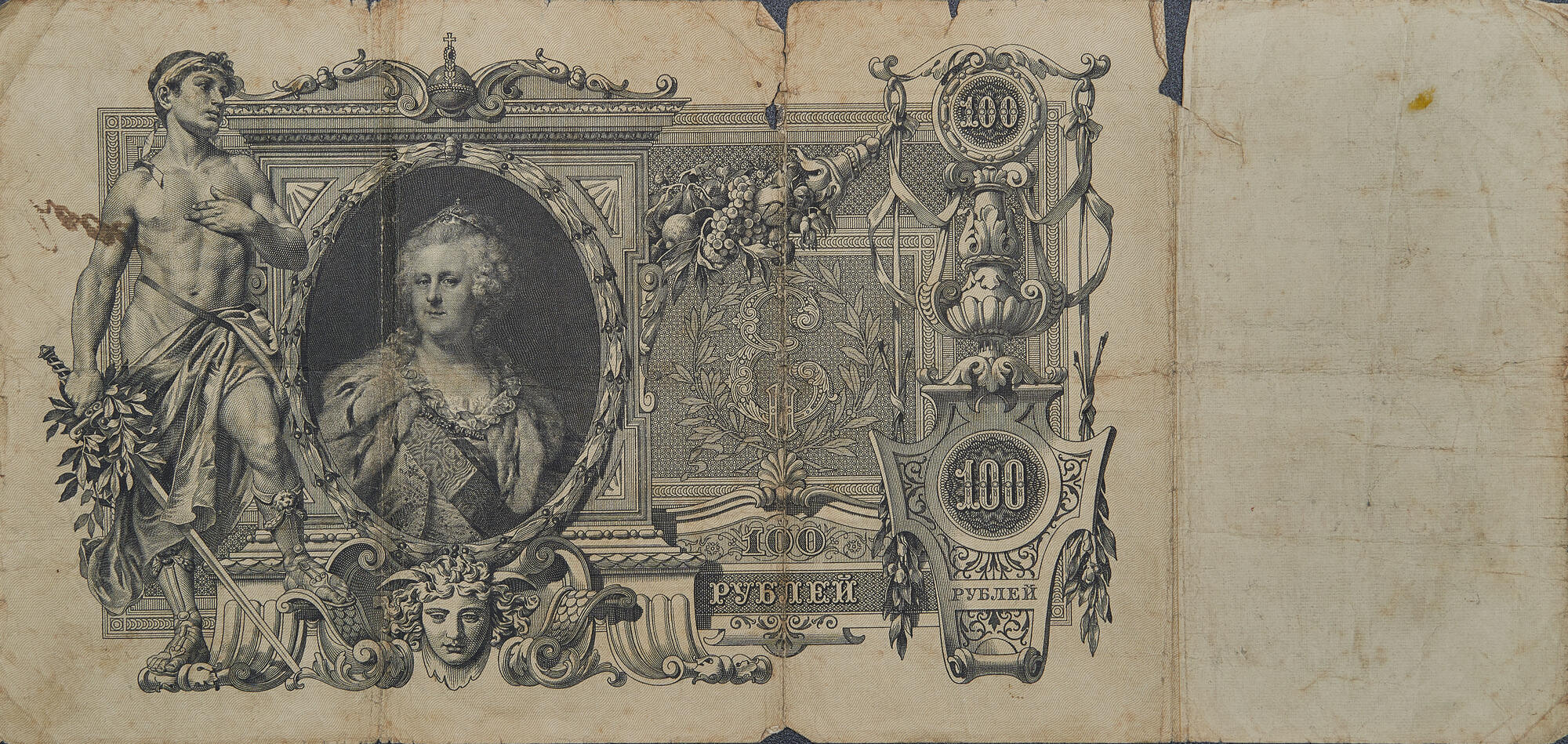


The numismatic collection of the Urazovo Local History Museum includes a paper banknote, with a face value of 100 rubles, issued in 1910.
In the 9th–10th centuries in Russia they began to mint their own coins, but at the same time the Tatar coin ‘tenga’ became very popular. It is believed that the name of Russian money originated from this coin. During the Ivan III Tsarist period, a drawing of a horseman with a spear (in Russian — ‘kopyo’) began to be minted on silver coins, so the word ‘kopeck’ (in Russian — ‘kopeyka’) arose. In 1704, during Emperor Peter I time, the coin acquired the shape of a regular circle and money with a different face value was issued: from a ruble to a kopeck.
There are many theories about the origin of paper money. Some historians maintain that in the 1st century BC, pieces of skin were used as the unit of exchange. In China, white deer skins and tree bark with universal marks were applied. According to another version, the first form of banknotes arose as a result of the emergence of storage facilities for metals in exchange for a written receipt. The history of money took on a new round of development with the issuance of paper money. They first appeared in 910 in China, thanks to advanced papermaking technology. Since then, they have been in circulation.
In the 9th–10th centuries in Russia they began to mint their own coins, but at the same time the Tatar coin ‘tenga’ became very popular. It is believed that the name of Russian money originated from this coin. During the Ivan III Tsarist period, a drawing of a horseman with a spear (in Russian — ‘kopyo’) began to be minted on silver coins, so the word ‘kopeck’ (in Russian — ‘kopeyka’) arose. In 1704, during Emperor Peter I time, the coin acquired the shape of a regular circle and money with a different face value was issued: from a ruble to a kopeck.
There are many theories about the origin of paper money. Some historians maintain that in the 1st century BC, pieces of skin were used as the unit of exchange. In China, white deer skins and tree bark with universal marks were applied. According to another version, the first form of banknotes arose as a result of the emergence of storage facilities for metals in exchange for a written receipt. The history of money took on a new round of development with the issuance of paper money. They first appeared in 910 in China, thanks to advanced papermaking technology. Since then, they have been in circulation.