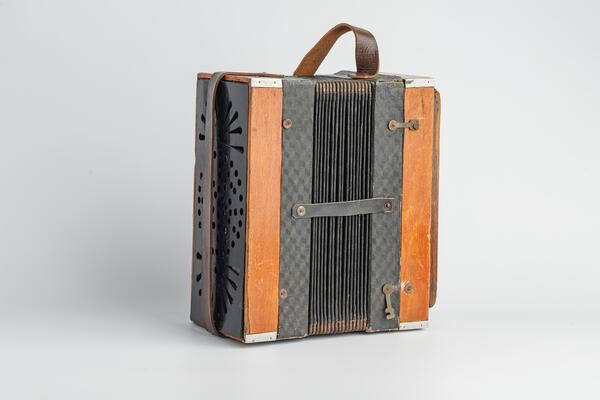
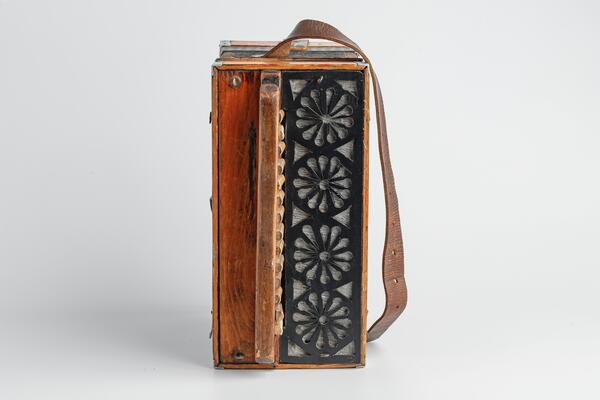
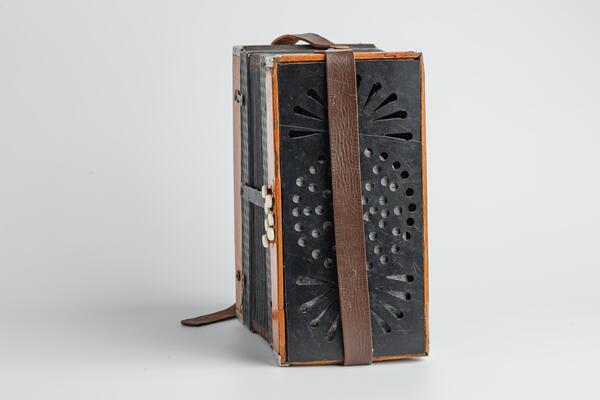
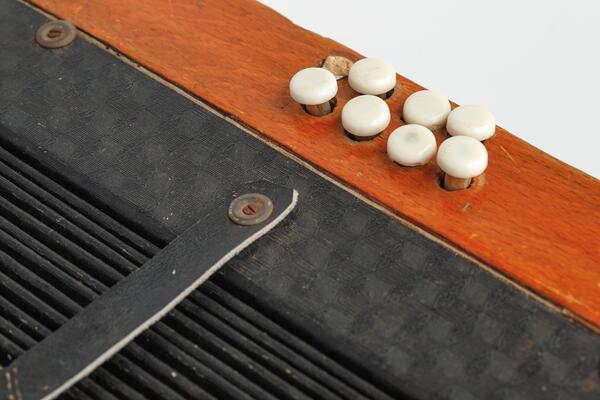
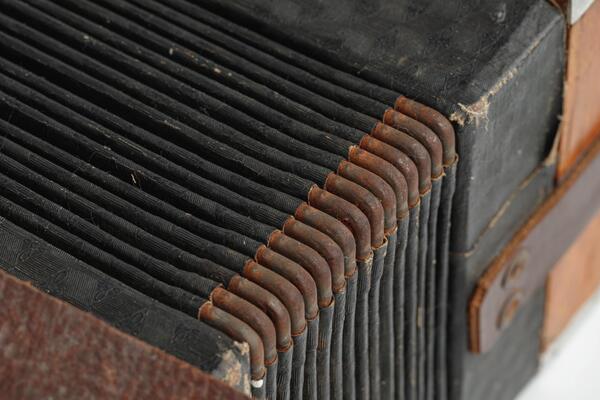
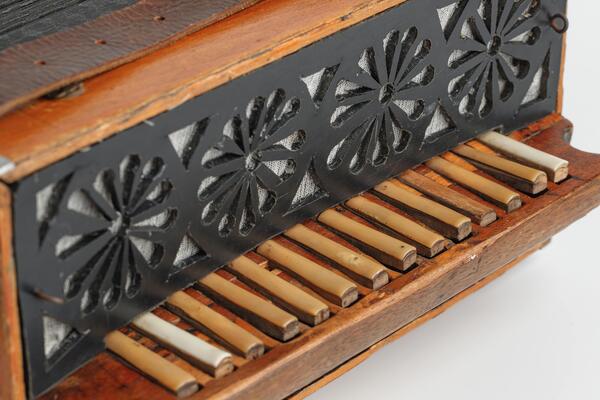
The Museum of Intelligence Officer Nikolai Ivanovich Kuznetsov in the village of Zyryanka houses a single-row button accordion that once belonged to Yefrem Yeliseyevich Bersenev (born in 1910), a veteran of the Great Patriotic War.
The accordion is a reed-based, pneumatic keyboard instrument. Its sound is produced by air flowing through free reeds as the bellows — positioned between the instrument’s left and right halves — are expanded and compressed. The exact origins of the accordion remain debated: some scholars trace it to early 19th-century England, others to Germany. In the Russian Empire, at the turn of the 20th century, accordions were primarily made by individual artisans. Following the Russian Civil War, production shifted to cooperative workshops (artels), and by the 1930s, the first state-run factories for harmonicas and accordions were established.
The Russian term “garmon” (accordion) is used only in Russia: in other countries, the term “accordion” covers a wide range of instruments that use the same principle of operation. One of them is a talianka accordion, especially popular in the 19th century in the north of Russia and in the Volga region: it has 12–15 elongated keys and 3–6 buttons. The sound of a talianka resembles the ringing of bells. By opening and closing the bellows, the musician can change the pitch and tone of the sound.
Nikanor (the childhood name of the future intelligence officer Nikolai Ivanovich Kuznetsov) first learned to play the accordion while living in Zyryanka. His teacher was his uncle Grigory Ivanovich Kuznetsov — a cousin of Ivan Pavlovich Kuznetsov, Nikolai’s father.
Ivan Konstantinovich Cherdantsev recounts this formative experience in his book “Character Is Tempered from a Young Age” as follows: