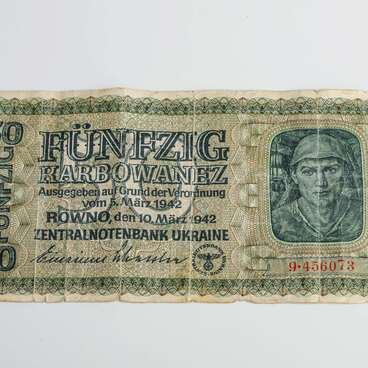
The Museum of Intelligence Officer Nikolai Kuznetsov houses a 100-karbovanets banknote issued in 1942 by the Central Bank of Ukraine under the authority of the Reichskommissariat Ukraine.
At the bottom of the note appears the signature of the bank’s manager. To its right is an official stamp featuring the coat of arms of Nazi Germany — an eagle with outstretched wings clutching a wreath of oak leaves encircling a swastika. Enclosed within a circular frame is a portrait of a sailor in a cap, set against a maritime backdrop of steamships. Beneath the portrait are the series designation and a six-digit serial number printed in red. This imagery aligned with Nazi propaganda, which portrayed Ukraine as an agrarian and raw-material appendage to the Reich. The note’s design employs dark olive and blue-black hues on white paper, with a multicolored vertical security stripe composed of fibrous threads running down the center of the obverse side.
According to conservative estimates, the Central Bank of Ukraine issued at least 12 billion banknotes during the occupation. Denominations included 1, 2, 5, 10, 20, 50, 100, 200, and 500. Notably, although 2-karbovanets notes were printed, they saw little circulation — their distribution was largely thwarted by partisan sabotage, and most of the printed stock was destroyed. These occupation banknotes circulated alongside the German Reichsmark in the occupied territories of western and central Ukraine at an official exchange rate of 10 karbovanets notes to 1 Reichsmark.
In frontline zones, however, the Soviet ruble remained the preferred and de facto official currency throughout the occupation. In Ukrainian, the ruble was commonly referred to as “karbovanets”, leading to ambiguity: prices in occupied Ukraine were typically quoted in “karbovanets banknotes”, a term that could refer either to the Soviet ruble or to the occupation-issued karbovanets notes.
For example, in mid-1942, admission to the infamous “Death Match” football game in Kiev — between the local Ukrainian team “Start” and the German Luftwaffe side Flakelf — cost 5 karbovanets notes. Entry to the Kharkov Zoo ranged from 1 to 3 karbovanets, while a meal (consisting of a first course, a second course, and ersatz cocoa) at a private café cost between 25 and 60.
Food prices reached their peak during the famine-stricken winter of 1941–1942 but declined following the 1942 harvest, particularly from September onward. The perceived military successes of German forces on the Eastern Front also contributed to a temporary strengthening of the occupation karbovanets during the summer and autumn of 1942.
Because the Soviet ruble remained in circulation on both sides of the front — and because the Germans artificially inflated the value of the Reichsmark (thereby undervaluing the ruble) — prices in Soviet-controlled territory were generally lower. Consequently, when cities were liberated, local market prices often dropped abruptly, sometimes by a factor of two or three, a development welcomed by the civilian population.