In the 19th and the early 20th centuries, there was a large number of music shops in the Russian Empire. One of them called “D. G. Silkin Garmon Shop” opened in Tsaritsyn. It is known that in 1914 the real estate of Dmitry Grigorievich Silkin in this city was estimated at 1218 rubles, with an average monthly salary of a factory worker at that time totaling 22 rubles 53 kopecks.
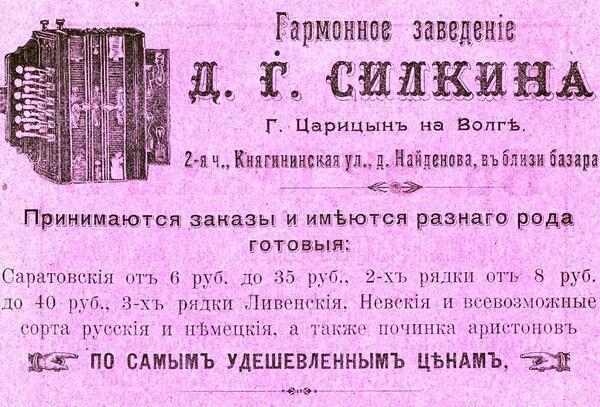
The shop advertisement from the collection of the Volgograd Regional Museum of Local History says that a Saratov garmon was available there for 6 to 35 rubles, and a two-row garmon — from 8 to 40 rubles.
The Saratov garmon has been known since the mid-19th century. It was notable for its bells, distinctive timbre and power of sound. It could be decorated with wooden carvings, velvet and leather.
A two-row garmon had two rows of buttons under the right hand. The “Viennese” and “German” double-row garmons were popular among those who loved such musical instruments. In the 1870s the first Russian garmon was made in Tula, which was also called “khromka”. This instrument was made by Leontiy Alexeyevich Chulkov on commission of the Russian garmonist Nikolay Ivanovich Beloborodov.
Dmitry Silkin’s shop sold Nevskaya as well as Livenka three-row garmons. One of the signs in the shop window invited customers to buy “a self-playing piano and a novelty from America — a Becker grand piano”.
The advertisement also said that it was possible to have “aristons” repaired in that Tsaritsyn shop. Presumably, these were organettes — mechanical musical instruments that were based on the principle of a physharmonica and operated by turning a knob. They were very popular at that time, and one of the most famous models was the Ariston organette from Leipzig.
In 1900, Russian garmonists conquered the French capital. At the World’s Fair, the two- and three-row garmons of the Kiselev brothers received awards. The garmoshka in Russia became a true work of art created by musical instrument makers.
The shop advertisement from the collection of the Volgograd Regional Museum of Local History says that a Saratov garmon was available there for 6 to 35 rubles, and a two-row garmon — from 8 to 40 rubles.
The Saratov garmon has been known since the mid-19th century. It was notable for its bells, distinctive timbre and power of sound. It could be decorated with wooden carvings, velvet and leather.
A two-row garmon had two rows of buttons under the right hand. The “Viennese” and “German” double-row garmons were popular among those who loved such musical instruments. In the 1870s the first Russian garmon was made in Tula, which was also called “khromka”. This instrument was made by Leontiy Alexeyevich Chulkov on commission of the Russian garmonist Nikolay Ivanovich Beloborodov.
Dmitry Silkin’s shop sold Nevskaya as well as Livenka three-row garmons. One of the signs in the shop window invited customers to buy “a self-playing piano and a novelty from America — a Becker grand piano”.
The advertisement also said that it was possible to have “aristons” repaired in that Tsaritsyn shop. Presumably, these were organettes — mechanical musical instruments that were based on the principle of a physharmonica and operated by turning a knob. They were very popular at that time, and one of the most famous models was the Ariston organette from Leipzig.
In 1900, Russian garmonists conquered the French capital. At the World’s Fair, the two- and three-row garmons of the Kiselev brothers received awards. The garmoshka in Russia became a true work of art created by musical instrument makers.