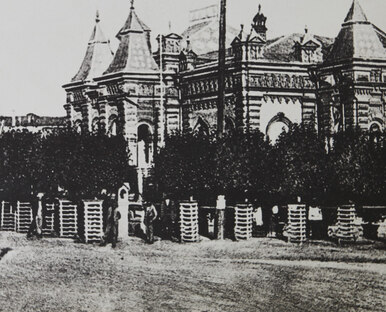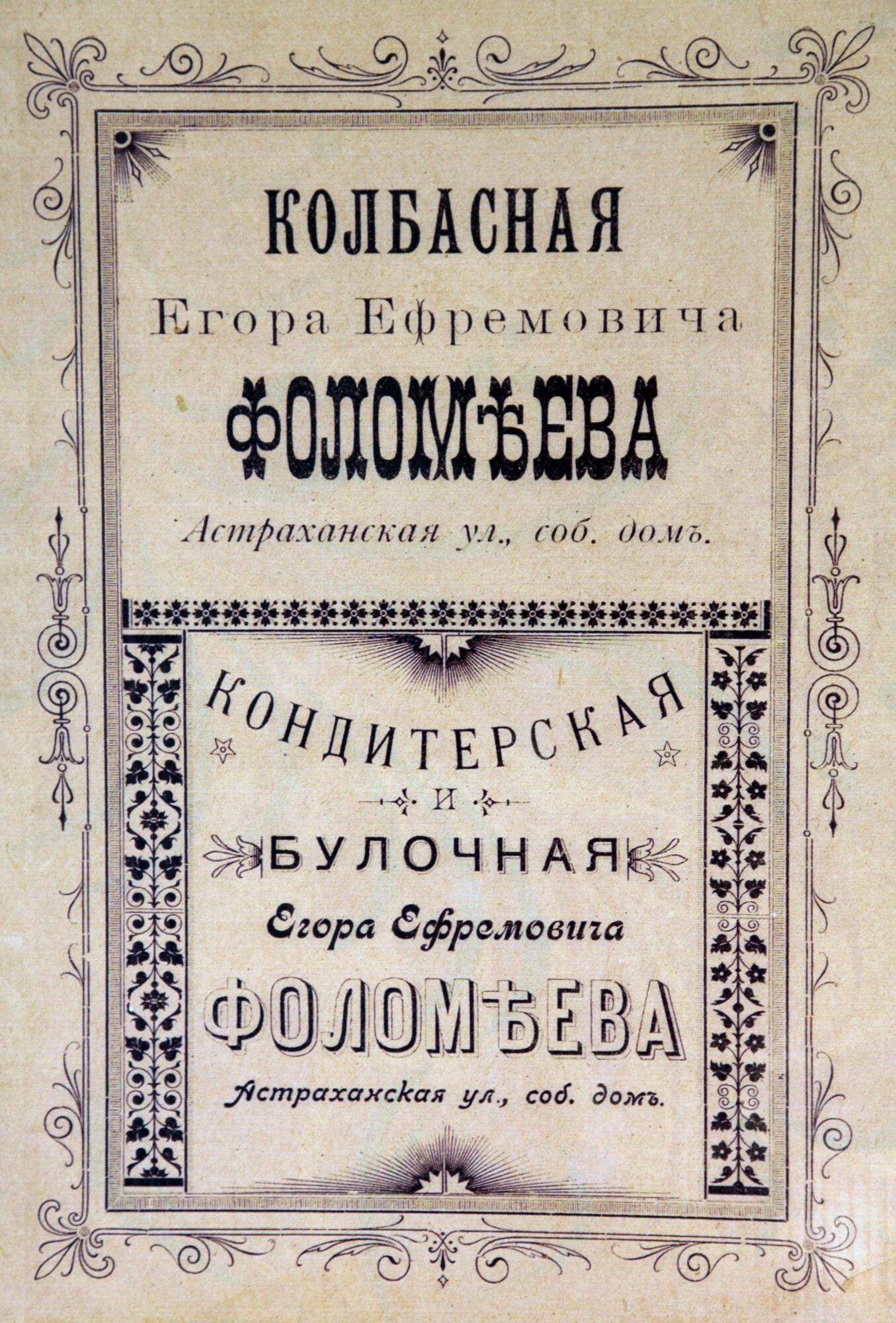


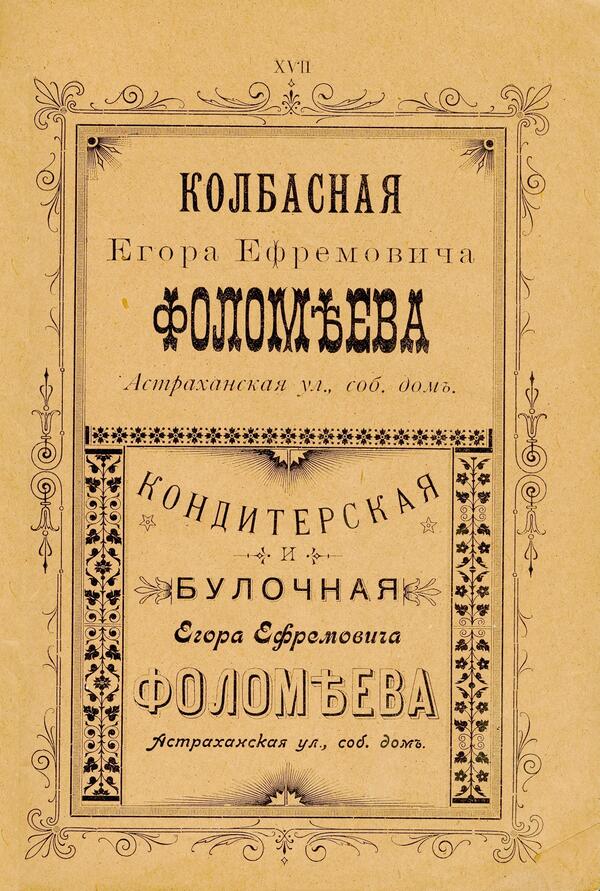
The shop of the Folomeyev merchants was situated in Tsaritsyn on Astrakhanskaya Street. They traded in delicatessen, groceries, confectionery goods and wines. Their sausage shop was decorated with glazed tiles. The owners also gave great attention to the display of their goods and sometimes used flowers.
The marble counter had a nickel-plated tank for sausages, which were then made not only of pork, but also hare, as well as veal and goose liver. Yegor Folomeyev’s shop offered more than 100 types of sausage products and owned slaughterhouses making it a self-sufficient enterprise.
The shop sold smoked, boiled, and blood sausages, as well as liver and tongue sausages with various additives. The connoisseurs identified the sausage by its cut — by the shape of the lumps of lard. For example, Braunschweig sausage had star-shaped lard pieces, while Tambov sausage had long, narrow strips of lard. For some sausages it was cut very coarsely, for others — really finely.
One of the most expensive sorts was the imported Italian salami, made from donkey meat.
“It is very tasty”, the contemporaries wrote of it, “but affordable only for gastronomes”. This was the word used at the time to describe gourmands.
Russian first grade salami, which was probably also available in Folomeyev’s shop, was made from steamed beef, pork and brisket instead of lard, with cardamom and Madera. It was lightly smoked in the alder sawdust fumes until the casing turned yellow.
Moscow salami was one of the best types. The brisket was cut into the right cubes, and the mince was made from the highest quality meat. Cognac was added to the spices. The smoked sausage was not smoked, it was just jerked in a dry and well-ventilated room, which made it very dry. In addition to his sausage business, the merchant had a flourishing confectionery and bakery shop. An extensive new assortment was usually prepared for Christmas.
Like many merchants before him in other Russian cities, Folomeyev became a ktitor. This was the word used to describe the people who allocated funds for the repair or construction of an Orthodox church. In 1892, Folomeyev sponsored the repair of the Assumption Cathedral in Tsaritsyn. On June 22, 1896 he was granted a gold medal “For Diligence” to be worn on the Stanislavsky ribbon.
The marble counter had a nickel-plated tank for sausages, which were then made not only of pork, but also hare, as well as veal and goose liver. Yegor Folomeyev’s shop offered more than 100 types of sausage products and owned slaughterhouses making it a self-sufficient enterprise.
The shop sold smoked, boiled, and blood sausages, as well as liver and tongue sausages with various additives. The connoisseurs identified the sausage by its cut — by the shape of the lumps of lard. For example, Braunschweig sausage had star-shaped lard pieces, while Tambov sausage had long, narrow strips of lard. For some sausages it was cut very coarsely, for others — really finely.
One of the most expensive sorts was the imported Italian salami, made from donkey meat.
“It is very tasty”, the contemporaries wrote of it, “but affordable only for gastronomes”. This was the word used at the time to describe gourmands.
Russian first grade salami, which was probably also available in Folomeyev’s shop, was made from steamed beef, pork and brisket instead of lard, with cardamom and Madera. It was lightly smoked in the alder sawdust fumes until the casing turned yellow.
Moscow salami was one of the best types. The brisket was cut into the right cubes, and the mince was made from the highest quality meat. Cognac was added to the spices. The smoked sausage was not smoked, it was just jerked in a dry and well-ventilated room, which made it very dry. In addition to his sausage business, the merchant had a flourishing confectionery and bakery shop. An extensive new assortment was usually prepared for Christmas.
Like many merchants before him in other Russian cities, Folomeyev became a ktitor. This was the word used to describe the people who allocated funds for the repair or construction of an Orthodox church. In 1892, Folomeyev sponsored the repair of the Assumption Cathedral in Tsaritsyn. On June 22, 1896 he was granted a gold medal “For Diligence” to be worn on the Stanislavsky ribbon.