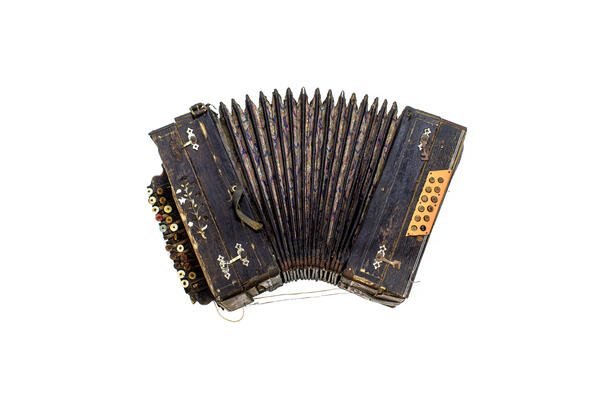
The museum houses a hand-operated garmon (a Russian button accordion) made in the 1940s. It belongs to the family of free-reed instruments. The garmon consists of two casings with keys or buttons attached to opposite sides of a bellows. The way to play it is to either hold it in hands or place it on a knee: the garmon player expands and compresses the bellows, pressing the keys at the same time. The melody is played on the right keys, while the left ones are used to perform the accompaniment.
Nowadays, there is no possible way to determine the name of the person who invented harmonicas, for instruments like that were already made centuries ago in England, France, Italy, Germany and Russia. Russian art expert Alfred Mirek claimed that the present-day-looking garmon first appeared in Saint Petersburg in 1783 and was made by Czech organist Frantisek Kirsnik. There is also one other theory that the first hand-operated harmonica was created by Christian Friedrich Ludwig Buschmann, a craftsman from Berlin, in 1822.
In 1830, garmons became so popular and loved in Russia that no important event could do without them — they were played even at funerals. Garmons were made by craftsmen in almost every governorate and were named after the places of their invention or manufacturing, giving rise to many varieties, such as Saratov, Livenka, talyanka, Vyatka, Yelets ‘royal’, Kirillov, Vologda, Cherepovets, Viennese garmons and others.
During the Great Patriotic War of 1941–1945, the garmon was played during halts to help soldiers maintain their martial spirit. The image of the character from Alexander Tvardovsky’s poem Vasily Tyorkin, a high-spirited soldier playing a garmon, became especially well-known. Alexander Makushev, the author of “Accordion”s Story” reminisced about his war experience,
Nowadays, there is no possible way to determine the name of the person who invented harmonicas, for instruments like that were already made centuries ago in England, France, Italy, Germany and Russia. Russian art expert Alfred Mirek claimed that the present-day-looking garmon first appeared in Saint Petersburg in 1783 and was made by Czech organist Frantisek Kirsnik. There is also one other theory that the first hand-operated harmonica was created by Christian Friedrich Ludwig Buschmann, a craftsman from Berlin, in 1822.
In 1830, garmons became so popular and loved in Russia that no important event could do without them — they were played even at funerals. Garmons were made by craftsmen in almost every governorate and were named after the places of their invention or manufacturing, giving rise to many varieties, such as Saratov, Livenka, talyanka, Vyatka, Yelets ‘royal’, Kirillov, Vologda, Cherepovets, Viennese garmons and others.
During the Great Patriotic War of 1941–1945, the garmon was played during halts to help soldiers maintain their martial spirit. The image of the character from Alexander Tvardovsky’s poem Vasily Tyorkin, a high-spirited soldier playing a garmon, became especially well-known. Alexander Makushev, the author of “Accordion”s Story” reminisced about his war experience,