During the first post-revolutionary months, the Red Army men and their commanders adopted the uniforms that were worn by the Imperial Russian army, only removing shoulder boards. According to the Soviet documents, when the White Army introduced their military uniforms, which were made in the same fashion, the Workers’ and Peasants’ Red Army decided to introduce new elements to their uniforms so that it was possible to tell apart the Red Guard soldier from the White Guard one from a distance or in the dark.
In May 1918, the Military People’s Commissariat of the RSFSR announced a contest for the best design of the uniform for the Red Army soldiers. Among the participants were Viktor Vasnetsov, Boris Kustodiev, Mikhail Yezuchevsky, Sergey Arkadyevsky, and other famous artists. In December 1918, based on the works submitted for the contest, the Revolutionary Military Council approved a new type of winter headdress.
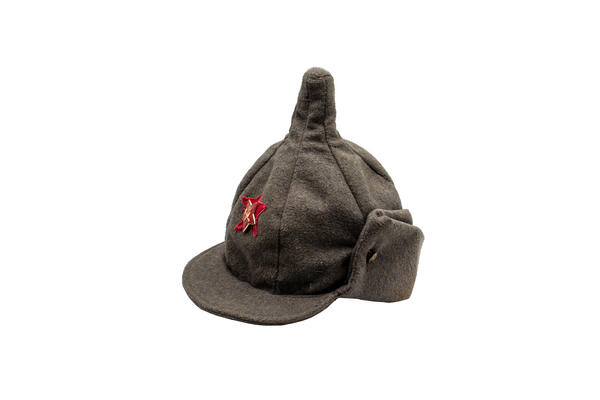
The new broadcloth helmet resembled a medieval yerikhonka or a helmet with an aventail, which was part of the armor of the epic Russian bogatyrs. For this similar appearance, it was called “bogatyrka”. In Vasily Chapayev’s division, the headdress received the name of ‘frunzevka’ in honor of the commander Mikhail Frunze. However, the name was soon changed in honor of Semyon Budyonny — his 4th cavalry was among the first ones to receive new broadcloth helmets in early 1919. The museum houses a budyonovka, which was made in the first half of the 20th century.
Budyonovkas were created with the Russian cold climate in mind: its neck-flap, folded in half, bent upwards and fastened with two buttons on the sides, could be lowered and fastened under a chin to cover ears and neck from wind and precipitation. A woolen five-pointed star was sewn on the front side of the headgear.
In 1922, a summer version of budyonovka was introduced. It was sewn from tent cloth or light gray cotton fabric. The summer helmet looked the same as the winter one, except it did not have flaps on the neckpiece.
While the winter budyonovkas remained in use, the summer ones stayed with the Red Army for only two years: in May 1924, the helmets were replaced with peaked caps. In 1922, the winter style was slightly changed: the shape was rounded, the helmets became a little taller, and dark gray cloth was used instead of the light gray one.
During the Soviet-Finnish war, budyonovkas proved to be ineffective against severe frosts, so they were officially removed by the decree of the People’s Commissar of Defense of the USSR to be replaced with ushankas (Russian fur caps with ear covering flaps).
In May 1918, the Military People’s Commissariat of the RSFSR announced a contest for the best design of the uniform for the Red Army soldiers. Among the participants were Viktor Vasnetsov, Boris Kustodiev, Mikhail Yezuchevsky, Sergey Arkadyevsky, and other famous artists. In December 1918, based on the works submitted for the contest, the Revolutionary Military Council approved a new type of winter headdress.
The new broadcloth helmet resembled a medieval yerikhonka or a helmet with an aventail, which was part of the armor of the epic Russian bogatyrs. For this similar appearance, it was called “bogatyrka”. In Vasily Chapayev’s division, the headdress received the name of ‘frunzevka’ in honor of the commander Mikhail Frunze. However, the name was soon changed in honor of Semyon Budyonny — his 4th cavalry was among the first ones to receive new broadcloth helmets in early 1919. The museum houses a budyonovka, which was made in the first half of the 20th century.
Budyonovkas were created with the Russian cold climate in mind: its neck-flap, folded in half, bent upwards and fastened with two buttons on the sides, could be lowered and fastened under a chin to cover ears and neck from wind and precipitation. A woolen five-pointed star was sewn on the front side of the headgear.
In 1922, a summer version of budyonovka was introduced. It was sewn from tent cloth or light gray cotton fabric. The summer helmet looked the same as the winter one, except it did not have flaps on the neckpiece.
While the winter budyonovkas remained in use, the summer ones stayed with the Red Army for only two years: in May 1924, the helmets were replaced with peaked caps. In 1922, the winter style was slightly changed: the shape was rounded, the helmets became a little taller, and dark gray cloth was used instead of the light gray one.
During the Soviet-Finnish war, budyonovkas proved to be ineffective against severe frosts, so they were officially removed by the decree of the People’s Commissar of Defense of the USSR to be replaced with ushankas (Russian fur caps with ear covering flaps).