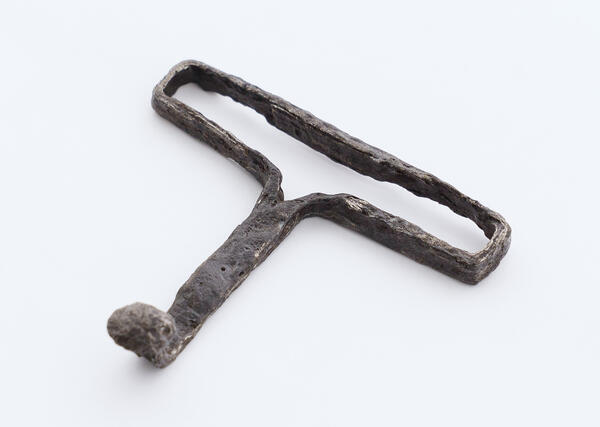
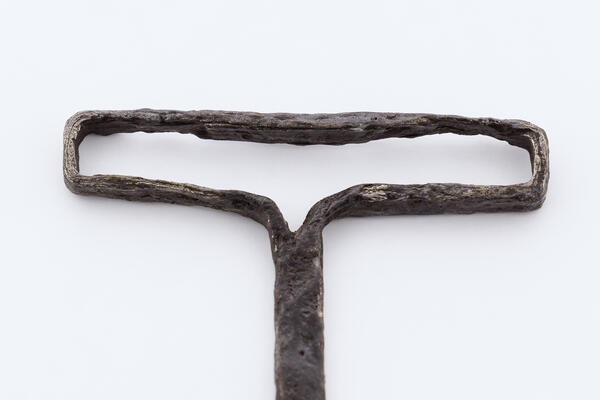
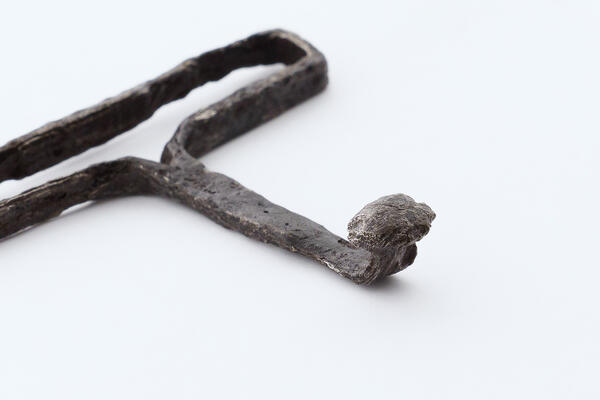
The buckle of a quiver belt on display at the museum is a part of a warrior’s equipment (specifically, a waist belt) from the 14th–15th centuries. It has a rectangular frame and a rectangular hook with a bent tip that is made in the shape of a bead. The buckle was made from an iron javelin. To create it, a hook was first formed by bending the javelin in half, both halves were joined by forging, and then the frame was formed from the ends of the dart. The ends were brought together on the side opposite to that of the hook and also joined by forging.
The buckle was discovered in 1982 during an archaeological survey of the Izborsk settlement in the Pechora region (Pskov Oblast) by an expedition of the Institute of Archaeology at the Russian Academy of Sciences, led by Valentin Vasilyevich Sedov.
A quiver belt is a specially designed belt, on which a quiver with arrows and a bow case with a crossbow were suspended. The style and appearance of a quiver, or a quiver set have always been influenced by the nomadic lifestyle, and they changed more than once over the centuries. It was not until the 10th century that the quiver belt finally had its established design.
Starting from the 12th century, quiver belts stopped being decorated, and their metal elements became simpler, with minimalism overtaking the previously predominant traditions of luxury.
Since ancient times, the belt has been an important part of clothing and equipment for hunters and warriors. During the time of the Battle of Kulikovo, as evidenced by the materials of Golden Horde archaeology, warriors could wear as many as three belts at once. One was the main belt, which was part of the apparel, and the other two made part of military equipment. The former was a shoulder belt that carried bladed weapons such as a sword or saber. The latter, known as a quiver belt, held a bow and a quiver with arrows. It was simpler in design compared to the other two belts. A similar practice was likely to exist in Rus as well.
The item on display at the State Museum-Reserve “Kulikovo Field” is a quiver belt that held a shooting set with a bow and arrows. Hook fasteners for quiver belts have been often found in archaeological materials from both the Golden Horde and Ancient Rus.