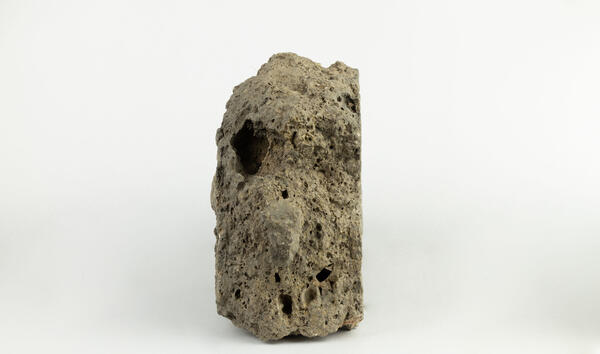
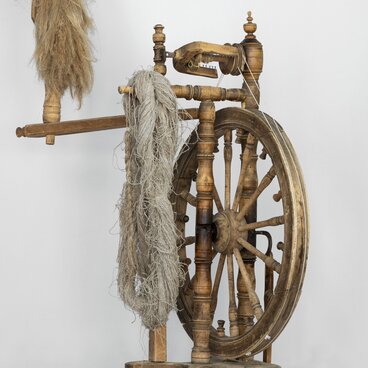
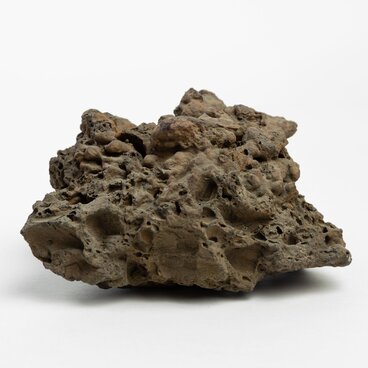
A fragment of a millstone was found during excavations at the medieval settlement of Idnakar, the main archaeological monument of the culture of the Kama-Cheptsa interfluve of the 9th–13th centuries. Legend has it that it was founded by the hero Idna, the son of Dondy, after whom another settlement is named — Dondykar. Idnakar is located on Soldyr Mountain in the Cheptsa River basin, where the ancestors of the northern Udmurts lived.
Idnakar was a military, trade, craft and administrative center. It was surrounded by a rampart and a moat, and ceramic, blacksmithing, bone-cutting and metallurgical industries flourished inside. Idnakar, which was captured and burned in the 13th century, represents the medieval Finno-Ugric culture.
The fragment from the collection of the Glazov Museum is part of a millstone, key farm inventory. Millstones were used for grinding dry grain into grits and flour, as well as for grinding nuts. Millstones appeared in the Kama region during the early Middle Ages, and were widely used a thousand years ago. This tool consisted of two heavy flat stones with a diameter of 30–45 cm. From the inside, they featured special grooves on the working surface — they ground the grain, and flour was directed along the grooves to a container. The millstone discs were made of fine-grained, porous sandstone or fossiliferous limestone.
In the center of the upper millstone there was a small hole, an eye, into which the grain was poured. The millstones were part of hand mills, they were set in motion by using a stick. One end of it was inserted into the upper opening, and the other was attached to the ceiling. There is a plethora of riddles and proverbs about millstones, for example: “A stone sea turns round and round, and a white hare lies down beneath it to everyone’s pleasure.” The answer is millstones and flour.
Spelt, spring rye, oats, as well as wheat, barley, and peas were found in grain storage facilities and houses of Idnakar. The Udmurts engaged in slash-and-burn agriculture, when some trees were cut down and a section of the forest was burned to cultivate crops with ash fertilizing the soil. Another way to avoid a dismal crop yield in a challenging climate was to use a multi-grain mixture, with which plots were sown and seedlings of some or the other crops were obtained in all weather conditions.
Idnakar was a military, trade, craft and administrative center. It was surrounded by a rampart and a moat, and ceramic, blacksmithing, bone-cutting and metallurgical industries flourished inside. Idnakar, which was captured and burned in the 13th century, represents the medieval Finno-Ugric culture.
The fragment from the collection of the Glazov Museum is part of a millstone, key farm inventory. Millstones were used for grinding dry grain into grits and flour, as well as for grinding nuts. Millstones appeared in the Kama region during the early Middle Ages, and were widely used a thousand years ago. This tool consisted of two heavy flat stones with a diameter of 30–45 cm. From the inside, they featured special grooves on the working surface — they ground the grain, and flour was directed along the grooves to a container. The millstone discs were made of fine-grained, porous sandstone or fossiliferous limestone.
In the center of the upper millstone there was a small hole, an eye, into which the grain was poured. The millstones were part of hand mills, they were set in motion by using a stick. One end of it was inserted into the upper opening, and the other was attached to the ceiling. There is a plethora of riddles and proverbs about millstones, for example: “A stone sea turns round and round, and a white hare lies down beneath it to everyone’s pleasure.” The answer is millstones and flour.
Spelt, spring rye, oats, as well as wheat, barley, and peas were found in grain storage facilities and houses of Idnakar. The Udmurts engaged in slash-and-burn agriculture, when some trees were cut down and a section of the forest was burned to cultivate crops with ash fertilizing the soil. Another way to avoid a dismal crop yield in a challenging climate was to use a multi-grain mixture, with which plots were sown and seedlings of some or the other crops were obtained in all weather conditions.