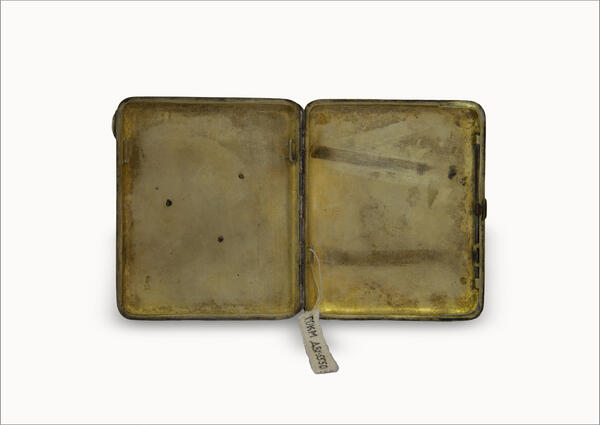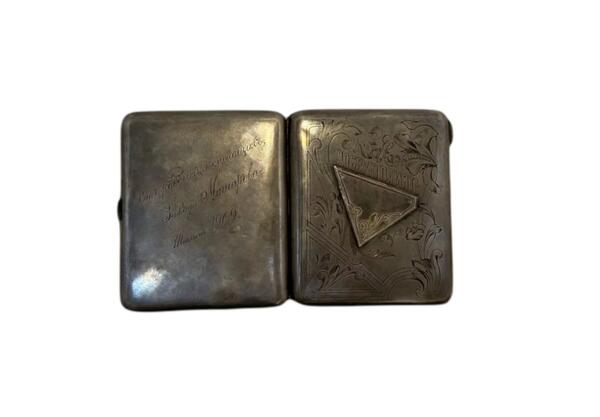
This silver cigarette case with an engraving on the bottom half “From the workers and employees of the Masharov Factory. Tyumen 1909” was most likely given to Nikolay Dmitrievich Masharov as a present for the tenth anniversary of the iron foundry. The top half features an engraving with a floral pattern and the inscription “With best wishes”, below there is an overlay in the form of a truncated triangle. The cigarette case is gilded inside and has two maker’s marks. The first oval mark denotes 84-carat silver and features a young woman’s head wearing a kokoshnik, with her profile to the left. It means that the cigarette case was made before 1908, because after that year the brand was changed. The second rectangular mark features the initials “FV”, which allegedly denote either the artisan or the second owner of the cigarette case. However, Fyodor Verkhovtsev, a jeweler from St. Petersburg, who could have made the cigarette case, died in the middle of the 19th century, and it was impossible to find out who used the cigarette case later.
In 1899, Nikolay Dmitrievich Masharov bought a small workshop with a cupola furnace, which was located in a dugout, from the merchant Andrey Grigoryevich Zakolyapin, and organized an iron foundry and nail production. The wooden buildings erected after the acquisition of the workshop burned down a year later. Nikolay Dmitrievich decided to build a stone building and therefore addressed the city government with a request to register full ownership of the land plot. By the end of 1902, the land on which the plant was located became the property of “N.D. Masharov and Co.”, which included, in addition to Nikolay Dmitrievich Masharov, four more merchants and one trading house. In the same year, a foundry shop, a metalwork and mechanical shop, a nail department and warehouses, and later an enamel workshop buildings were built from brick. A steam boiler was installed at the plant, which replaced the horse-drawn mechanism, and then it was replaced by the first electric motors in the city. The plant produced a wide range of products — from nails and horseshoes to ashtrays and plaques.
Inside the building of the People’s House (13, October 25 Street) and in the building of the women’s gymnasium at 6 Volodarsky Street, cast-iron staircases made at the iron foundry have been preserved. During the First World War, the plant produced military supplies — hand grenades and mines. In 1918, when Soviet power was established in Tyumen, N.D. Masharov’s enterprise was nationalized.
In 1899, Nikolay Dmitrievich Masharov bought a small workshop with a cupola furnace, which was located in a dugout, from the merchant Andrey Grigoryevich Zakolyapin, and organized an iron foundry and nail production. The wooden buildings erected after the acquisition of the workshop burned down a year later. Nikolay Dmitrievich decided to build a stone building and therefore addressed the city government with a request to register full ownership of the land plot. By the end of 1902, the land on which the plant was located became the property of “N.D. Masharov and Co.”, which included, in addition to Nikolay Dmitrievich Masharov, four more merchants and one trading house. In the same year, a foundry shop, a metalwork and mechanical shop, a nail department and warehouses, and later an enamel workshop buildings were built from brick. A steam boiler was installed at the plant, which replaced the horse-drawn mechanism, and then it was replaced by the first electric motors in the city. The plant produced a wide range of products — from nails and horseshoes to ashtrays and plaques.
Inside the building of the People’s House (13, October 25 Street) and in the building of the women’s gymnasium at 6 Volodarsky Street, cast-iron staircases made at the iron foundry have been preserved. During the First World War, the plant produced military supplies — hand grenades and mines. In 1918, when Soviet power was established in Tyumen, N.D. Masharov’s enterprise was nationalized.