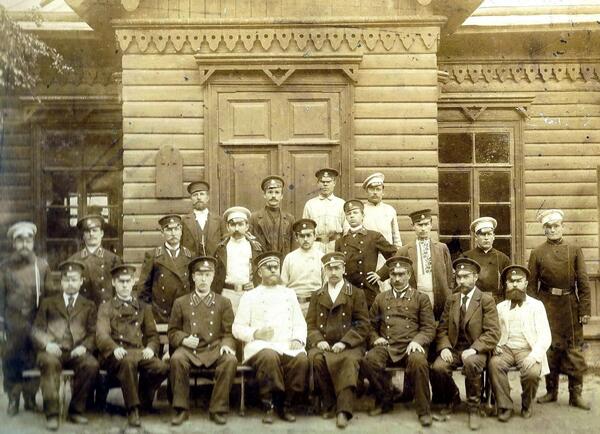
The collection of the Zheleznodorozhny Local Lore Museum contains a panel format photograph dated 1912. This format was used for photographs of colleagues or graduates of gymnasiums and higher educational institutions.
Judging by the arrangement of the people in the photograph, it can be said with certainty that these are colleagues, and the man in the center — the head of the Obiralovka station, Ivan Nikolayevich Tsvetkov — is their leader. He is wearing a double-breasted uniform jacket, a cap and trousers. Next to him are workers and employees of the Obiralovka station: telegraph operators, clerks, controllers and conductors. The group photo was taken in front of the wooden building of the Obiralovka railway station. The stations of the Nizhny Novgorod Railway were attributed to a certain class. The building of the Obiralovka station belonged to the fourth class. All buildings of this class had the same size and design: they were wooden and had a stone foundation.
The wooden station building stood for more than a hundred years. In the 19th century, it was considered the center of Obiralovka. There was a buffet at the station, and the clergy of the Savvinskaya Church held services on Sundays. The cleanliness of the station was maintained by the staff. For example, the following order was issued in 1862: “The stations are not nearly clean and neat enough. Station managers are ordered, under pain of the penalty (!), to ensure that the stations are immaculately clean: brooms, mops, garbage cans and other objects that are unpleasant to look at must be removed.” The positions of ticket clerks and conductors were considered particularly prestigious. They were divided into classes according to their salary: for example, a 1st-class conductor received 420 rubles a year, a 2nd-class conductor — 360 rubles, and a 3rd-class conductor — 300 rubles. Regardless of their salary, they were given lodging allowances and daily allowances for travel and uniforms. The salary of ticket clerks was 480 rubles. The conductors were allowed 28 vacation days but still had to earn them. So, one of the orders read as follows, “A vacation is a privilege granted by the Society, therefore it ought to be earned through merits.”
Group
photographs were extremely popular in Russia at the turn of the 20th century.
Graduates and teaching staff of educational institutions, participants in
meetings and councils, and even friends who gathered at a picnic or around the
table considered it their duty to take a group photo. Such photographs were
placed in frames and hung on the walls.