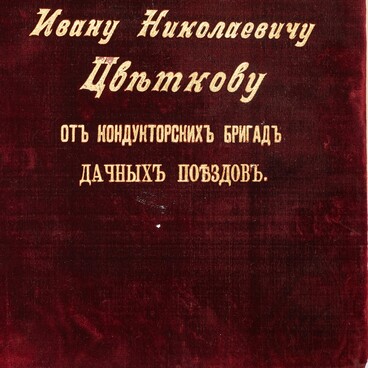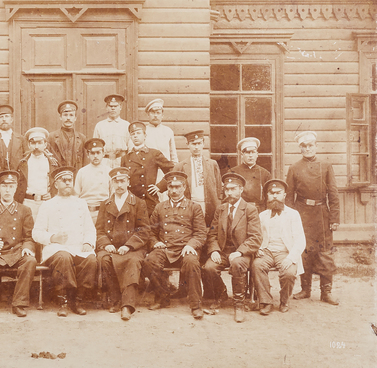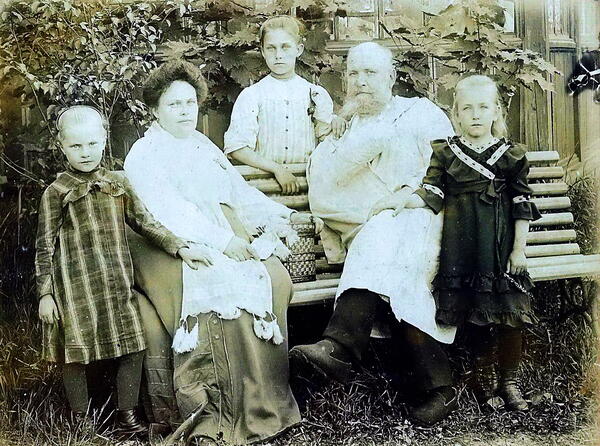
The collection of the Zheleznodorozhny Local Lore Museum contains a photograph of Ivan Nikolayevich Tsvetkov, the head of the Obiralovka railway station, depicted with his wife and daughters Valentina, Augusta and Nina.
Ivan Nikolayevich Tsvetkov was born into a noble family on November 6, 1852, in the town of Pavlovsky Posad, Bogorodsky Uyezd, Moscow Governorate. He had sisters named Anna, Vera, Alexandra and Lyubov. Tsvetkov graduated from the Moscow Don Theological School. He started his railway career as a third-class telegraph operator in 1877. Until 1878, he worked at the Vyazniki station. Then he did some military service, after which he returned to the railway. He worked as a weigher and assistant to the head of the Drezna, Bogorodsk, and Moscow-Tovarnaya stations. From 1899 to 1917, Ivan Tsvetkov was the head of the Obiralovka station.
The beginning of the 20th century was marked by a real boom in photography. In 1900, Eastman Kodak released the Brownie, an affordable and easy-to-use camera that set the scene for amateur photography. It was used especially widely in family photography. Unlike professional studio portraits, amateur photographs provide more historical and social information, being somewhat of a sketch of family life. Studio photographs of the 19th and early 20th centuries are characterized by many conventions and restrictions. For example, studio photographs taken before the 1920s have very few people smiling. The official portrait strictly required a serious facial expression. Families with an average income — townspeople, priests, merchants and nobles — considered group photographs of large formats obligatory. They were placed in frames on the walls of living rooms or boudoirs. Hence the name of the format — “boudoir portrait” or “panel”. Such photographs could show numerous relatives with children, and often with pets, all gathered with the purpose of being photographed.
The photograph presented in the museum’s exhibition
dates to the beginning of the 20th century. This is an amateur
photograph, of course, but one cannot help but notice that the mise-en-scène of
the photograph was well thought out. It seems that the photographer employed
the basic rules of portrait composition.