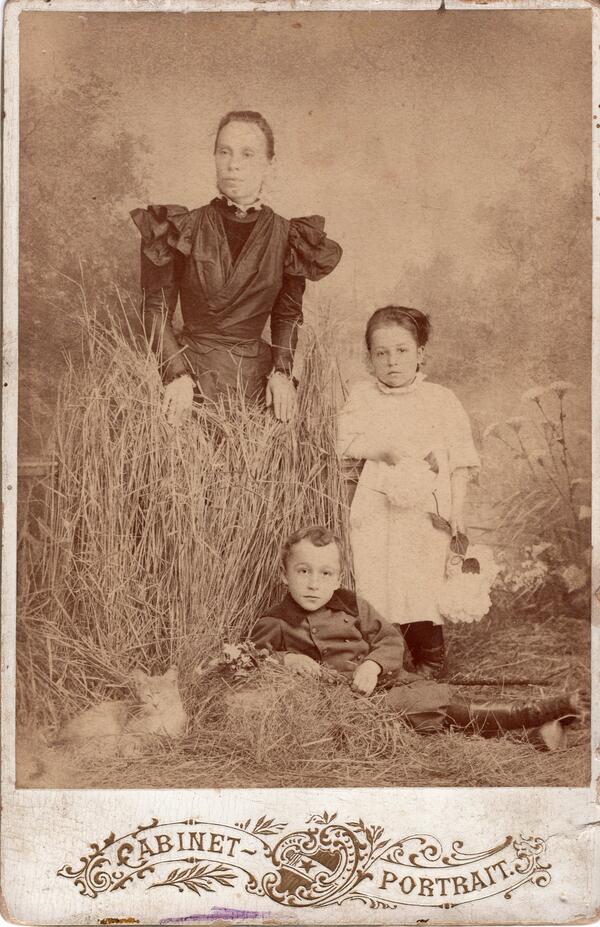
The photograph of the Lugakovsky family has a gold embossing at the bottom of the mount: Cabinet portrait. On the back side there is an imprint with the details of the Yaroslavl photo studio. The photo also has a handwritten inscription in ink “Lugakovsky Cleopatra Petrovna, Nikolai Leonidovich and Ekaterina Leonidovna” and an inscription in pencil “grandmother, Kolya and Katya and a cat with them”.
Cleopatra Petrovna Lugakovskaya was a grandniece of the Astrakhan merchant Grigory Vasilievich Tetyushinov. She was born in 1866 in Baku to the family of military doctor Pyotr Mikhailovich Korinfsky, son of the famous Russian architect Mikhail Petrovich Korinfsky.
One of the formats most popular with clients of photo studios in the middle and second half of the 19th century was the visit portrait, or visit card. A photographic print was made on thin paper measuring 5–5.5 centimeters in length and 9–10 centimeters in height. After printing, it was carefully glued to a cardboard base. The visit cards often served as a kind of identification of the owner, for which an official only needed to make a corresponding note on it.
In the 1870s, after the invention of gelatin-coated photographic paper, the so-called “cabinet portrait” became particularly popular. This format of photos replaced visit cards and became a common type of portrait photography by the late 19th — early 20th century. The optimal size of the photo, in this case 14×10cm, allowed the person to insert the portrait into a photo album or a frame. Mounts for such photos were 16,5×11.5 cm. Apart from its size, the cabinet portrait differed from the visit portrait in that it had information on the front and back of the cardboard base.
In the case of the photographic portrait of
Cleopatra Petrovna Lugakovskaya and her children, the size of the mount does
not correspond to the standard and is 16.5×10.7 centimeters. Probably, such a
cut by 0.8 centimeters is due to the manufacturer’s desire to cut costs, as the
mounts were printed and sent to photo shops in dozens of thousands.