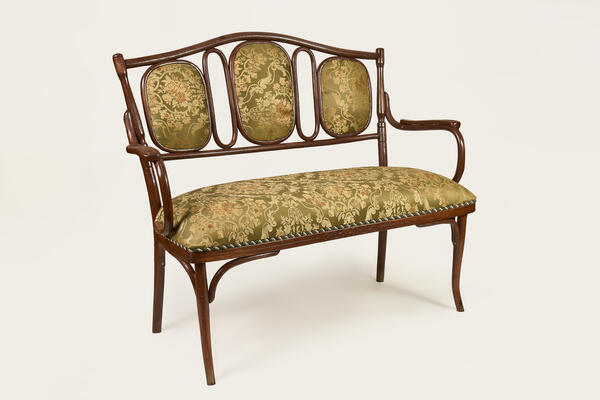
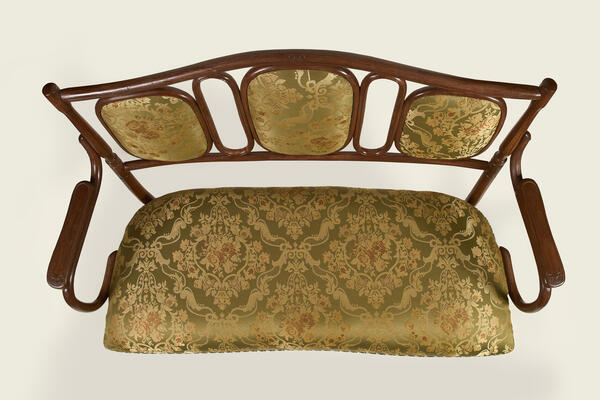
The sofa on display in the “Merchant’s Study” was created by the “Thonet Brothers” company and is part of a set. It is not known how many items were in the set, but there are also three chairs from it in the museum’s collection.
The first bentwood furniture, which this sofa represents, appeared in England in the 17th century. It was not until the mid-19th century that the Austrian furniture maker Michael Thonet was able to commercialize this technology.
Thonet opened his first furniture workshop focusing on parquet flooring in 1819. From 1830, he began experimenting with joinery. For example, Thonet created chairs from sheets of plywood bent together, which he then glued together in four or five layers. Thanks to this technique, the furnishings were light and compact. Thonet’s experiments began to gain public interest, and in 1842 Chancellor Richard von Metternich invited him to Vienna. For the next five years Michael Thonet worked in the Austrian capital on the neo-Rococo interiors of the Liechtenstein Palace. This marked the beginning of the industrial production of bentwood furniture, which became known as “Viennese” in Russia after the place where it was made.
Thonet’s work was highly praised at the Great Exhibition of the Works of Industry of All Nations in London. Two years later, Michael Thonet teamed up with his sons to set up the firm Thonet Brothers. In 1856, Thonet improved the assembly process again: he heated wood, particularly solid beech wood, to give it a curved shape. Meanwhile, Thonet began mass production of furniture: his products were even exported to South America. Factories were opened in Hungary and Moravia (territory of the Czech Republic). Thonet’s furniture showrooms opened all over Europe and the USA.
Products of this manufacturer also appeared in
Russia. They could be seen everywhere: from the tsar’s chambers to the homes of
factory workers. The production of “Viennese furniture” was launched in Poland,
then part of the Russian Empire, which allowed not to tax Thonet furniture with
import duties in Russia. This meant that the furniture came at an affordable
price. Furniture showrooms of the “Thonet Brothers” appeared in both Russian
capitals, as well as in Kiev, Odessa and other major cities.