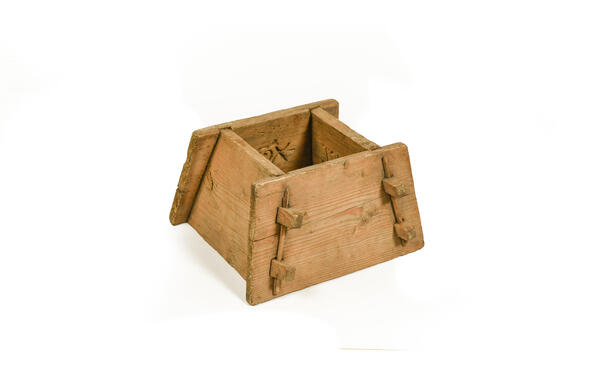
People used a wooden mold to prepare a traditional festive Easter dish. The dish was called ‘paskha’ and made from quark or curd cheese. This kind of mold was popular among Siberian families — both among peasants and rich citizens. The mold was traditionally made in the form of a truncated tetrahedral pyramid: it symbolized Calvary, where, according to the New Testament, Jesus Christ was crucified.
The mold from the collection of the Bishop’s House was assembled from four smooth boards pressed tightly together. They are connected through special grooves. A shallow pattern is carved on the inner surface. On one side there is a cross, a spear, and a sponge, with which the crucified Christ was given a drink in the biblical legend. The other three sides have an inscription in the Church Slavonic language, which reads “Truly Christ has risen!” The craftsman cut out the mirror images of the letters so that the text would look correctly on the dish. The patterns on the wooden surface became flatter over time.
In addition to the images of the cross and the inscription “Christ has Risen”, other drawings were carved on the paskha: doves, angels, vines, silhouettes of churches, and church domes.
The paskha was traditionally made of quark, sour cream, sugar, and egg yolks. They were mixed into a smooth paste, then raisins, nuts, or candied fruits were added. The mold was filled with the mixture and left overnight in a cool place so that the dish would freeze. Then it was placed on a large plate, and the mold parts were removed. In wealthy homes, the paskha was decorated with grated chocolate and candied figurines. It was customary to place colored eggs around the paskha on the plate: in the Easter tradition, they symbolized eternal life.
Easter, or the Resurrection of Christ, is considered the main and oldest holiday among Christians of all denominations. The festivities on this occasion began right in the churchyard, immediately after the divine service, and lasted from one to seven days depending on the province. At this time, it was customary to exchange Easter eggs and greet one another with the phrases “Christ has Risen” and “He has Risen indeed!” Only at Easter, anyone was allowed to ring the church bells.
The mold from the collection of the Bishop’s House was assembled from four smooth boards pressed tightly together. They are connected through special grooves. A shallow pattern is carved on the inner surface. On one side there is a cross, a spear, and a sponge, with which the crucified Christ was given a drink in the biblical legend. The other three sides have an inscription in the Church Slavonic language, which reads “Truly Christ has risen!” The craftsman cut out the mirror images of the letters so that the text would look correctly on the dish. The patterns on the wooden surface became flatter over time.
In addition to the images of the cross and the inscription “Christ has Risen”, other drawings were carved on the paskha: doves, angels, vines, silhouettes of churches, and church domes.
The paskha was traditionally made of quark, sour cream, sugar, and egg yolks. They were mixed into a smooth paste, then raisins, nuts, or candied fruits were added. The mold was filled with the mixture and left overnight in a cool place so that the dish would freeze. Then it was placed on a large plate, and the mold parts were removed. In wealthy homes, the paskha was decorated with grated chocolate and candied figurines. It was customary to place colored eggs around the paskha on the plate: in the Easter tradition, they symbolized eternal life.
Easter, or the Resurrection of Christ, is considered the main and oldest holiday among Christians of all denominations. The festivities on this occasion began right in the churchyard, immediately after the divine service, and lasted from one to seven days depending on the province. At this time, it was customary to exchange Easter eggs and greet one another with the phrases “Christ has Risen” and “He has Risen indeed!” Only at Easter, anyone was allowed to ring the church bells.