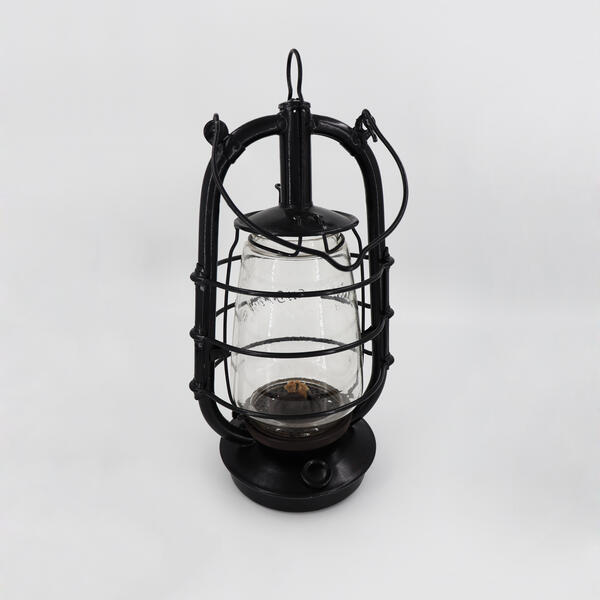
The “Red Torch” lantern, commonly known as “the Bat” is a kerosene lamp. Kerosene, which is produced from the distillation of petroleum, was first obtained in the early 1850s. The first lamp using kerosene as a fuel was invented several years later, in 1853, by the Polish pharmacist Ignacy Łukasiewicz. It was a cylinder-shaped structure where the lower part consisted of a fuel tank, and the upper part — of a glass tube surrounding the wick.
A kerosene lamp offered considerably brighter lighting than wax candles. The brightness of the lantern varied depending on the wick thickness which was measured in lines — an old Russian and English unit of length. One line was equal to 2.54 mm. A thicker wick provided a brighter glow. Kerosene had a number of advantages compared to the oil previously used in lamps: when burned, it offered increased brightness and did not form deposits on the walls of the lantern.
The design of the “Bat” lamp was based on the first kerosene lamps but was more advanced and ensured better safety characteristics. At the bottom of the lantern, there was a metal tank for kerosene with a wick attached to it. On the side wall, there was a fuel port. The tank was connected to the lamp burner. At the bottom of the lantern, there was a rod with a disk attached to it, to adjust how much of the wick extends above. Outside, the wick was surrounded by a wick tube. In turn, it was enclosed with several metal wires fixed on vertical tubes.
Before the war, the “Red Torch” lanterns were manufactured at Metalloshtamp Plant No. 5 in Samara and the Leningrad Metal Plant.
During the Great Patriotic War, such lanterns became particularly widespread. In the absence of electricity at the frontline, such lamps were used in various areas, including dugouts, trenches, headquarters, and hospitals. Such lamps were even used as signal lights for aircraft pilots. Sometimes, due to the lack of industrial-made lanterns, homemade wick lamps were used at the frontline. They could be made from a rolled cartridge case or a tin can. In terms of brightness, they were inferior to the “Bat” lamps.
A kerosene lamp offered considerably brighter lighting than wax candles. The brightness of the lantern varied depending on the wick thickness which was measured in lines — an old Russian and English unit of length. One line was equal to 2.54 mm. A thicker wick provided a brighter glow. Kerosene had a number of advantages compared to the oil previously used in lamps: when burned, it offered increased brightness and did not form deposits on the walls of the lantern.
The design of the “Bat” lamp was based on the first kerosene lamps but was more advanced and ensured better safety characteristics. At the bottom of the lantern, there was a metal tank for kerosene with a wick attached to it. On the side wall, there was a fuel port. The tank was connected to the lamp burner. At the bottom of the lantern, there was a rod with a disk attached to it, to adjust how much of the wick extends above. Outside, the wick was surrounded by a wick tube. In turn, it was enclosed with several metal wires fixed on vertical tubes.
Before the war, the “Red Torch” lanterns were manufactured at Metalloshtamp Plant No. 5 in Samara and the Leningrad Metal Plant.
During the Great Patriotic War, such lanterns became particularly widespread. In the absence of electricity at the frontline, such lamps were used in various areas, including dugouts, trenches, headquarters, and hospitals. Such lamps were even used as signal lights for aircraft pilots. Sometimes, due to the lack of industrial-made lanterns, homemade wick lamps were used at the frontline. They could be made from a rolled cartridge case or a tin can. In terms of brightness, they were inferior to the “Bat” lamps.