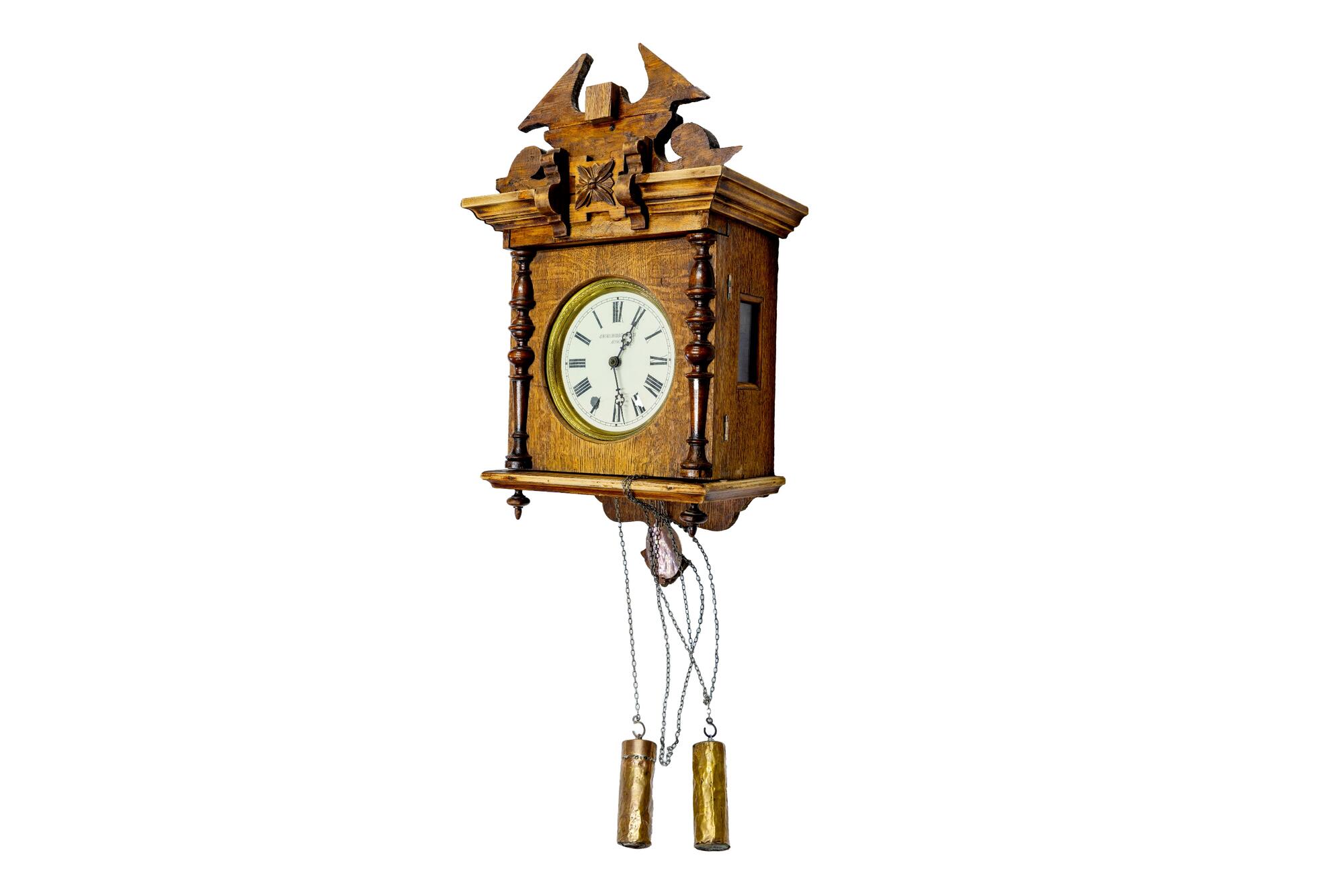


The wall clock by the “M. P. Kalaschnikoff & Fils” factory was made in Moscow in the period between the end of the 19th century and the beginning of the 20th century. Now its mechanism does not work anymore, but the massive wooden case is well preserved. It was necessary primarily to protect the clockwork drive from dust. Moreover, the watch served as an interior decoration. That is why the case was trimmed with carvings. This model has patterns, which are located on the sides of the door and above it.
One can see a white clock face with black Roman numerals and two ornately-shaped hands behind the round glass. The mechanism is hidden inside, behind a wooden door. Two massive falling weights are attached to the bottom part of the case with the help of a long metal chain. They were an engine for the mechanism. Therefore, when the pendulum suspension gradually lowered, energy generated and turned the gears. Every once and a while, it was necessary to pull up the falling weights so the clock would not stop.
A merchant of the first guild Mikhail Kalashnikov founded the company “Kalaschnikoff” in the 18th century. A few years later, his son Peter joined the family business, and the company was renamed “M. P. Kalaschnikoff & Fils”. The merchants sold German watches wholesale and retail. These goods were of great interest among wealthy Moscow residents. High-quality foreign clocks were considered a sign of wealth and served as interior decoration. Their most expensive and beautiful models were certainly hung in studies and living rooms. Simpler models could be placed in bedrooms, nurseries, mistresses’ rooms.
In the Kalaschnikoff’ store, it was possible to buy the other types of clocks and watches. Among them were pocket watches, table clocks, long-case clocks. The merchants also sold spare falling weights and chains, details of the mechanisms, fobs for pocket watches. The assortment expanded little by little. It included both Russian goods and the works made by the watch masters from England, Switzerland, France, and Germany.
The company “M. P. Kalaschnikoff & Fils” was one of the largest watch trading houses in Moscow at the end of the 19th century and the beginning of the 20th century. In its workshops, their precise mechanisms were assembled, reconstructed, and other manufacturers’ clocks and watches were repaired.
The company worked until 1917. After the Russian revolution, the State Trust for Precision Mechanics was founded based on a previous trading house.
One can see a white clock face with black Roman numerals and two ornately-shaped hands behind the round glass. The mechanism is hidden inside, behind a wooden door. Two massive falling weights are attached to the bottom part of the case with the help of a long metal chain. They were an engine for the mechanism. Therefore, when the pendulum suspension gradually lowered, energy generated and turned the gears. Every once and a while, it was necessary to pull up the falling weights so the clock would not stop.
A merchant of the first guild Mikhail Kalashnikov founded the company “Kalaschnikoff” in the 18th century. A few years later, his son Peter joined the family business, and the company was renamed “M. P. Kalaschnikoff & Fils”. The merchants sold German watches wholesale and retail. These goods were of great interest among wealthy Moscow residents. High-quality foreign clocks were considered a sign of wealth and served as interior decoration. Their most expensive and beautiful models were certainly hung in studies and living rooms. Simpler models could be placed in bedrooms, nurseries, mistresses’ rooms.
In the Kalaschnikoff’ store, it was possible to buy the other types of clocks and watches. Among them were pocket watches, table clocks, long-case clocks. The merchants also sold spare falling weights and chains, details of the mechanisms, fobs for pocket watches. The assortment expanded little by little. It included both Russian goods and the works made by the watch masters from England, Switzerland, France, and Germany.
The company “M. P. Kalaschnikoff & Fils” was one of the largest watch trading houses in Moscow at the end of the 19th century and the beginning of the 20th century. In its workshops, their precise mechanisms were assembled, reconstructed, and other manufacturers’ clocks and watches were repaired.
The company worked until 1917. After the Russian revolution, the State Trust for Precision Mechanics was founded based on a previous trading house.