


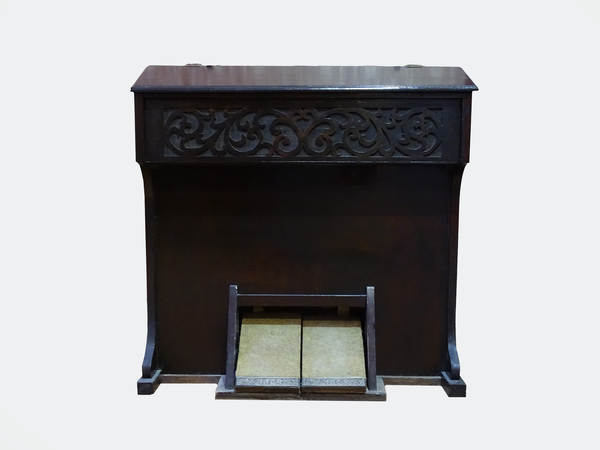
The physharmonica is a wind keyboard musical instrument invented in the 1810s. Its predecessors were instruments made by the masters of the first harmoniums. Among them are the pump organ made by master Rackwitz for the famous German organist Georg Vogler, as well as the “choraleon” made by Warsaw master Bunner, which was used in small churches to accompany the choir. In the middle of the same century, improvements made by the French craftsman Alexandre François Debin gave the harmonium its modern appearance. Sounds on the instrument are extracted by vibrations of metal reeds driven by a jet of air, which is pumped by two foot pedals. The harmonium has two manuals with 61 keys and 25 registers, which are switched on by retractable levers.
The production of these instruments was underdeveloped in Russia. A few small factories and workshops operated in Moscow, St Petersburg and Kiev. In 1887 Dmitry Mitropolsky opened a specialised harmonium factory in Bologog, where mainly small portable instruments were made. Large, stationary harmoniums were produced in single copies. Therefore in Russia harmoniums, although distributed in large numbers, were almost exclusively of foreign brands.


