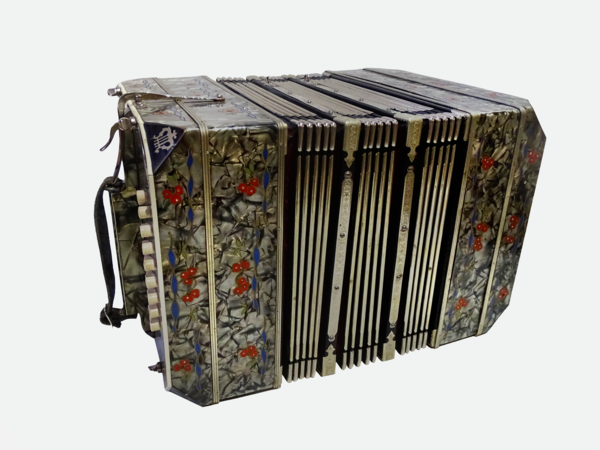
The bandoneon is a reed instrument of the hand harmonica family. It was designed on the basis of the German concertina in 1840 by Heinrich Band of Krefeld. It was initially used to perform spiritual music in churches in Germany.
The bandoneon is a “little man’s instrument”. It was invented for people of lower classes who did not have the opportunity to take lessons from music teachers. However, music was still a part of their daily need. For example, in day-to-day life, they wanted to hear or play a melody from an opera aria.
Folk instruments were
not very suitable for this purpose. Harpsichords and pianoforte were expensive
and not transportable. Accordions, which were produced in family workshops in
Vogtland and the Ore Mountains, did not have a broad range of sound. The
bandoneon, which appeared in the 1840s, solved all these problems. The standard
capabilities of the accordion and concertina (a type of hand harmonica) were
significantly expanded in its design. The sound was produced by vibrations of
metal reeds, when air pumped by the bellows passed through narrow space in the
metal plates. At the same time, the same button of the bandoneon could produce
completely different sounds when the bellows inhaled and exhaled.