A sling is one of the oldest projectile weapons. Throughout almost five thousand years of its history, it has remained virtually unchanged. Ancient slings have been found in North America, Egypt and the coast of Peru. The sling is mentioned by Homer and other ancient authors; its images can be seen on ancient bas-reliefs, tapestries and coins. In European armies, the sling was used until the end of the 16th century.
The sling’s main advantages are its accessibility and ease of use. Anyone who had a suitable stone and a band at hand and practiced the throw could become a slinger. Experienced slingers were as efficient as archers and could throw a projectile with great destructive force. The most difficult thing about handling a sling is achieving accuracy.
The principle of operation of the sling is unique. A stone thrown with a sling flies under the influence of centrifugal force, which causes it to gain speed and cover a distance of about 100 meters.
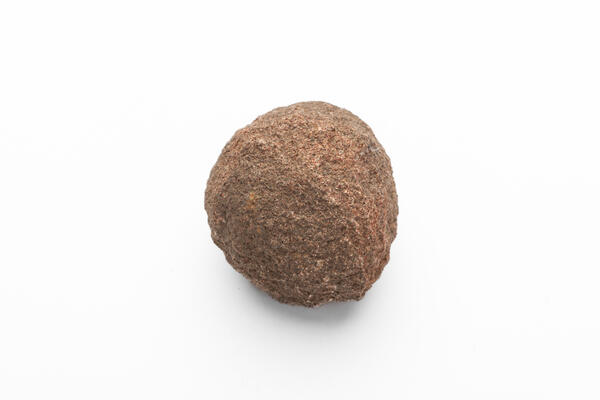
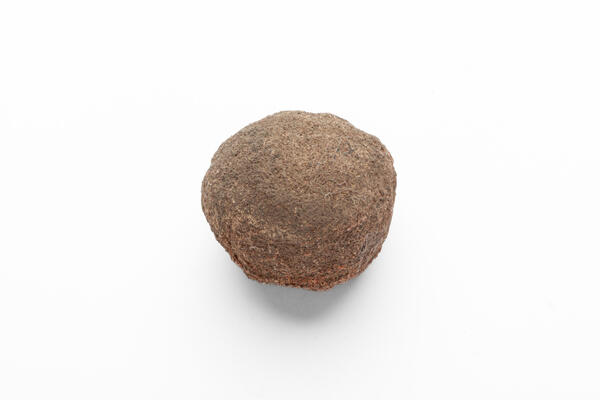
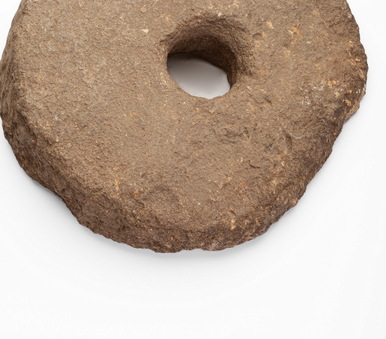
In the Idnakar hillfort, sling stones were carved from gray limestone. They have a somewhat irregular rounded shape with a diameter of two to eight centimeters. Idnakar’s collection includes 99 sling projectiles.
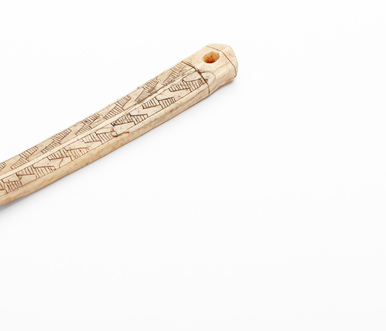
The most widespread type of sling is a rope or band sling. It has an expanded part in the center for one or more projectiles: a stone, a ceramic ball, a clay bullet or a metal projectile.
One end of the sling has a loop that was draped over the wrist or finger. The slinger held the free end of the sling with the same hand. To throw in extended formation, the slinger horizontally rotated the sling with the projectile, usually above his head, gradually increased the circular movements and, at the moment of the most powerful swing, released the free end of the sling.
To use a sling in a relatively close formation, the Greeks and Romans rotated the sling vertically. Bullets made of stone and clay were dangerous if the enemy did not have hard or shock-absorbing armor, especially helmets. Slings were not popular in Asia, which abounded in powerful bows.