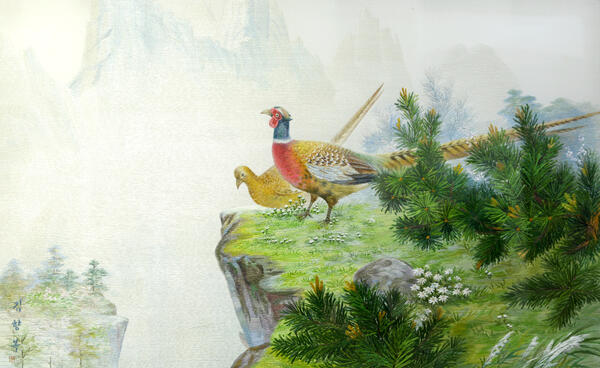
The panel is made using the damask stitch embroidery technique on silk. Two pheasants are depicted on a gray background — a male and a female. They stand in a meadow, behind the spruce branches at the edge of the cliff. In the distance you can see high cliffs looking like peaks, on the left — hills with trees and bushes. There is a gorge in front of the birds. The female is embroidered with yellow-ocher threads, the male is embroidered with multi-colored threads. For these distant relatives of the chicken and guinea fowl, the male must always be more beautiful than the modest female to attract her attention.
The composition is framed in a light green silk passe-partout. Korean arts and crafts is a rich world of images and objects that is vibrant and unusual. The history of this art is closely connected with people, their way of life, daily routine, ideals and how they imagine beauty.
Already in the 10th century, the art of decorative needlework reached the summit of skills and was widespread. Currently, North Korean embroiderers create works of art using more modern techniques and various forms. It may take several months to make one canvas, and it will take years to learn the craft. Korean girls who wanted to become craftswomen, after reaching the age of sixteen, left for Pyongyang, where they worked in local workshops. It is believed that this is where you can learn the skill of silk embroidery.
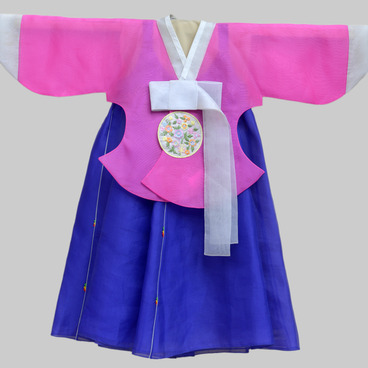
Initially, embroidery in Korea was widely used to decorate national clothes. People of no noble birth could wear the Korean national dress ‘hanbok’ only for weddings. Rich and well-born people appeared in such attire much more often.
The fabric for the embroidery was silk, the threads were also made of silk. The main subjects were stylized animals, traditional ornaments, flowers. Usually yellow, red, white and black threads were used. Nowadays in North Korea, embroidery is found everywhere: in clothes, in household items, as a home decoration. Embroidery is divided according to the principle of its manufacture: manual embroidery usually performs decorative functions, and machine embroidery has a utilitarian purpose. The most common subjects found in handicrafts are landscapes, plants, portraits and animals. Handicrafts are created by the incredible work of craftsmen who have accumulated experience and knowledge for many years.
The embroidery was purchased by the Amur Regional Museum of Local Lore in 1990.
The composition is framed in a light green silk passe-partout. Korean arts and crafts is a rich world of images and objects that is vibrant and unusual. The history of this art is closely connected with people, their way of life, daily routine, ideals and how they imagine beauty.
Already in the 10th century, the art of decorative needlework reached the summit of skills and was widespread. Currently, North Korean embroiderers create works of art using more modern techniques and various forms. It may take several months to make one canvas, and it will take years to learn the craft. Korean girls who wanted to become craftswomen, after reaching the age of sixteen, left for Pyongyang, where they worked in local workshops. It is believed that this is where you can learn the skill of silk embroidery.
Initially, embroidery in Korea was widely used to decorate national clothes. People of no noble birth could wear the Korean national dress ‘hanbok’ only for weddings. Rich and well-born people appeared in such attire much more often.
The fabric for the embroidery was silk, the threads were also made of silk. The main subjects were stylized animals, traditional ornaments, flowers. Usually yellow, red, white and black threads were used. Nowadays in North Korea, embroidery is found everywhere: in clothes, in household items, as a home decoration. Embroidery is divided according to the principle of its manufacture: manual embroidery usually performs decorative functions, and machine embroidery has a utilitarian purpose. The most common subjects found in handicrafts are landscapes, plants, portraits and animals. Handicrafts are created by the incredible work of craftsmen who have accumulated experience and knowledge for many years.
The embroidery was purchased by the Amur Regional Museum of Local Lore in 1990.