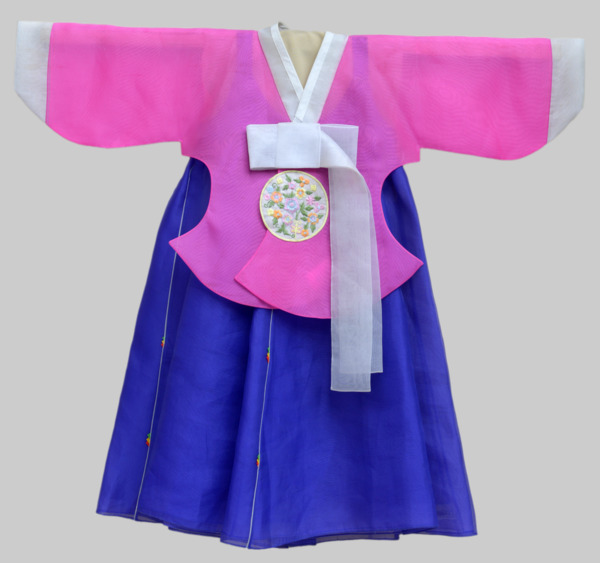
In Korea, traditional clothing is called hanbok. It received this name even before the appearance of the Korean state of Joseon. For five hundred years, its look practically hasn’t changed, only certain elements were later borrowed from the Mongols and the Chinese, where they were more practical and more convenient.
In the outfits of the 13th-14th centuries, shamanic motives can be seen, and in their appearance, they resembled the clothes of nomads. After some time, the basis of the costume were the Confucian canons, a distinctive feature of which was modesty. The costumes were concolor, but bright enough. This especially applied to of the outfits worn for the holidays. The brightness of Korean suits is achieved by combining several colors in one image.
But it is worth noting that such clothes were worn only by respected people — aristocrats, officials, representatives of the upper class. Ordinary workers were not allowed to dress not only in bright, but also in light. If the nobility, especially children and women, were allowed multi-colored shades, the ordinary people had to wear beige and gray.
Moreover, each of the five colors had its own meaning. Red was a harbinger of wealth, which is why rulers and brides wore robes of these color. Blue was a symbol of stable development, usually an official could be seen in such clothes. Also, costumes with different shades of this color were worn by women who had a son. A woman in a blue outfit could be met at the wedding of her son, but the mother of the bride appeared in pink. Black was considered a symbol of infinity and creativity. The hats that the men wore were usually black. The yellow color indicated a person related to the royal family. White is an exceptional color that speaks of the aristocracy of the wearer.
The fabric from which the outfit was made depended on which social stratum a person belonged to. Peasants or ordinary Koreans were ordered to wear hemp or cotton clothing. It was thin and had no color. The rich could afford silk robes that were embroidered with gold threads, ornaments and appliqués.
A set of national clothes — hanbok — was passed over to the Amur Regional Museum of Local Lore by the spouses from South Korea, who named themselves Joseph and Anna, after visiting the exhibition “Culture of the Orient: China, Japan, Korea”. The clothes belonged to their granddaughter.
In the outfits of the 13th-14th centuries, shamanic motives can be seen, and in their appearance, they resembled the clothes of nomads. After some time, the basis of the costume were the Confucian canons, a distinctive feature of which was modesty. The costumes were concolor, but bright enough. This especially applied to of the outfits worn for the holidays. The brightness of Korean suits is achieved by combining several colors in one image.
But it is worth noting that such clothes were worn only by respected people — aristocrats, officials, representatives of the upper class. Ordinary workers were not allowed to dress not only in bright, but also in light. If the nobility, especially children and women, were allowed multi-colored shades, the ordinary people had to wear beige and gray.
Moreover, each of the five colors had its own meaning. Red was a harbinger of wealth, which is why rulers and brides wore robes of these color. Blue was a symbol of stable development, usually an official could be seen in such clothes. Also, costumes with different shades of this color were worn by women who had a son. A woman in a blue outfit could be met at the wedding of her son, but the mother of the bride appeared in pink. Black was considered a symbol of infinity and creativity. The hats that the men wore were usually black. The yellow color indicated a person related to the royal family. White is an exceptional color that speaks of the aristocracy of the wearer.
The fabric from which the outfit was made depended on which social stratum a person belonged to. Peasants or ordinary Koreans were ordered to wear hemp or cotton clothing. It was thin and had no color. The rich could afford silk robes that were embroidered with gold threads, ornaments and appliqués.
A set of national clothes — hanbok — was passed over to the Amur Regional Museum of Local Lore by the spouses from South Korea, who named themselves Joseph and Anna, after visiting the exhibition “Culture of the Orient: China, Japan, Korea”. The clothes belonged to their granddaughter.