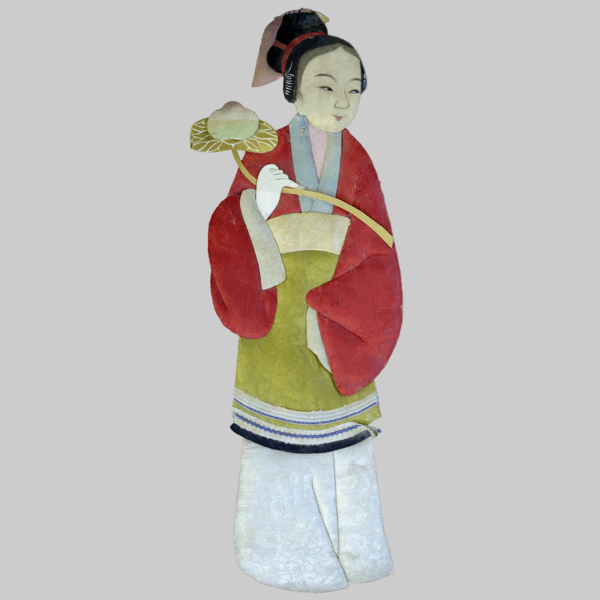
Ba-Xian is a heroine of Chinese mythology. The doll is made as an applique in the shape of a young girl standing in full growth with a lotus flower in her right hand. She is dressed in traditional Chinese clothing — a gray-green-red kimono, which consists of a blouse with wide sleeves and a long skirt to the floor. Black hair is tied at the back of the head in a bun. Well-defined eyebrows and eyes give the doll a sly expression. The applique is glued to yellow cardboard.
Ba-Xian, or ‘Eight Immortals’ is a group of heroes popular in Taoist mythology, in which one of the most important subjects was the story of magicians preparing a wonderful drink that gives eternal life. Porcelain products were decorated with their images, they were popular heroes of painting. Often there are paintings with feasting, relaxing, swimming across the sea magicians. They were painted together with the founder of Taoism Lao Tzu.
Legendary heroes actually lived in China, only at different times, and were engaged not only in the search for the elixir, but also in the spiritual practices of enlightenment. Then they turned into mythical characters. The Ba-Xian list also included the woman He Xiangu, the prototype of the doll. According to some sources, she was born in Hunan Province in Yong Prefecture. When she turned 15, she met Lü Dongbing, who began courting her. But his main goal was to introduce the girl to the Tao. Later, becoming his disciple and gaining secret knowledge, she was able to fly over the mountains and pick wild fruits, thus earning a living and bringing her mother a bountiful harvest.
In the city of Guangzhou, a temple was built in honor of He Xiangu, where she is worshiped on the 7th day of the third moon according to the Chinese calendar. She is believed to be responsible for the preservation and maintenance of the home. There are a lot of stories about girls who bore the surname He. Apparently, the heroines of these stories have merged into one image over time. Wei Tai’s “Notes by the East Terrace” speaks of He from Yongzhou, who was treated with dates or peaches as a child. After that, she never felt hunger again, and could predict destinies. For the locals, she was a saint, and they called her He Xiangu.
According to another legend that appeared in the 13th-14th centuries, He was the daughter of He Tai from a county near Guangzhou. In the days when the Tang empress ruled, she lived by the Mica Creek. At the age of fifteen, she saw in a dream a saint who taught her to eat mica flour to become light and not die. For this she promised not to marry. After some time, she ascended to heaven, but after that she was seen many times on earth.
Ba-Xian, or ‘Eight Immortals’ is a group of heroes popular in Taoist mythology, in which one of the most important subjects was the story of magicians preparing a wonderful drink that gives eternal life. Porcelain products were decorated with their images, they were popular heroes of painting. Often there are paintings with feasting, relaxing, swimming across the sea magicians. They were painted together with the founder of Taoism Lao Tzu.
Legendary heroes actually lived in China, only at different times, and were engaged not only in the search for the elixir, but also in the spiritual practices of enlightenment. Then they turned into mythical characters. The Ba-Xian list also included the woman He Xiangu, the prototype of the doll. According to some sources, she was born in Hunan Province in Yong Prefecture. When she turned 15, she met Lü Dongbing, who began courting her. But his main goal was to introduce the girl to the Tao. Later, becoming his disciple and gaining secret knowledge, she was able to fly over the mountains and pick wild fruits, thus earning a living and bringing her mother a bountiful harvest.
In the city of Guangzhou, a temple was built in honor of He Xiangu, where she is worshiped on the 7th day of the third moon according to the Chinese calendar. She is believed to be responsible for the preservation and maintenance of the home. There are a lot of stories about girls who bore the surname He. Apparently, the heroines of these stories have merged into one image over time. Wei Tai’s “Notes by the East Terrace” speaks of He from Yongzhou, who was treated with dates or peaches as a child. After that, she never felt hunger again, and could predict destinies. For the locals, she was a saint, and they called her He Xiangu.
According to another legend that appeared in the 13th-14th centuries, He was the daughter of He Tai from a county near Guangzhou. In the days when the Tang empress ruled, she lived by the Mica Creek. At the age of fifteen, she saw in a dream a saint who taught her to eat mica flour to become light and not die. For this she promised not to marry. After some time, she ascended to heaven, but after that she was seen many times on earth.