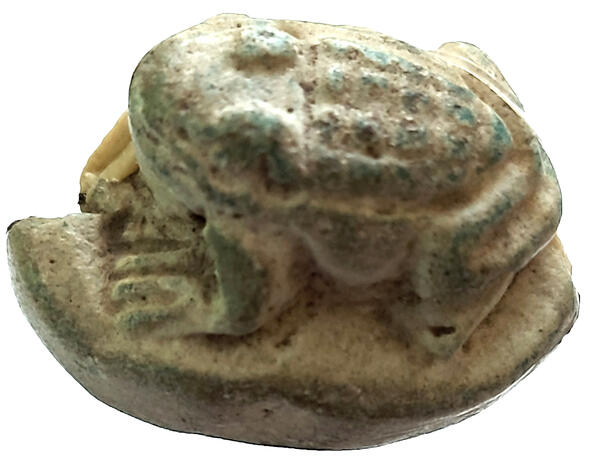
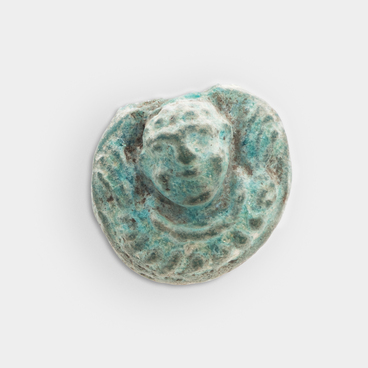
The first evidence of artifacts made of faience, or “Egyptian glass”, was discovered in the Nedvigovka settlement in 1887. Another frog-shaped pendant was accidentally discovered in 1984.
The researchers note that such pendants are usually found in children’s graves. They can also be found in women’s graves, although less frequently. The presence of such amulets in children’s graves is explained by the wish to provide children with all the necessary tools for a safe passage to the afterlife. Ancient people believed that amulets connected the worlds, heaven and earth.
The bead is an oval-shaped plaquette with a frog sitting on it. Its grayish-turquoise body is covered in rows of small bumps and its rounded eyes are emphasized. The through hole runs along the frog’s body. Crushed quartz was used to create faience, with soda and table salt added. The mixture was molded, glazed, and fired. The result was a durable solid material with decorative properties achieved thanks to the colored glaze. The glaze itself was created from powdered quartz, mixed with wood ash and soda. After firing, a glossy coating was formed. Malachite was used as a dye, with dark blue, light blue, or green being the most popular colors, imitating precious stones.
Faience figurines were used as amulets and were very popular among the barbarian peoples. Such items were brought to the Black Sea region through the trade between Egypt and Greece in Miletus, with another intermediary being the island of Rhodes. Faience products began to be imported in large quantities in the 3rd century BCE. This process lasted for nearly six centuries, until the 3rd century CE. The later objects differ in shape and material composition from earlier ones. The exact location of their production remains uncertain. Some researchers believe that workshops producing faience jewelry were located somewhere on the northern coast of the Black Sea.